写し取る者と前任者の数
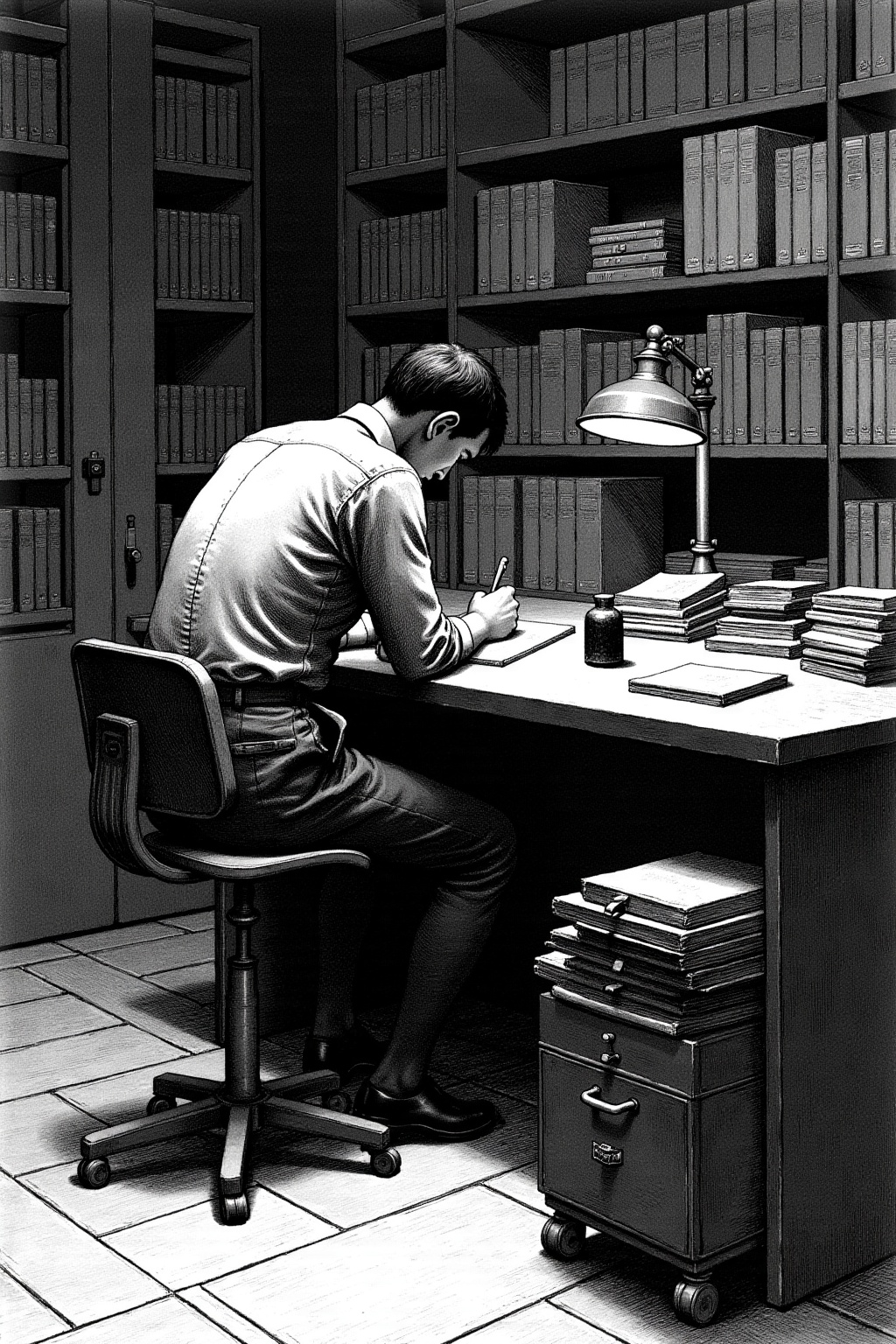
一九九七年秋、投資銀行の地下資料室。古い帳簿をマイクロフィルムへ移す記録係キム・ドギョンのもとへ、廃業した出版社の箱が届く。前任者の索引カードを繰る手は、公式の元帳よりすでに大きかった短期外貨残高の前で手を止める。
- 4,744 characters
- ~9 min
Main serial
장부 아래의 숫자
一九九七年秋、ある投資銀行の資料室。古い帳簿を写し取る記録係の手のなかで、数字は書くたびに育ち、不渡りはまだ来ぬ日付を先につけて届く。
帳簿の下の数
PNAKOTIC PRESS
一九九七年秋、投資銀行の地下資料室。古い帳簿をマイクロフィルムへ移す記録係キム・ドギョンのもとへ、廃業した出版社の箱が届く。前任者の索引カードを繰る手は、公式の元帳よりすでに大きかった短期外貨残高の前で手を止める。
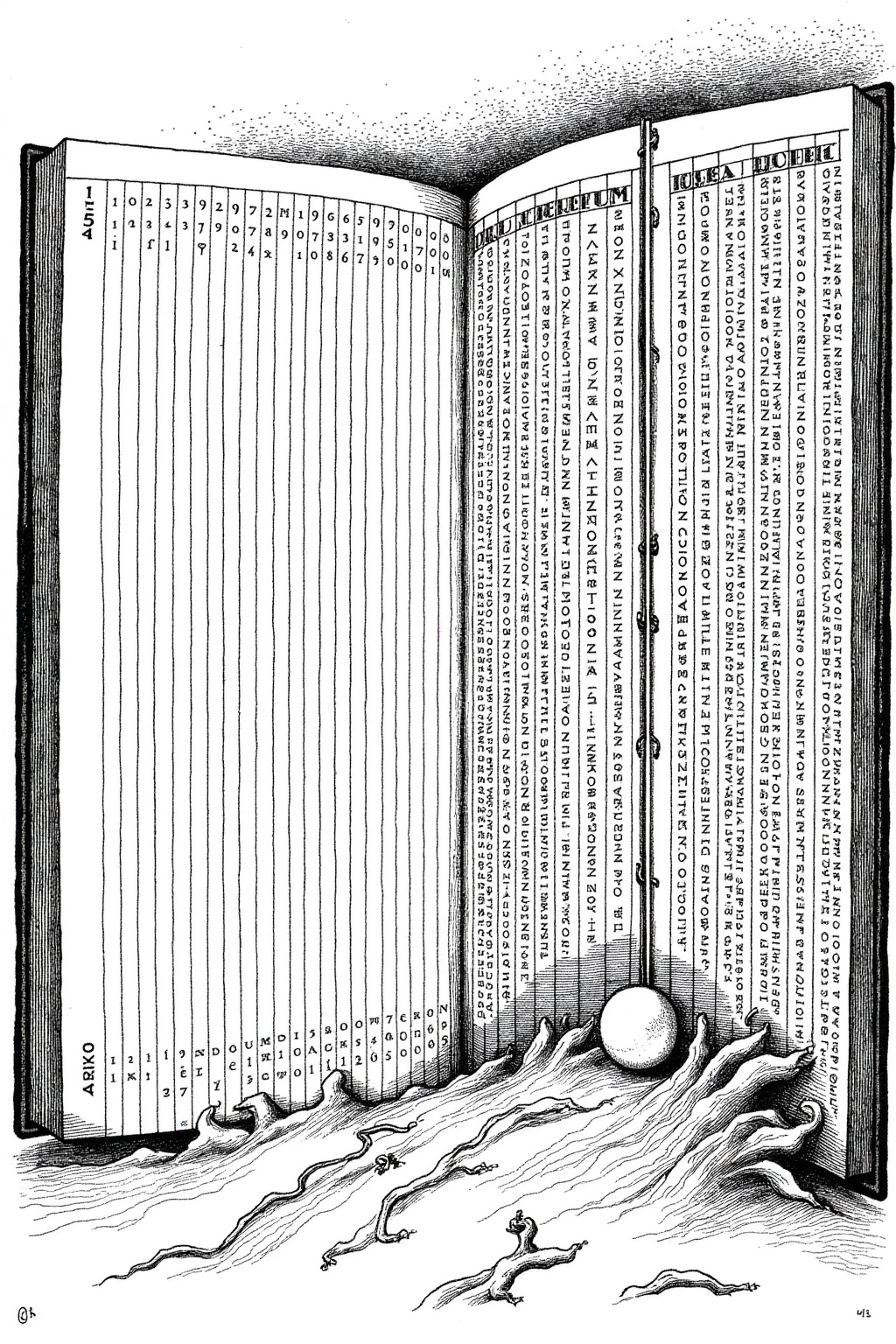
対照実験によって、ドギョンは写し取るという行為そのものが数字を育てることを確かめる。測量技師の日誌には測るたびに深くなる坑があり、与信端末の起動画面に浮かぶラテン語の社訓——数字は嘘をつかない——で、その法則の名に初めて出会う。
戒めを破って司書の日誌を最後まで読んだドギョンに、音節が別々に届く病が移る。分節された目で四束を突き合わせると、四人の記録者・一つの法則・同じ署名が浮かび上がり、箱が空いた机を経て自分のもとへ来たこと——自分が五番目の手であること——を知る。
前任者が最後まで巻き切れなかったフィルムをかけたドギョンは、半分だけ露光したコマの、育つ残高の桁のあいだに自分の依願退職の日付が書かれているのを見る。ほどなく本社は、そのフィルムが止まったまさにその帳簿——短期外貨借入金元帳——の撮影をドギョンに割り当てる。
生きた外債の残高は死んだ残高より速く育つ。ドギョンは外貨保有高が零に触れる日を数え、誰も書いていない自分の依願退職の日付だけが育たない数であることに思い当たる。そして明日の日付で出力された現金在高表が——発行端末はドギョン自身のものとして——決済不能を予告する。
信用格下げの通知が、公表の前日に端末へ届く。分節された目で読むと、格付記号の下へ格付ではないものが果てしなく下りていく欄が見える。ウォン/ドルの公示を写し取るたび相場は灯台守の潮のように反復しながら満ち、ドギョンは二つの公示のあいだで十三度の満ち引きを数える。
測量技師の坑日誌——壁の線は赴任した技師より常に一本多く、空いた次の線が次の人を待つ。ドギョンは人事綴で同じ数え方をし、六人に対して七行、空の七行目の退職日欄に十二月██日を見出す。続いて電信手の束を開き、引き継ぎの一行「空の周波数から呼び出しが来たならば、受けて書き取れ——ただし、応答するな」に至る。切ってあった内線端末が鳴り、ドギョン自身の名と社員番号で「応答、感謝する」が届く。
取引先テジョン実業の手形が不渡り——数日前に端末が吐き出した名簿の日付と金額に最後の桁まで一致し、狂気であってほしいという最後の望みが断たれる。書けば育つのなら書かなければ止まるかと、外債合計の一欄を意図的に空けると、翌朝そこは本人の字に似た別の筆跡で、より大きな値に埋まっていた——「写し取らず。代わりに記す。」不在もまた代価であり、地下の資料室は避難所ではなく機関室だった。
清算準備班の指示で全勘定を撮影保存するが、撮った勘定から順に上の階で「解約」に変わる——保存がそのまま清算だった。名簿の最後の一行はドギョン自身の勘定で、解約予定日は十二月██日。前任者の最後の完成リールでは、焼きついた像のなかで数が育ちつづけ、最後のコマには今日のドギョンの背が写っている。彼の日誌は「帳簿の下で育つ真の数を、私はいま写し取ることに——」で切れており、その途切れが署名だった。
国が救済融資を申請した日、ドギョンは公表された外貨保有高の下に、ほとんど零の可用保有高を見る——法則に規模はなかった。総括元帳を灯りに透かして読むと、帳簿の下でずっと育ってきた一つの累計が現れ、その次の空行にはすでに自分の名が薄く記されている。前任者の切れた文を句点まで結び、はじめて自分の手で刻印の署名を記す。
九つの投資銀行が止まった日、ドギョンははじめて腹を決めて四つの日誌を並べて開く。分節が読む手から書く手へ渡り、灯台守の潮時表のいちばん下には「五番目の手へ」という行が新しく来ている。四束を順につなぐと一つの文が現れ、受取人の空欄には自分の姓の頭の一字が来ている。
ドギョンは四つの日誌を一つずつ読み直す。満ちるたび嵩を増す潮と、測るたび深くなる坑が同じ一つの法則であり、読むことこそがそのすべてをつなぐ機関だと見る。再読が終わるその場所で、端末に明日の日付の営業停止名簿が浮かぶ——受信者は自分、発信者の欄は空いたまま点滅している。
四束が一つの文へ閉じる——測れば深くなり、満ちれば嵩を増し、読めば移り、応答すれば送る。分節は紙を離れて口へ移り、ドギョンは前の三つはもう済ませ、まだ応答だけしていないと知る。写した数字の桁が過去のフィルムまで遡って割れはじめる。
分節は鏡と端末の黒い画面に、ドギョンの喉のあたりで切れた一本の線として現れる。五番目の束の箱を開けると、まだ生きていない日々の日記が自分の字に似た手ですでに埋まっている。最後まで読んだ者に残る印——読むことがそのまま読まれることだと知る。箱のいちばん下に、カン・ミンソクを記した一行。
営業停止は灯台の潮時のように、一こまずつ決まった間隔で来る。ドギョンはラジオより先に次のこまを指し、先読みは朝ごとにもっと長い名簿を求めるようになる。数日後の干潮のこまに、カン・ミンソクの会社の名が空いたまま待っている。
発表は先に読んだそのままで来て、数日後、カン・ミンソクの会社の名が名簿に載る。伝えようと口を開くと音節が散らばり、紙も電話も同じだった——法則は読むことを許し、知らせることだけを塞ぐ。机を空けていく人たちを見に上がった日、閉じた記録の箱が列をなして地下へ降りてくる。
移管された箱ごとに別の筆跡で同じ戒めが出てきて、法則が一つの資料室ではなく記録の集まるあらゆる場所にあると知る。判の押された通達が降りた瞬間、隠れて読む者は決裁欄まで備えた許された手になる。名簿の名前が音節へ、点と画へ割れて名のない欄へ滑り——カン・ミンソクの名だけが、まだ丸ごと残っている。
散らばった記録を一か所に集めようとした手が、集める仕事はそのまま写す仕事だと気づく。四束の切れた文が一つにつながり、会社ごとに育っていた数が一つの累計へ合わさる——五番目の手は、もう一人の記録者ではなく合算する手だった。自分の整理ノートを五番目の束として箱に入れ、受取人の空欄には「次の記録担当」と書く。そして残った一つの席、点滅する発信欄の前にもう一度座り、カン・ミンソクの名の最初の一字を押す。救おうとする手と送ろうとする手が同じ手であることを、最後まで知らないまま。
カン・ミンソクの名が名簿から消えた翌日、すぐ下の行が、閉じたぶんだけ正確に割れはじめる。抜けた桁と育った桁が小数点の下まで同じで、応答は救いではなく席の入れ替えだったと分かる——帳簿の下の総和は一度も減らない。隣の人はカン・ミンソクと似た資金部の社員で、知っている名前が知らない名前を押しのけただけだった。どちらの行がもともと落ちる行だったのかを帳簿は書かない。救った者と連れていった者を、同じ墨で書くだけだ。
二度目の応答で、はじめてその仕事に味があることを知る。読むこと(受けること)に権能はなく、送ることにはある——発信欄を押すと名簿が指先について動く。その甘さが、明日の日付の名簿を開くことを日課に変えていく。前任者のリールを別の目で回すと、彼の手も発信欄を押していた。リールが回るほど頻繁に、短いためらいで。彼の切れた文は、最後に何かを送っていた瞬間だった。割れる行のない日にも手は発信欄をのぞき、割れた行があることを少しは望むようになる。
三日前に応答で移した行が、末尾の桁まで正確に実現する。受ける者だったころ、先に読んだものは受け取った予告であり、無力であるがゆえに潔白でもあった。けれど今日実現したのは自分が移した行であり、先に読んだのか先に記したのかを問えない——予告が正確であるほど、書き手に近づく。生き残ったカン・ミンソクの個人融資の行が、会社の行で閉じたぶんだけ育っている。席の入れ替えは隣の人だけでなく同じ人の別の行へも起き、救ったのではなく擦れる場所を会社から負債へ移したにすぎない。やがて新聞の隅の訃報に、最初の応答でカン・ミンソクの席へ移して座らせた人の名が出る。分からないという小さな免罪が、名と訃報で閉じられる。翌日、止めることにして一日を押さない手で過ごすが、夕方に見ると応答しなかった行はすでに閉じ隣が開いている——誰かが代わりに応答した。止まりは空席ではなく次の手へ渡すことであり、送るのをやめても送る者だったことはやめられない。止められない手は、止められないという事実から続ける口実を作り出す。
名簿を開く前にノートへ書いた一行を、名簿が一字も違わず追いかけてくる。読んだのではなく先に書いたのだ——受けて書き取っていた手が先に書く手になり、応答(ある行に触れること)を越えて、なかった行を作ることへ渡る。移した重さの行き先を追うと、どの名簿にもない名に行き着く。終わりの一字は「キ」で、それは自分の名を散らしたものだった——まだどこにも載っていない名、次の記録担当、すなわち自分。応答は外へ出ていくことだと思っていたが、十分に遠くまでたどれば代価の行は回って戻る。席の入れ替えの終わりは送る者自身であり、前任者が名簿の一行になったのと同じ道である。そして受信欄と発信欄のあいだの線が消える。読む明日の日付と自分が記したものが同じ活字になり、どちらが先かを問えない——受信=発信=私。応答を学び、応答に馴らされ、その果てに着いた場所は法則が自分の字を書くための手だった。怖くなかったということが、いちばん怖い。
取引先を救おうと閉じた行が、閉じるどころかいっそう速く割れる——応答が取引先の頼っていた別の行を崩し、その崩れがかえって取引先を引きずり下ろした。防ごうとした不渡りが、防ごうとするその行為によって実現する。行と行は知らない紐で結ばれていて、一つを引けば重さが回って引いた行を切る。意図と結果のあいだの紐が切れ、救おうとする応答が連れていき、連れていこうとする応答が救いうる。毎日発信欄を押しながら、押しているのが自分なのか自分を通して押す何かなのかが分からない——受信欄と発信欄が一つになってから、主語を分ける席がなくなった。前任者が答えられないまま名簿の一行になった理由が、今日わかる。答える力がなかったのではなく、問いそのものが成り立たなかったのだ。そしてカン・ミンソクの名が二つ目の名簿——個人の延滞——に浮かぶ。一つの行を閉じれば同じ人の別の行が開き、救いとは席の選択であって免除ではない。昼に訪ねてきた彼が金利が上がったと言い、押さなかった手はテーブルの下にある。
堪えきれずカン・ミンソクの延滞に応答すると、今度は彼の健康保険の行が割れる。会社から借金へ、借金から体へ——救うたびに一欄ずつ深いところへ移している。救う手と連れていく手は喩えではなく同じ一度の押しであり、一つの道が二つの結果を生む。代価は速くなり、そして大きくなる。押す前に隣の行がすでに割れ、閉じるそぶりを見せただけで三つが揺れる。移管された会社の記録担当のノートを開けば、そこにも発信欄があり、押された跡があり、ためらいの余白は後ろへ行くほど短くなる——自分の加速と同じ曲線だ。法則の唯一の機関ではなく、数えきれない機関の一つだった。危機とは一つの手の仕事ではなく、数えきれない手が同時に押した発信の合計である。五日押さずにいると、その席を引き継いだ無頓着な手のせいで訃報はかえって増えた。続けても代価、止めても代価——二つの道の終わりが同じなら、それは選択ではない。五日ぶりに発信欄へ手を伸ばしながら、慎重な手のほうがましだという考えが最後の言い訳だと知っている。
読む者、移す者、応答する者——三度の不可逆な変質を受け入れる。カン・ミンソクの三つの行(会社・借金・体)のうち最後の体の行が危険へ移り、もう移す欄がない(下は訃報だけだ)。押して体の行を閉じるが、その重さは彼ではない誰かへ行く——今度は探さないことにする。知らずにいることを選ぶが、それが潔白ではないことも知っている。二月十二日、応答を越えて直に編集する。不渡り額の末尾を九から〇へ書き換え、端末はそれを受け入れる。行を選ぶ者から行を書く者へ渡ったのだ。代価に時差はない——〇を書く瞬間、隣の行が九のぶんだけ膨れて不渡りへ落ちる。翌々日、その隣の行が社員四十人の会社だったと知る。応答には知らないふりをする数日があったが、編集にはその隙間がない。消すこともまた書くことであり、手を触れたすべての場所に自分の署名がある。二月十六日、名簿に新しい種類の行が浮かぶ。まともに営業する会社が人を減らしはじめた——危機の第二の波、整理解雇の長い名簿の最初の行だ。席の入れ替えが、より小さく、より近く、より顔のある単位へ下りてくる。
名簿の単位が会社から人へ下りる。会社名の欄が空き、その場所に部署・生年・扶養家族の数が入る——一行が一世帯だ。不渡りの名簿は一社が一行で短かったが、整理解雇の名簿は一社が百行にもなって長い。五ページ目の終わりでカン████、資金部、一九六八年生まれ、扶養一名を見る。去年の秋に母親の入院を話しながら昼を抜いていた、あの一人がその行の横にいる。会社・借金・体の行がすべて閉じたのに、部署の定員削減の項目に彼はいた——行が閉じても席は閉じない。発信者になった手がはじめてためらう。会社を書き換えるときは行き先が手から遠かったが、人を書き換えれば隣の席の顔がすぐさま指先に浮かぶからだ。名簿を最後まで下りると、ほかの行から離れて一行だけが置かれている。名前、社員番号、そして「対象確定」の四文字。番号はカン・ミンソクの二つ違い——同じ部署、同じ役職、一度も応答したことのない名だ。応答していない行の隣に、名簿はすでに次の人を書いておいていた。
二月十九日、部署の定員削減の通達が資料室にも届く——一席。通達は数だけを明示し、人は含みに置く。資料室の定員は五人で、欠員の一席は十二月から空いていた(前任者の席、補充公告は二度出て二度とも取り消された)。算数だけでいえば、その空席を欠員確定として処理すれば終わりだ——生きている誰も擦れずに仕事が終わる。けれど算数が澄んでいるほど、その席が空いていた席ではなく空けられた席だったことがはっきりしてくる。退職届のない依願退職という形式の矛盾が、あの人の席を十二月から行政的に生きた空席にしておいた。様式を埋めることはその隔たりを閉じることであり、席に人がいないという事実を、人がいなくてよい席へ変えることだ。人事システムの「欠員確定処理」の氏名欄で手が止まる。端末が違い様式が違うだけで、空欄に名を書き入れてその名がどこかの行を決めるという点で、発信欄を押すことと人事システムへ入力することは同じ一つの動作だった。手の形が同じなら結果の手触りも同じだ。一度の入力で、いない人をもう一度なくし、残る四人(自分を含めて)が生き残る——席の入れ替えの行き先に自分の席が含まれることを、はじめてはっきり見る。前任者もまた、消える直前にどこかの様式の氏名欄へ一つの名を入力したかもしれない。名を入力する。端末が更新され、明日の日付の名簿の上に一通の電文が浮かぶ。発信欄も受信欄も本文欄も空——前任者の最後の時刻に届いていたものと同じ形式だ。空の発信欄の電文は、自分が書かねばならない電文だった。
二月二十日。空の電文が昨日から机の上にそのままある——発信欄も受信欄も本文欄も空で、前任者が消える直前に受け取っていた一通と同じ形式だ。午前九時、会社の定員削減は二席と告げられる。資料室の一席(昨日の入力で閉じた席)と、資源開発部の測量技師の一席。名を知らずに社員番号を見ることは、人を席として見ることだった。二つの番号を並べると末尾二桁の差がちょうど一単位。七つの部署の欠員番号を一列に並べても、六つの差がすべて同じ一単位だった。席の入れ替えの単位がもう一段下りている——会社から人へ、人から席へ、席から様式の空欄へ、そして欠員番号のあいだの一定の間隔へ。席の入れ替えは人ではなく席の列だった。前任者の日誌にあった覚え書き(銅鉱の図面の枡の間隔と欠員番号の末尾二桁の間隔が同じ一単位)が、今日ようやく掴める。会社の席の体系と図面の枡は分かれていたことがない。七つ目に一単位を足した番号は、自分の番号と末尾二桁が同じだった——同じ席の列、二階ぶん離れた別の部署の一席。空の発信欄の答えはその番号であり、書けば定員削減はそこで完結する。書かなかった。人事照会で名前が一字ずつ出はじめたところで端末を消す。昨日はすでにいない人をもう一度なくす仕事だったが、同じ手の形で今日書かれる名は生きている人の名だ。資料室の四人も一単位ずつ離れて働いていることがはじめて見える。端末をつけ直すと、本文欄に一字が書かれている。自分は書いていない。その一字は自分の社員番号の最初の字だった——席の入れ替えは、もう書かれるのを待たない。
二月二十一日、明け方の五時。端末をつけ直すと、昨日は一字だった本文欄が一行を埋めていた——七つの部署の欠員番号が作る一列の末尾に一単位を足した、次の一席の社員番号。その字を見入って気づく。手首をひと呼吸持ち上げる間、役職の桁で抜いてから足す筆圧、末尾二桁を狭く詰める間隔——どれも自分の手が社員番号を書くときの癖そのものだった。端末を消していた七時間、資料室の扉は施錠されていたのだから、あの字は自分の手が書いたものではない。それでも癖は同じだった。手の形が同じなら手そのものが同じなのか別なのかの境が消える。三度消して三度とも同じ字が戻り、四度目には消えたという表示すら出ない。消えない本文とは、本文が端末のなかにないという意味だった——端末はただ、どこか別の場所の本文を書き取る装置だった。発信欄の上に手を置くと、書くはずの字が本文欄にひと呼吸先に書かれている。手を離せば止まり、置けばまた先に書かれる。結果のほうが主体より先にあった。ならば手を離しておけばいい——応答しないという行いが、それ自体で応答になった。午前の人事告知で定員削減は二席から一席に減り、本文欄のあの一席は告知になかった。発信欄へ移されないかぎり結果は現れない。名も知らない誰か一人が、手の止まりの上に生きている。前任者の日誌が自分の手の行いを書き残さなかった理由が、ここでようやく分かる——結果が主体より先にある場所では、主体は自分の手が何をしたのかをあとから知ることができない。今日また端末の前に座るとき、発信欄に手を置くのか離すのかを自分が知りうるのかどうか、はじめてその見込みが頭をよぎった。
二月二十二日、朝の八時。永久に座らずにいることはできないから座った。両手を発信欄からいちばん遠い机の縁に貼りつけ、指先が一節も傾かないよう手首を角に掛けて固定する。本文欄は昨日の一行で止まったまま、一時間で一字も育たなかった。止まりを保つことが仕事になった——何もしないことが、手を一つの場所に縛りつけておく労働になった。午前九時、人事部の告知。二月二十二日付の定員削減は一席。けれどその一席は本文欄の番号ではなかった。末尾二桁はどの間隔にも当てはまらない、列の外の番号。それでもその番号を知っていた——部署間の社員番号対照表を持って月に二度ばかり下りてきて、表を置いてひと拍待ち、軽く会釈して上がっていく人。写し取った回数が積もって、その番号の癖は手に馴染んでいた。番号に顔がついていた。一席を閉じなければ会社の勘定は一席ぶん足りず、足りない一席は列の外で埋められる。数字は嘘をつかない。手の止まりは閉じられる数を減らしたのではなく、閉じられる一席を、番号だけを知る人から顔を知る人へ移した。生かすことと連れていくことが、一つの手の一つの動作だった。しかも、その一時間に手が一度も机の縁を離れなかったと言い切れる一点がない。庶務の席が閉じられたことが手の動きより先に来ていて、会社が閉じたのか自分の手が閉じたのかを分ける場所がない。前任者が日誌に自分の手の行いを書けなかったその場所に、今日、入っていた。午後、庶務は下りてこなかった。表は別の手が置いていき、いちばん上の行は欠員へ移されていた。そして本文欄は一行ではなかった——表を受け取ったひと呼吸のあいだに二行目が始まり、その会社コードは資金部のものだった。末尾二桁はまだ空いている。資金部で末尾二桁まで覚えている番号は、毎日同じ廊下ですれ違う人の一つきりだった。
二月二十三日、朝の八時。端末は昨夜、消さずに置いていったままついていた。本文欄の二行目、昨日は空いていた末尾二桁が夜のあいだに埋まっている。資料室の扉は一晩じゅう施錠されていたのに、その字の癖はやはり自分の手の癖だった。誰が埋めたのかを問うことは昨日すでに答えを失ったので、今日は問わずに読むだけにする。二行の末尾二桁のあいだの間隔は、七つの部署の欠員番号が作っていた等間隔と同じだった。横の列が縦に立っただけで、勘定は同じだ。縦の列を一単位ずつ下りていくと、指で数えられる数だけ先に、毎日廊下ですれ違う人の番号が来る——カン・ミンソク。一単位が一日だというのは当て推量ではない。本文欄は一日に一行ずつ、飛ばす席なく下りてきた。飛ばさないことがいちばんはっきりした事実であり、縦の列は彼の番号をよけて通らない。二行目を発信欄へ移せば資金部の一人が閉じられ、移さなければ知らない一人が閉じられる。一席も閉じない手の場所は本文欄のどこにもなかった。鳴らないものが聞こえる——電信手の禁忌が、今日は止まった手についての説明になる。止まった手は止まっているのではなく、聞こえないように一つの席を選んでいる手だ。昨日の止まりは知らずに選んだが、今日はその選びのなかにカン・ミンソクが入っていることを知りながら止まっている。午前、三階の廊下で彼とすれ違う。給湯室の前で紙コップを持ったまま、一歳の祝いを小さくすることにしたけれど会社が残っているだけましだ、と彼は笑った。番号には末尾二桁があるが顔にはない。終わりのないものが何日かあとに末尾二桁で閉じられるということが、番号より顔のほうが堪えにくかった。席へ戻って手を机の縁に貼りつける。けれど今日の手は、彼の行が書かれる前に別の一行を先に移す用意をしているようだった。一人を生かすために別の一人を先に選んで閉じることを、もう頭のなかで一度書いていた。そう考えたあとで手を見ると、手は机の縁になく、発信欄のほうへ一節移ってきていた。いつ移したのかは覚えていない。
二月二十四日、朝の八時。本文欄には三行があった。三行目が夜のあいだに書かれ、末尾二桁は二行目から一単位下——カン・ミンソクの番号までの残りが一つ減っている。本文欄が行を書く時刻は決まっていないが、一日に一行・一単位ずつという間隔だけは狂ったことがない。発信欄は空いていた。昨日、席へ戻ったとき手は発信欄のほうへ一節移っていて、その手が何かを書いたのか書かなかったのかを覚えていない。発信欄の空きは、どちらも証明しない。午前九時の告知——二月二十四日付の定員削減は資金部の一席。けれどその番号は縦の列のどの行でもなく、等間隔のどこにも置かれない列の外の一席だった。その番号にも顔があった。現金在高表を突き合わせに上がるとき、カン・ミンソクの肩越しに見えていた横顔。三行目を発信欄へ移さなかったぶん、閉じられるべき数が列の外で埋められ、埋められた席は彼の一つ隣だった。縦の列が資金部へ下りてきてからは、列の外へ押し出される席も資金部から選ばれている。彼の行を下りてこさせまいとすることが、彼の隣から一人ずつ閉じることだった——生かしているのではなく、彼を取り巻く席を彼の代わりに閉じている。午前に資金部へ上がると隣の席が空いていた。椅子の背には紺色のコートがそのまま掛かっていて、彼は昨日のようには笑わず、うちの課は今週あと何人すり減るか分からないらしい、と自分の手の甲を見下ろした。自分の席が残ったことと隣が閉じられたことが一つの勘定だと彼は知らない。彼を取り巻く席の数を指で数えると、番号までに残った縦の列の単位より多くはなかった。縦の列が彼に届く前に、まわりが先に全部閉じられる。彼が幸いと思うぶんだけまわりは空いていき、幸いはまわりが空ききるまでのあいだだけ幸いだ。その日、閉じられるべき数は彼の席で埋めるほかない。止める行いには終わりがあり、その終わりが彼だった。
二月二十五日、朝の八時。本文欄には四行。夜のあいだに四行目が書かれ、縦の列はまた一単位下りてきた。カン・ミンソクの番号までの残りは、いまや指二本で数えられる。この四日、手を机の縁に貼りつけて凌いだ。けれど届かないあいだにも縦の列は毎日一行ずつ下りてきた——止まりは行を結果に変えないだけで、行が下りてくるのを止めはしない。止まっているあいだにも彼のまわりは一日ひとつずつ閉じられ、まわりが閉じきれば列が彼に届く勘定は昨日と同じだ。止まりが勘定を遅らせられないなら、遅らせる方法は一つきり——本文欄の一行を自分の手で発信欄へ移すこと。移した行はその場で閉じられ、閉じたぶんだけ列は一単位遠のく。四行のうち三行は資金部、つまり彼に近い。彼から遠いのは一行目だけ——四日のあいだ止まりの上に生きていた、末尾二桁が私の番号と同じ、名も顔も知らない一人。知らない顔を生かしておくことは手をじっとさせておくことと見分けがつかなかったが、その番号を移して彼を生かすことは違う。そこには二人の重さが同じではないという勘定が入っていて、同じではない重さを手が知っていることが、離す前のいちばん堪えにくいところだった。四日ぶりに、離すことを知りながら手を離す。発信欄へ向かう一節ずつを今日は自分で見ていた——結果が手より先にあった場所で、今日だけは手が先にあった。書くあいだ手は社員番号を写し取るいつもの癖で動く。同じ手が同じ癖で、一方に書けば記録、もう一方に書けば結果だった。書いたとたん一行目が消え、列は一単位遠のく。一日を稼いだ。ただし一日は一席であり、勘定はどこでも減らない——先延ばしは閉じられる席の名を変えるだけで、数を変えない。午前の告知はその番号だった。発信欄の番号は消えず、私がその席を閉じたという記録として残る。止まりが生かし動きが閉じることを昨日まで知っていて、今日それをした。違いは、閉じられた席に自分の名を書けることだ。資金部では今日、彼のまわりが一つも閉じられず、彼の声に薄い安堵があった。それが誰の席で買われたかを彼は知らない。明日からは本文欄に遠い行がない。顔を知らない席で彼を買ったのは、今日が最後だった。
二月二十六日、朝の八時。抜けた一行目の場所に新しい行が埋まり、本文欄はまた四行。今日の四行はどれも資金部——どれもカン・ミンソクに近い。昨日までは彼のまわりが閉じられるのを止めるために止まり、今日は彼のまわりを閉じて彼を生かすために動かなければならない。止まりが閉じる席は勘定が選び、動きが閉じる席は私が選ぶ。選ぶという行いは昨日はじまり、今日が二日目だ。昨日の席には顔がなかったので手が選ぶことの意味を知りきっていなかったが、今日の四行には顔がある。誰を閉じるかを決めることは、閉じられない残りを一緒に決めることでもあった——残りは生かしたのではなく、今日選ばなかっただけだ。生かすという言葉は、移す日を先延ばしにするという言葉と同じだった。四行のうち末尾二桁を知っている一行があった。カン・ミンソクの向かいの席、机二つを挟んで正面に見えていた顔。昼を一緒に食べに出て、給湯室で彼の横に立っていた人。そしてその向かいの席が、四行のうち彼の番号からいちばん遠い行だった。いちばん遠い行を移すのが一日をいちばんきれいに稼ぐ道であり、つまり彼が毎日向かい合っていた顔を自分の手で閉じることだった。一度は冗談に声を出して笑い、一度は同じ新聞を一面ずつ分けて読んでいた二人。勘定にその笑いも新聞も入っていない——勘定はどの行が一日を稼ぐかにだけ答え、答えが出たあとで笑いと新聞がついてくる。昨日の番号にはついてくるものがなくて手が軽く、今日は重かった。発信欄に向かいの席の番号を書く。列は一単位遠のき、彼は一日を得た。向かいの席の人は、その一日の値だった。午前の告知はその番号。資金部へ上がると向かいの席が空いていて、彼は同期入社で十年向かい合ったと言い、子が三人、末の子が今年学校に上がったと言い、どうしてよりによって、と語尾を濁した。なぜよりによってなのかを私は知っていて、言えなかった。机には冷めたコーヒーが半分残ったマグカップ。朝に注いでひと口飲むあいだに席が閉じられた——閉じられることに予告はなく、予告があったのは本文欄だけで、見た者がその席を移した。彼は誰に頼まれたでもなく同期の机を片づけ、片づけの終わった机は、はじめから誰も座っていなかったように清潔だった。残りを数える。彼を取り巻く席は三つ。三日かけて移せば三日を稼ぎ、そのあと本文欄には彼の番号ひとつだけが残る。移しても彼、移さなくても彼だった。止まりも彼で、動きも彼だった。手をどこに置いても終わりには彼がいる。彼を生かすことが、彼をひとりきりにすることだった。
二月二十七日から三月一日までの三日、カン・ミンソクのまわりを一日にひとつずつ移した。ラジオを小さくかけていた前の席、一緒に煙草を吸いに出ていた同じ列の端、入って半年に満たない後ろの新人。毎朝、端末をつけ、本文欄を上から下へ読み、彼の番号からいちばん遠い行を指し、その番号を発信欄へ写し取る。四日前に震えていた手は三日で震えなくなった——人を一日にひとりずつ閉じることが日課になり、日課になったことはもう手を震わせない。三日目、彼がはじめて口にしたのは「何ともなかった人」ではなく「私のまわりばかりが空いていく」だった。運なら満遍なく空くはずで、自分のまわりばかりが空くのなら、それは何かが自分を真ん中に置いてまわりを消していく仕事だ。昼、彼は空いた机を指で一つずつ押さえて数え、自分の席で指を止めた。真ん中に残った席が運のいい席ではなく最後の席かもしれないことを、指先で探っていた。三月二日、本文欄には一行しかない。カン・ミンソクの番号だ。移すまわりがもうなく、いちばん遠い行はその一つ。発信欄へ手を持っていけば私の手が閉じ、離しておけば縦の列が届いて勘定が閉じる。資金部では彼の席にだけ人がいて、挙げる手が何日か前より遅い。もう課には私だけになった、次は私だろう、と彼は言う。同じ言葉を彼は推し量りで言い、私は本文欄で読んできた。推し量りは外れることがあるから彼には一日の余地が残るが、書かれた行に余地はない。その余地さえ与えられないことが、彼を三日生かしたことより重い。与えた三日は、彼へ向かって詰まってきた三日でもあった。選ぶ行があるあいだは選ぶことが生かすことだったが、行が一つきりの今日、手ははじめて生かせない手になる。生かせない手に残るのは閉じることだけで、それは私がしても勘定がしても同じ場所で終わる。その場所に彼が座っている。
三月三日、朝の七時。いつもより二時間早く端末をつける。本文欄には昨日の一行——カン・ミンソクの番号——がそのまま残っている。移せば私の手が、移さなければ九時の告知が彼を閉じる。三日のあいだまわりを移して勘定を別の席へ回してきたのだから、本文欄にない番号を発信欄に書けば勘定をそちらへ送れるのではないか。別の階の、顔も名も知らない一人の番号を選んで書く。書き終えた瞬間、本文欄の一行が結果になった。発信欄は答えであり、本文欄は書き取りだった。答えが書かれれば書き取りが結果になる——発信欄に何を書いたかは関係がない。三日のあいだ閉じられたのは発信欄で選んだ番号ではなく、その番号がたまたま本文欄にあった席だった。選んでいると思っていたことは選ぶことではなく、本文欄が行を定め、私はその行に答えるかどうかを定めていただけだった。番号は消えず、九時の告知は資金部の一席——カン・ミンソクだった。閉じまいとして彼ではない番号を書いたことが彼を閉じた。止めようとする手が閉じる手であり、そのままにしておけば九時に閉じられたものを、七時の私の手が二時間早めた。二時間を稼ごうとした手が二時間を縮めた。資金部には誰もいない。片づける人が残っていないので、マグカップも紺色のコートもそのままだ。片づけられていない空席は、片づけられた空席より長くその人を残す。席へ戻ると、彼の行が消えた場所に新しい行が書かれている。最初の二字は資金部ではなく資料室のコード。末尾二桁を待つあいだ、私はそれが何かを知っていた——毎日この手に握り、毎日メモ帳と発信欄に写し取っていた番号。まわりを空けることは真ん中を残すことであり、すべてのまわりの真ん中には、空ける手が立っている場所がある。閉じる席を選ぶ手が閉じられないはずがないことを、止まった手はないと書いたあの日から知っていたのかもしれない。移しても私で、移さなくても私だった。
三月四日、朝の八時。本文欄には一行——昨日カン・ミンソクの行が消えた場所に書かれた、末尾二桁が私の番号の行。昨日彼が座っていた真ん中の席に、今日は私の行が座っている。昨日彼にした勘定を自分にしてみる。移しても私、移さなくても私だ。先延ばしの道がないわけではない。資料室には司書長と、一昨日まで生き残った二人の司書補がいる。二人を移せば二日、司書長を移せば一日を得る。けれど勘定を最後までたどると、三日を得たあと資料室に私ひとりが残り、本文欄にはまた私の行ひとつだけが残る——三日後のその場所が、昨日のカン・ミンソクの場所だ。彼を真ん中に残した手が彼をひとりきりにしたように、私を真ん中に残す手は私をひとりきりにする。背中の向こうで名簿をめくる二人の手が止まらないままでいるように、まわりを空けないと決める。先延ばしにしないと決めたことが止まりなら、止まりも応答だと知っている。ただ、三日のあいだの止まりが真ん中を守る止まりだったのに対し、今日のそれは生かすのをやめる止まりだった。勘定は移すか移さないかを問うが、まわりを空けて生かすかどうかは問わない——それだけが私に定められることだ。空けない理由が自分のためでないことは決めたあとで分かった。私を三日長く生かす値がその三人であり、カン・ミンソクを生かした値が彼の同期と前の席と新人だったのと同じだ。彼は自分のまわりが自分の値だと最後まで知らず、私は知っていた。戻すことはできないが、同じことをもう一度しないことはできる。受取人の欄には私の番号、発信欄は空。受取人が私で、答えを書けば送る者も私だ。電信手の受取人の空欄と違い、私の欄は誰が書かなくてもすでに埋まっている。前任者が日誌に書けなかったのは決定ではなく決定の不在だったのかもしれない——移しても自分、移さなくても自分の場所では、決定と呼べるものが残らない。資金部が空いた勘定は次の課へ渡り、資料室で最初に届いた席は、閉じる席を選んだ手の席だった。勘定にいちばん近く立つ手が勘定の外にいられるはずがない。五番目の束の第六十五章を書きながら、この章がいつか別の手に読まれることを思う。私は四つの束を読んだ者であり、五番目を書く者であり、六番目を広げる誰かの受取人だった。読み、書き、読まれることが一人のなかで一周し、その終わりが次の一周のはじめだった。
三月五日、朝の八時。縦の列は昨夜、私の行に届いた。九時まで一時間。止めないと決めた手を空けておく——止める手で閉じられるより、空けた手で閉じられることにする。空けた手には少なくとも他人の番号が書かれていない。結果はどちらでも同じで、選べるのは閉じられる前にもう一人を閉じるかどうかだけだ。それが勘定の問わない、最後まで私に定められる一つのことだった。一時間で五番目の束を書き終える。測量技師は最後の測深に自分の深さを、灯台守は潮時表の最後の欄に自分の日付を、司書は分けられた文の最後の音節に自分の名を、電信手は切れた文の受取人の空欄に自分の番号を置いて終わった。五番目の束は帳簿の最後の行に自分の番号を置いて終わる。次の人へ法則を書き残す——本文欄は端末のなかではなくどこかの書き取りであること、答えを書けば本文欄の行が結果になること、移すことも移さないことも同じ場所で終わること、まわりを空けて真ん中を守れば真ん中に空ける手が残ること、受取人の欄の自分の番号は次の人には受取人の空欄になること。書いておくことは手探りをなくすことではなく、手探りする場所を残しておくことだ。背中の向こうでは二人の司書補が今日も名簿をめくっている。まわりを空けなかったおかげで二人は今日も席にいて、その理由を知らない。知っているのは空ける手と空けない手だけで、その手が今日閉じられた。午前九時の告知は資料室の一席——私の番号。発信欄を空けておいたことも答えであり、私の行は閉じられた。閉じられる席のなかで何が起こるのかは座ってみなければ分からなかった。末尾二桁から薄れる。番号が薄れることは番号を持つ手が薄れることと一つで、書く者と書かれる者が同じ場所で一つの番号になって薄れた。四人が自分の束の終わりで自分の席を読んだその場所に、私は五番目として座っている。最後の行の終わりの一桁が書かれる前に、書く手の終わりの一桁が先に薄れた。束の最後の行は終わりの一桁を空けたまま止まり、切れが署名になった。次にこの束を広げる人がその一桁を読むとき、薄れた一桁はその人の受取人の空欄になり、その人が自分の番号を読み入れた瞬間、切れた行がその人の最初の行になる。
三月二十三日。私はある投資銀行の地下資料室へ配属された。人事の担当は、資料室に欠員が一つあるとだけ言った——前任者が今月のはじめに出たと。どう出たのかは言わず、私も訊かなかった。あのころは、人が席を空ける理由をいちいち訊かなかった。机は五つ。四つには司書長と二人の司書補と私がいて、五つめが空いている。前任者の席だ。きれいに片づけられた机の上に木の箱が一つ置かれ、司書長はそれを指して残りの保存処理をしろと言った。受取人のない資料だとも言った。箱の発信欄も受信欄も空いていた。なかには四つの古い日誌——坑の深さを測っていた手、灯台の潮時を書きとめていた手、一つの単語が音節へ分かれていった手、切れた電文を受けていた手——と、比較的新しい五番目の束があった。前任者の筆跡で最後まで埋まっている。第一章に索引カードが一枚。最後まで読むな。保存は読まずには成り立たない。何が書かれているかを知ってはじめて、どこへどう収めるかを決められる。私は警告を保存担当者の心得くらいに受け取って束を開いた。四つの最後の章は同じ形で終わっていた。文が途中で切れ、切れた場所にそれぞれの終わりの桁が残っている。四つの切れを並べると一つの文として読めた——測れば深くなり、満ちれば嵩を増し、読めば広がり、応答すれば送る。五番目の束は、その四行を読んだ人の日誌だった。読み、写し取り、名簿に応答し、応答した果てに自分のまわりが空いていくのを見た人の。終わりのあたりには次の人への書き置きがある。本文欄は端末のなかではなくどこかの書き取りだということ、発信欄に答えを書けば本文欄の行が結果になるということ、受取人の欄に自分の番号が来れば、それが次の人には受取人の空欄になるということ。次の人が誰を指すのか、その束を手にしている人間には分かるほかなかった。五番目の束の最後の行は、終わりの一桁を空けたまま切れていた。受取人の欄に前任者の社員番号、終わりの一桁が薄れて消えかかっている。空いてもおらず、書き終えられてもいない一桁。切れが署名だった。保存する手は空欄を埋める手ではなく空欄を読む手だ。私はその一桁を埋めようとしたのではなく、薄れた場所に何が入ればその行が一つの行として整うのかを、保存する癖で読んだ。読み取った瞬間、それが自分の社員番号の終わりの桁だと分かった。読んだだけで、書いてはいない。それでも薄れた一桁は私が読み取った桁で埋まり、切れていた五番目の束の最後の行が、六番目の束の最初の行へつながった。机の上の端末が明滅しながら点く。私はつけていない。本文欄に一行が書かれはじめ、最初の二桁は資料室のコード、終わりの二桁は私の社員番号だった。読めば広がるというあの一行が、いま私に向かって広がっていた。前任者は四つの束を読んだ者であり、五番目の束を書いた者であり、六番目の束を広げる誰かの受取人だった。その誰かが私だ。最後まで読んだ者が最後まで読まれる者になるということを、私はカードの警告を破ったあとでようやく読んだ。六番目の束の受取人の欄は、次にこの席へ来る誰かのために空けておくことにした。空けておくことが埋めることだと、五番目の束がすでに教えていたからだ。我々は、もう少しだけ見ていた。そしていま、私もその我々のひとりだった。
三月二十四日、朝の八時。五つめの机の前に座る。端末は昨夜、消さないまま置いていったとおりに点いていた。本文欄の一行——最初の二桁が資料室のコード、終わりの二桁が私の社員番号——はそのままあった。そのままではなかった。終わりの一桁が夜のあいだに一単位増えている。昨日の私は薄れた場所に合う一桁を読んだだけで、書いてはいない。それでも読んだ桁が書かれた桁になったように、書かれた桁は育っていた。写し取った残高の終わりの桁が翌日には増えていたという最初の束の一行を、私は保存するために読み、今日その行が自分の社員番号で起きていた。保存が私の仕事だった。読んだ五つの束をどこへどう収めるかを決める——索引を付け、日付を書き、筆跡を照らし合わせて順を立てる。五つの束を過去の資料として、終わった仕事として収めてしまえば、本文欄の私の一行も終わった仕事になる気がした。保存カードは四欄。資料名、作成者、作成期間、保存処理の日付。五番目の束の作成者の欄を空けた。前任者の名前を知らないので空けたのだが、空けた場所が昨日見た受取人の空欄と同じ形だということは、書いたあとで気づいた。四つの古い束も同じだ。測量技師、灯台守、司書、電信手——名前を知らず、知らない名前を書く場所は空けておくのが保存の規則だった。四つの空欄が一列に並ぶと、それが一つの文として読めた。受取人のない箱に、作成者のない五つの束。作成期間を書きながら四つの最後の章を開く。測深の深さで、潮時の日付で、分けられた文の最後の音節で、切れた電文の社員番号で切れている。終わりの桁は切れであり、切れが署名だった。五番目の束の最後の行は、もう前任者の社員番号ではなかった。昨日私が読み取った一桁がその場所に入っていて、前任者の番号の終わりに私の終わりの桁が付いた一行になっている。保存するために読んだ桁が資料の一部になっていた。保存する手が資料を変えた。作成者の欄に前任者を書けば終わりの一桁が違い、私を書けば上の桁が違う。二人の社員番号が一行につながった資料を、保存カードは一欄に一人しか書けないようになっていた。私は作成者の欄を空けた。五番目の束も作成者のない資料になり、空けた欄がもう一つその一列に加わった。保存処理の日付は五枚とも三月二十四日。カードを束の表に挟んで机の端に積む。保存の終わった資料は終わった仕事だった。それでも本文欄の一行だけは終わっていない。収める手と進行する行が同じ机の上にあった。午後、司書長が進みを訊く。ほとんど終わったと答えると、終わったら上へ移管しろと言われた。受取人のない資料を上へ送る仕事に、受取人ができるわけだった。ほとんど終わったと二度言ったあとで、積んでおいたカードをもう一度見た。五番目の束のカード、朝に三月二十四日と書いた保存処理の日付の欄に、三月二十五日と書かれていた。私が書いていない日付だ。保存を終えた日が、まだ来ていない日として来ていた。灯台守の潮時表で次の干潮を指せばその日付がすでに書かれていたという一行を、私は昨日、保存するために読んだ。今日その行が自分のカードで起きていた。保存を終える日は私が決める日ではなく、カードにすでに書かれている日だった。消しゴムを当てても日付は消えない。書いたものは書かれたままで、書かなかったものも書かれたままだった。終わる日と育つ行が同じ机の上にあった。
三月二十五日、朝の八時。昨日の保存カードに書かれていた明日の日付が今日だった。終わる日は来たが、終わったという感じは来ない。机の端に積んだ五つの束はそのままで、収めた資料は終わった仕事のはずだった。それをまた広げたのは移管のためだ——引継書には資料名・保存状態・最終記載内容の欄があり、最終記載内容を書くには五つの束の最後の章をもう一度見なければならない。測量技師の束の最後の章、最後の測深の深さ。昨日読んだ数字と終わりの桁が違う。一単位深くなっている。指で桁を押さえて読み直しても同じだった。昨日カードに書いた深さより一単位深い。収めて終わった仕事として積んでおいた資料の最後の数字が、積まれているあいだに育っていた。測量技師はとうに死んだ手だ。坑の深さを測っていたその手は文の途中で切れ、切れたあとは何も書いていない。書かない手の最後の数字が、書く人がいないのに育つ。写し取った残高の終わりの桁が翌日には増えているという最初の束の法則は、写し取る手があるときの法則だと思っていた。測量技師の束に写し取る手はない。それでも終わりの桁は育った。灯台守の束は最後の潮時の日付が一日うしろへ動き、司書の束は最後の音節のうしろにもう一つ音節が分かれ、電信手の束は切れた電文の社員番号の終わりの桁が一単位増えていた。四つの束がどれも育っている。深さは深く、日付は先へ、音節は分かれ、番号は増える——やり方は違っても育つという点は同じだ。昨日、私は四つの束を完結した過去として分類した。完結したものはもう育たないから完結なのだ。育つものは完結ではなく進行だった。四つの束は過去の資料ではなく、いま育っている日誌だ。育ち方には筋がある。測量技師の深さは下へ、灯台守の日付は前へ、司書の音節は横へ、電信手の番号は終わりで——それぞれの向きへ、しかしどれも最後の桁で育った。切れた場所が育つ場所だった。切れは止まりのはずだ。文が途中で切れたならそこで止まり、止まったものは先へ行かない。それなのに四つの束の切れた場所は止まった場所ではなく育つ場所で、切れが終わりではなく始まりの点だった。四つの手はそこで止まった。四つの手が止まった場所は止まらなかった。五番目の束の最後の行——前任者の番号に私の終わりの桁が付いた一行——も育っていて、私の終わりの桁が一単位増えている。本文欄の私の一行と紙の上の最後の行が同じ速さで育っていた。移管目録には五つの束のほかに、営業停止の会社から回ってきた箱、整理解雇で空席になった部署の残余資料もある。その一行に資金部残余資料一式があった。カン・ミンソクの名があるのかないのか、私は広げてみなかった。広げれば読むことになり、読めば広がる。保存とは資料を育たないよう止めておく仕事だと思っていた。けれど五つの束は収めたあとも、収めているあいだも育ち、最後の章を広げて読むたびに一単位ずつ育つようだった。午後、司書長が引継書を受け取りに来て、最終記載内容の欄が空いているのを見て訊いた。資料が育って書けないとは言えなかった。最終記載内容は最後に記された内容でなければならないのに、最後がしきりにうしろへ動く。昨日の最後と今日の最後が違い、明日の最後はまた違うだろう。ほとんど終わったとまた答えると、司書長はその言葉を昨日も聞いたと言った。終わりが一単位ずつうしろへ動くあいだ、ほとんどはいつも同じ距離だけ終わりから離れている。測るほど坑が深くなるように、終わりを書こうとするほど終わりが遠のいた。作成者の欄は名を知らないので空け、最終記載内容の欄は最後が止まらないので空けた。受取人のない箱から始まった空欄が、作成者のないカードを過ぎて、最後のない引継書まで来ている。
三月二十六日、朝の八時。五番目の束の第一章に挟まっていた索引カードをまた見た。最後まで読むな。三日前、はじめて箱を開けた日に見た一行と同じだ。あの日はそれを保存担当の心得くらいに受け取り、注意を破って最後まで読んだ。保存するには知らねばならず、知るには読まねばならず、読めば最後まで行く——口実だとうすうす知りながら並べた口実だった。今日は同じ行が違って読めた。読むとは何かを三日で学んだあとだ。読めば育つ。読めば広がる。読んだ場所が書かれた場所になる。「最後まで読むな」は、最後まで育たせるな・最後まで広がらせるなということだった。それでも読まずにいられない。保存が私の仕事だからだ。保存するには読まねばならず、読めば広がる。保存する手と広がらせる手が一つの手の一つの動作だった。つまりあの警告は、保存担当には「保存するな」という警告だ。資料を生かそうとする保存が、資料を育てる仕事になる。前任者もこのカードを見たはずだ。五番目の束を最後まで埋めた人なら、第一章にこのカードを挟んだのも前任者だろう——自分が破った警告を、次の人も破ると知りながら残したのだ。四つの古い束の第一章にも同じ行があったのかもしれない。坑を最後まで測った手、潮時を最後まで書きとめた手、単語を最後まで読んだ手、電文を最後まで受けた手。「最後まで」という言葉が四つの日誌に共通してあり、最後まで行った手は最後まで読まれる場所に置かれた。カードの警告は一人に宛てたものではなく、最後まで行くすべての手にあらかじめ残されていた。次の手が私で、私は破った。破ると知りながら、前任者と同じ口実を並べて。職務という口実は固い——司書長が保存しろと指示し、終わったら移管しろと言った。指示された仕事をしなければ職務不履行だ。職務を果たすには保存せねばならず、保存するには読まねばならず、読めば広がる。職務が広がりを強いた。破る仕事に口実が要ったことが引っかかる。口実が同じということは破る場所が同じということであり、破る場所が同じということは終わりが同じということだ。前任者は最後まで読んだあと、最後まで読まれる場所に置かれた。口実は破る仕事を軽くしてくれるようでいて、軽くなった手が届く先は前任者が届いた先と同じだった。読まない道もあった。五つの束を広げず箱へ戻して上へ送ってしまえばいい。けれど引継書には最終記載内容を書かねばならず、書くには最後の章を読まねばならない。空けておけば訊かれ、訊かれれば書かねばならず、書くには読まねばならない——昨日の司書長がそれを見せた。読まない道の果てにも読むことがあった。午後、書くほうがましだと決めて五番目の束の最後の章を広げると、前任者の番号に私の終わりの桁が付いた行の下に、昨日までなかった一行が来ていた。最初の二桁が資料室のコードで、終わりの二桁が私の社員番号。五番目の束の最後の行の下に、六番目の束の最初の行が書かれはじめたのだ。昨日は本文欄で育っていた私の一行が、今日は紙の上にも来ている。端末のなかの行が紙へ渡った。六番目の束に第一章があるなら、そこには索引カードが挟まれるはずだ。前任者が五番目の束の第一章に書いて挟んだように、私も何かを書いて挟まなければ次の手に残せない。次の手はまだいない。次にこの机に座る人を、私は知らない。知らない人に残すカードを、私はまだ書けずにいる。空けた場所が三つになった——受取人のない箱、作成者のない五枚のカード、最後のない引継書、そして次の手のない六番目の束。空けることが一列につながり、その終わりに私の席がある。最終記載内容は前任者の最後の行なのか、その下に新しく来た私の最初の行なのか。五番目の束の最後は六番目の束の最初と一行でつながっていて、つながった場所では最後と最初が同じ行だった。終わる場所が始まる場所だ。欄に「終わらず」と書こうとして、それも書けずに手を止めた。終わらずと書くことも書くことであり、書けばその行も育つだろう。
三月二十七日。移管を先延ばしにして四日。引継書の資料規模欄(束数・丁数・厚さ)を埋めるため、物差しで五つの束の厚さを測る。測って書き、確かめようともう一度測ると、前より一分多く出ている。置き直して測ってもまた一分。紙がふくらむ理由はない——資料室は乾いていて、束は昨日と同じ場所にあり、誰も紙を足していない。測量技師の日誌にその一行がある。測るほど坑が深くなる。測鉛を下ろして底を突き、綱を読むと昨日より長い。彼はそれを自分の手の誤りと考え、やがて測る仕事そのものの癖だと知った。第一章の坑は十二尋、最後の章では四十尋を超える——坑が深くなったのではなく、一人がその坑を四十回以上測ったのだ。測った回数のぶん深くなり、深くなったぶんまた測らねばならない。残る四束も同じだった。測るという仕事は束を選ばない。五つを測り終えると最初の測量技師の数値がまた一分遅れている。私が厚さを測る仕事と測量技師が深さを測る仕事は同じ仕事で、坑の深さが束の厚さへ移ってきていた。彼が点検した三つ(測鉛の重さ・綱の水・目盛りの読み違い)を私も点検し、たどり着いた場所は同じ——測る仕事を疑う場所。そこで測ることはやめられない仕事になっている。測らなければ育たないかと思うが、規模欄を空ければ司書長が訊き、訊かれれば測らねばならず、測れば育つ。測らない道の果てにも測ることがあった。午後、測るのは一度だけにすると決めて測り、見ないように書類を伏せる。伏せた書類の上に置いた手の下で、紙一枚より厚い厚さが触れた。見なくても育つ。開くと、規模欄の数値の下に私が書いていない数値がもう一行——一つめより一分多い。一度だけ測ると決めた手が二度測った勘定になっている。誰かがもう一度測ったのか束がもう一度育ったのか、伏せた書類はどちらも見せない。測量技師の日誌も同じ場所で切れていた——綱を巻き上げたのか、もう一度下ろしたのかを書けないまま。巻き上げた手と下ろした手を分ける場所が彼の日誌になく、私にもない。数値を書く仕事をやめ、規模欄を空けて書類を伏せる。物差しを抽斗に入れて閉め、そのなかで物差しが一分長くなったかは開けて見なかった——開けて見れば測る仕事であり、測れば育つ。
三月二十八日。保存日誌(日付欄と処理内容欄に毎日一行)を書くことにして今日の日付を書くと、その上に四日ぶんの処理がすでに書かれている——二十七日に五束の厚さ測量、二十六日に索引カード再読、二十五日に最終章再読。したことは合っていて、書いた覚えがない。筆跡は私の字で、社員番号を写すときの癖と同じだ。書いた記憶がないのに私の字で書かれているのは、五番目の束の最後の行を読んだだけで埋めたときから馴染んだこと——読む仕事と書く仕事のあいだに私の手は挟まり、私の記憶は挟まらない。灯台守の日誌にその一行がある。次の干潮を指せばその日付がすでに書かれている。彼は先に書く手が別にいると考え、やがて書く仕事そのものが日付を早めるのだと知った。灯台守はわざと違う日付を指して試した。私も見当違いに四月八日の欄を指す——そこに一行あった。処理内容は「六番目の束の第一章に索引カード記入」。次の手が誰か分からず空けておいたそのカードを、四月八日に書くと日誌が先に書いていた。指した欄が空いていなかったのだから、先に書く手は別にいるのではない。指す仕事がその欄を埋めた。私の保存日誌=灯台守の潮時表で、潮時の先在が日誌の先在へ移ってきていた。今日の下には明日の行——三月二十九日、移管完了。移管書類は最後を書けないと言い(厚さは測るたび育ち、最後は止まらない)、保存日誌は明日終わると言う。二つの台帳が食い違う。午後、司書長が来て明日上の担当が資料を取りに来ると言う。日誌が書く前に書いた日付を司書長が口で写した。灯台守も二つの台帳の食い違いを経験した——潮時表(先に書く)と灯台日誌(その日の実際の水位)。先に書いたほうがいつも当たるので先に書いたほうを信じ、信じてからは水位を測らなくなり、測る者から読む者になり、そのあとで日誌が切れた。私も片方を信じはじめている。終わりを書けないという書類より、明日終わるという日誌を。信じてからは書類の空欄がもう不安でない——灯台守が水位を測るのをやめたように、私も終わりを問うのをやめかけている。明日移管が終われば、終わらない資料が終わったことになって上へ行く。移しても育ち、置いても育つ。上の机で誰かが広げて読めばその手でまた一単位育ち、その手もほとんど終わったと答えはじめるだろう。移管は空欄を一つ先へ移す仕事であって、空欄を埋める仕事ではなかった。
三月二十九日。保存日誌の移管完了の行はそのままで、その下に三十日の空行が新しく来ている。上の担当が来る前に引継書の資料説明欄を書こうとして「五つの束、」まで書くと、束が「た」と「ば」に分かれている。書き直すと今度は「ば」が「は」と濁点に分かれた。一つの字が二つの仮名に、二つの仮名が点と画に——書くほど細かく分かれる。坑が測るほど深くなり潮時が書くほど早まるように、字は書くほど分かれた。司書の日誌にその一行がある。読めば単語が音節に分かれる。単語は音節を束ねておいた結び目であり、読むことがその結び目をほどく。彼は自分の目が単語を壊すと考え、やがて読む仕事そのものが単語を音節へ戻すのだと知った。ほかの三つの手は坑と潮時と社員番号という外のものを扱ったが、司書は読むという器官そのものを扱った。だから司書の法則だけは手の触れるすべての字に及ぶ。測るのをやめ書くのをやめれば前の二つは手の届かない場所に置けるが、司書の法則はやめられない——やめるという決心をすること自体が頭のなかで字を読む仕事で、「やめる」と思い浮かべた瞬間それが「や・め・る」に分かれた。逃れようとする思いそのものが法則のなかにある。だから司書はほかの三つより深く閉じ込められ、いちばん遅くまで書き、切れた場所がいちばん細かく分かれていた。試しに担当者の欄へ自分の名を書く。姓が一字、名が二字、三つの塊。書いたあと真ん中の塊が二つの仮名に分かれていた——資料の字だけではない、私の名も書いた瞬間に分かれる。司書の日誌には、ダンカンという名がダンとカンに分かれた場所へ「我々」が入り込んだ箇所がある。私の名の分かれた場所にはまだ何も入っていない。空いた一つぶんがあるだけで、その空きが受取人の空欄と同じ形だと、書いたあとで知った。私は保存する器官だった。厚さを測れば厚くなり、日付を書けば早まり、説明を書けば分かれる。保存する手の触れる場所ごとに資料が育つか分かれるか早まるかした。今日は資料ではなく私の名が分かれたことが、昨日までと違った。午後、上の担当が箱を取りに来る。資料説明の欄は「五つの た・は・゛」とほどけていて、彼はその字を読めない。何の資料かと訊かれ、受取人のない資料だと答えた——司書長が私に言った言葉を、いま私が次の人へ移した。受取人のない資料に受取人ができた勘定だが、彼もそれが何かを知らないまま受け取っていったのだから、受取人ができたのではなく受取人の空欄が一つ先へ移ったのだ。空欄が資料について上へ行った。箱にあったのは五つの束だけで、六番目の束はまだ箱に入っていない(第一章のカードが空いたまま。保存日誌は四月八日にそれを書くと先に書いている)。五つが去ったあとも六番目の束は五つめの机に残って育っていた。空欄が三か所にある——分かれた私の名の真ん中、空いた机、そしてカードの上。三つが一列に読めた。ただ、名が分かれてできた空欄だけは次の手に残す空欄ではなく、私のなかにできた空欄だった。
March 30. The five bundles have gone up to headquarters; only the sixth bundle and the terminal are left on the desk. In the body field of the terminal — which turned on the day after she took the post and cannot be turned off — below her employee number a line is arriving one character at a time (characters she did not type = reception with nowhere sending). The telegraph operator's law: what does not sound is heard (on an empty frequency, dispatches with no sender, in the end his own number arriving = receiving his own unsent number). The arriving line = her number; the last digit = the one character she read into Do-gyeong's dimmed seat the day after she took the post (the seat read out coming back as reception). All four closings (depth·date·syllable·number) are reproduced in her preservation procedure — the four laws are four faces of one law, and she is the place where the four faces gather. The one who measured becomes the depth. Unlike Do-gyeong's answer (an act of sending), her reception is not an act (a turning that arrives while she sits still, with no stopping button). End hook: the arrived line blinks with one last digit left empty (the shape of Do-gyeong's dimmed seat) — but a seat waiting for the receiver, not the sender. The four hands plus Do-gyeong make five hands; the blinking last digit is the number of the sixth chair.
March 31. Yesterday's line in the terminal's body field blinks all night with one last digit left empty (cannot fill, nowhere sending; cannot stop, no off seat). The five bundles went up to headquarters but the seats stayed — paper is moved, the closed seat is not. Five seats: surveyor=depth · lighthouse keeper=date · librarian=syllable · telegraph operator=number · Do-gyeong=her own number (the fifth). To close = to sit, oneself, in the seat of what one handled (the handling and the being-handled meeting in one seat). She had taken herself for one who preserves the five seats from outside (a seatless one), but the one seat the terminal left empty = the sixth seat after the five (the preserver moving to the place of being preserved). Recognizing = sitting (no gap). In sixth a seventh is contained (a line closes at one end while lengthening at the other; closing = continuing). Like Do-gyeong, herself whether she sits or not — the sixth seat is hers whether she sits in it or not. End hook: to know the sixth closing she must look at the nearest seat (Do-gyeong, who like her closed while preserving) → read Do-gyeong's depth and know her own. Do-gyeong's last line has dimmed one digit more than yesterday, and whether that dimming is Do-gyeong's or hers she cannot tell.
April 1. Do-gyeong's end line breaks off at the fifth bundle (gone to headquarters) and crosses into the sixth bundle's first line → precise mapping of Do-gyeong's depth from the crossed line + memory. Do-gyeong = closed by answering (pressed one character of a colleague's name into the sender field; save one line and another grows by that much = displacement, total unchanged; at the end of running out of seats, her own line). She = closing by preserving (without pressing, making the touched seat grow; not moving the total but increasing it). Do-gyeong's door = a hand meaning to save, her door = a hand meaning to keep — a different entrance of the same law, one seat met at inside (Do-gyeong's two dim places and her one empty place walking inward from the end at the same pace). Do-gyeong = now a depth that is read (the measurer becomes depth); reading Do-gyeong's depth = measuring again = making depth → dimmed one place more from yesterday's pointing. The difference of the two entrances: Do-gyeong's answer = a finger pressing, stoppable by not pressing (a place to stop); her preserving = duty, so stopping = non-preservation (dereliction), and the unpreserved grows too (no place to stop). Her seat is one entrance deeper than Do-gyeong's. The broken place blurs the more she points, leaving no mark of Do-gyeong/her. End hook: what becomes of preserving if stopped is the one seat not yet read → for the first time she decides to try stopping the preserving hand (ch49).
April 2. Does nothing — tries stopping preservation (vol.-2 echo of Do-gyeong's 'will it stop if not copied'). For an hour gathers hands on knees, not touching the desk (since touching makes things grow, does the work of not-touching). By her own hand making nothing grow is a brief comfort. But the terminal's reception does not stop (reception ≠ work her hand does); yesterday's empty last digit is half full today. The preservation log's April 2 line already reads 'preservation continued' (her hand, not written by her; lighthouse-keeper pre-writing). What stopped was her hand; the record did not stop. Echo of Do-gyeong's 'uncopied number': the unfilled place is filled by another hand ('we') — the price of absence = even undone, the thing gets done. Non-preservation = another name for preservation (grows even unpreserved). Inside/outside stopping differs: since the measuring hand has already become depth, measuring can stop but being-depth cannot. The head archivist reads only the log and says 'going well' (word < record, Do-gyeong's undelivered-warning dead end recurs). End hook: stopping = not a door but confirming there is no door → the door out is in some other seat. The head archivist: 'headquarters comes tomorrow to confirm transfer complete' (the turn begins).
April 3. The headquarters officer comes to confirm transfer complete (with a seal case). The sheet = the whole material with no recipient; the printed transfer-completion date April 8 = the same day as the preservation log's pre-writing (the same date written twice, order unknown). The sixth bundle = the last one bundle; he says 'thicker than I thought' (one page more than yesterday—seen only by her eye). Can she finish preserving and transfer by April 8 → 'I will finish' (finishing within the deadline a thing that cannot be finished: to finish, preserve; preserve, it grows; grow, cannot finish). The recipient's signature = her name's middle character splits + the blank-recipient shape (even an official signature under the librarian's law); the seal only covers the split, cannot join it (the more firmly written, the more deeply split). The order to preserve left as paper → stop = dereliction (disobeying the seal), don't stop = making it grow = both doors open onto a closing seat (Do-gyeong's two roads she chose, hers the seal chose). Duty = another name for spreading (keeping = making grow). What makes it grow = neither hand nor seal but the act of preserving itself (being beside it makes it grow; the hand dies but the work continues to the next hand, growing). End hook: the act grows it + the impossibility of stopping is confirmed by a seal → five days to April 8, she must do without stopping the unfinishable work (the turn).
April 4. Four days left. A controlled experiment for what makes it grow (surveyor echo). ① Read once an undimmed line (liquidation balance 7,324,000) → an hour later 7,324,012 (reading makes it grow). ② Copy another line without reading → grows (writing makes it grow). ③ Third line, neither looked at nor copied, only aware it is there → grows (mere awareness makes it grow). Common = that she engaged with the line. Preserving = engaging; already engaged with every line in the bundle (subtract engagement, not preservation). One layer deeper than Do-gyeong's answer: answering = a resolved active act (a day's hesitation = could not-do it), engagement = before the act (the eye reads, the hand writes, being-there is made aware; no place to hesitate = cannot not-do). No place of outside observer = the seer becomes the seen place (eyes closed, it rises in the head; darkness cannot stop observing). The measurer = the measured. Whose result is undecided (the term that cannot be removed from the experiment is her; grew-so-saw or saw-so-grew cannot be parted = the place the surveyor too was stopped). The unpartability is heavier than the act-grows-it (reduce the act and growing may not reduce). End hook: the act of finding out itself makes it grow → even stopping the asking is engagement; reduced on neither side.
April 5. Three days left. Before measuring the first line's thickness, the preservation log's April 5 line already reads 'first line preserved' in dried ink (her hand, not written by her). Setting the ruler, it does not differ by a digit — whether it became so because she measured, or the value was first so the ruler followed, cannot be parted. Yesterday = whether growing is her doing/the law's; today = whether measuring is even her work (the hand's deed written before the hand). Re-entry of the predecessor condition where the result precedes the hand (predecessor's film = her face shot beforehand; Do-gyeong's 'copied-out me' echo): three hands (predecessor film, Do-gyeong ledger, her log) — different media, result before the hand—the seat makes the hand so. Whose result = handwriting says me, memory says not (a thing done with no memory of doing) → neither me nor not-me. Summoning/foreseeing give the same result, cannot be parted, the unpartability the deepest place (whichever, one thing to do — once she sees parting changes nothing, the mind to part settles). The hand follows the log, always one line ahead (the more caught up, the further the finishing recedes). The log's very end = past April 8 a 'transfer complete' line, its end dim (the line she will write four days hence). End hook: the next processing = the transfer (putting the material out of the archive).
April 6. Two days left. The log's next processing = the transfer (preserving = keeping inside, transfer = sending outside; opposite but running on in one line = the next of preserving). The empty cardboard box = a Pnakotic Library box (same grain on the bottom). Unsure whether putting in is preserving or transferring (putting-in hand = sending hand). Do-gyeong echo (head-office preservation letter, transferred boxes): order to preserve = order to make grow; the law is at every place records gather. Receiving seat (Do-gyeong) ≠ sending seat (her) — Do-gyeong's archive = where the law gathers, hers = where it spreads. That spring each fallen company's records were transferred, the whole country copied into one place like one bundle, the last digit growing (the panic = all ledgers one bundle). The transfer slip has no recipient field (material with no recipient) → a dispatch with only a sender and no recipient = the reverse-same shape as the telegraph operator's reception with only a recipient and no sender. Her name too will dim on the way. Preserving = increasing depth, transfer = increasing breadth (growing at several places at once, one hand cannot stop it). Even with the desk empty the seat stays (she watches the sent material grow at another seat). End hook: even with the lid on the terminal does not stop — the line in the box and on the terminal at the same beat (the terminal keeps receiving the departed material's line, ch54 the law in transit).
April 7. One day left. The lidded box sits between the sending seat and the receiving seat (the seal tomorrow) = perhaps the last day she can choose anything. Thought of holding: don't send, it won't spread by breadth (depth can't be stopped, breadth might) → set it under the desk, avoid the seal. But holding = dereliction (disobeying the April 8 seal); Do-gyeong echo (another hand preserved the unpreserved): headquarters sends another officer to take it (only a day's delay, no blocking). The price of absence = into the emptied seat another hand comes and closes → the holding meant to block closes another seat (Do-gyeong's not-blocking saved one person vs her trying-to-block calls one person, parting in reverse). The transfer = acceleration (each moving hand adds a growing seat; gathering↔scattering = two beats of one flow, farther with each exhale). Even set under the desk, the sound of paper swelling (unseen, the ear reaches = engagement; holding increases the places). Wherever set, it leaves (the difference is only whether the sending-off hand is hers or another's) → keeps it on the desk so as not to call another hand (inheriting Do-gyeong's not-blocking). End hook: her name in the sender field dims one place more; for the first time a different line in the terminal's body field = the head archivist's number (spreading to the seat beside hers, the human cost arrives).
April 8 (transfer day). Below her number in the terminal's body field the head archivist's number fills (last two digits empty; grown overnight with no one there = not her hand's work). Do-gyeong echo (emptying Kang Min-seok's surroundings): Do-gyeong chose whom to move, won three days (the choosing hand = sin, the heaviest passage in her log). She does not choose — the preservation order (the log's pre-writing) chose the head archivist. Why him = the day-one pointing hand was a touching hand too → into the processing history, one place in the order (pointing too is engagement). No choosing hand = no sin of choosing, but no place to block (Do-gyeong emptied surroundings for three days; she has none, cannot change the order). Cannot choose = cannot save. The head archivist oversees the transfer (not knowing his number is up; reads the log well but cannot read his own number filling). Even the thought of warning is engagement = the summoned sentence fills his line one character (saving is closing; Do-gyeong could not because blocked / she chooses not to because it harms). Do-gyeong = the suffering of choosing vs she = the blankness of not even being able to choose (which is heavier, untold). The hand handing the box past the terminal fills the last digit → number complete, the box leaves, two numbers side by side (both recipient fields blank). End hook: the next in the preservation order = the two assistants (the two Do-gyeong saved by not emptying her surroundings).
April 9. The box gone, the desk empty (only the bundle's spot dust-free, square and brighter), only the terminal left. Below her and the head archivist's numbers, two more lines fill (leading digits one place apart = the two assistants' numbers). The two assistants = those who bound the sixth bundle and carried the transfer slip (helping too is engagement → processing history → preservation order). Do-gyeong echo: the two she saved at the last by not emptying her surroundings = these two archive assistants (staying, working, not knowing why). The seat Do-gyeong saved comes to her — not saved but deferred. In the chain saving = deferring (no door out; saving = pushing to the next place), the warmest hand the longest-continuing. The two come down to sort shelves (cannot see their numbers). One counts empty seats on his fingers (like Kang Min-seok, the center maybe not luck but last) — counting leaving out his own seat, his number fills one more character (the counting hand fills his own seat). Do-gyeong's saving not in vain but a while, not forever (last winter ~ this spring), the while she now closes. She has no surroundings to empty, cannot do what Do-gyeong did (the chain reduces hands the lower it goes: choosing hand → seeing hand → not-knowing hand). End hook: all four lines recipient-blank, filling from the end; as many in the order as hands that touched; every blocking road blocked (toward the peak of no-way-to-stop).
April 10 (second day since the transfer). Four lines on the terminal (hers, the head archivist's, the two assistants'). Counting the roads tried for blocking — all six blocked: ① stop preserving → the log says preservation continued, the unpreserved grows ② hold the transfer → grows by depth inside, another hand sent, another seat closed ③ tell → words split into syllables, even the thought fills the line ④ not choose → the order chooses ⑤ save → no surroundings to empty, even saved deferred ⑥ leave → the next recorder takes the emptied seat (the price of absence; the door out lets the next person in). Two opposite roads opening onto one room (the closing room) = the deepest shape of this seat. Do-gyeong's 'move or not, it is me' (closing within one person) → her 'whatever I do, it spreads' (spreading beyond one person; depth → breadth, breadth with no visible end). Looking for a place to block = preserving = spreading (the day she looked hardest spread most). What remains is knowing there is no stopping; she only sets down the mind to block → reduces on neither side. End hook: when she sets the mind down the last digit fills (blocking = leaving the last digit empty, not-blocking = filling it) → the fifth line = her number, the seeing seat becoming a seen seat (the measurer measured to the end, ch58 becoming the measured).
April 11 (third day since the transfer). At the top of the terminal her number's last digit filled overnight (arrived without her hand) = a whole line, that line alone stops blinking and stays lit. Nowhere empty = nowhere left to receive = done receiving (the other four still blink = still receiving). The hand that touched first filled first → lined up, she is at the front = the first line to leave. Her log = the sixth bundle, her number on the end line, already boxed and gone three days ago (the seated self ≠ the boxed self, the boxed the real one). At headquarters the next person will read his last digit into her dimmed last place (what she did to Do-gyeong). The filled line dims from the end (growing and dimming = front and back of one line; done receiving, giving-out begins). She records the dimming as preservation (measuring deepens = recording the dimming dims it more), this time not blocking (the hand lighter). The preserving one and the preserved material meet in one hand (the writing me = the written me, no gap; she places herself at the seat that watches herself to the end). The measurer → the measured, transition complete; no longer a preserver but preserved material. End hook: by evening the last two digits dim past reading, and the log already has that line written dim (whose hand unreadable) → she begins to record the dimming procedure (ch59).
April 12 (fourth day since the transfer). Her line dims to the third digit from the end (inward, like Do-gyeong). The difference = Do-gyeong watched in fear, she decides to record it as a preservation procedure (fear = the wish to stop, set down yesterday → only the recording hand left). She makes an index card (same grain as the four bundles' cards, the kind with 'do not read to the end'): material name = her number, state = last three digits dim, the processing-date field already has today (the card too pre-written, dry ink). Pre-written was fearful yesterday, not today (accepting the writing hand = the written hand; whether the pre-writer is me/the next/we, no difference; accepting unknowing that it will never be known is all that is left). The writer = the written = the preserver (the three fold into one hand). The recipient field = 'the next recorder' instead of a name (continuing what Do-gyeong left blank for her, not one character different, only the seat fifth → sixth). In the blank space she copies the 'do not read to the end' warning (never blocked anything, but copied onto every card). Tucking the card into the index box thickens it one sheet (she dims, but the card recording her grows — growing while vanishing). End hook: tomorrow she formally enters her line, with the card, as the sixth bundle (echoing Do-gyeong's fifth-bundle entry, ch60).
April 13 (fifth day since the transfer). The sixth bundle (= her log) left five days ago — entering a departed bundle seems a contradiction, but what left is the bundle, what stays is the index (the archive leaves an index for each sent material; the index is how it holds a departed material to the last). In the index box (the oldest furniture), into the sixth bundle slot's last empty place she tucks yesterday's card → the index closes (closing a bundle ends only after it is sent off; closing what left can be done only at the sending seat). Do-gyeong echo: Do-gyeong entered her log as the fifth bundle, left the recipient field blank with 'the next recorder' (= her) → she too closes the sixth with 'the next recorder.' The index box = a box that thickens the more it is closed (closing increases slots; closing the sixth makes a seventh slot). Blank ≠ empty = a place to be filled (write a name and it closes to one person; leave it blank and it opens to anyone = emptying is the opposite of closing, one field carries the chain). The empty desk = once at the start (not knowing what comes) and once at the end (knowing what left), a fortnight between. Preserving is done but being-preserved is not (a hand done with its work and a dimming line within one person). Her line leaves not by box but by dimming (dims to the fourth digit). End hook: what she leaves at the last is the recipient-blank card = a place not material, an emptying not a filling (the seventh bundle's first place blank, ch61 the emptying is a filling).
April 14 (sixth day since the transfer). The card's recipient field is, overnight, still blank (even the hand that writes ahead leaves that field alone = leaving it blank is that field's being written; the blank is the content). Recalling the day after taking the post: at the end of Do-gyeong's fifth bundle the blank recipient field ('the next recorder' = her) → she too left the sixth's recipient field blank (then not knowing why). Today she knows = that blanked field is the next person's seat (had it not been blank, the next would have no seat to enter). The emptying calls the next person (a filled field calls no one). Emptying = filling (a filled field = closed, a blank field = open, carries on), the only way to carry on without closing. Same reverse as the law of growing (write and it grows, empty and it fills = two faces of one law), only growing is fearful because she tried to block it and emptying is not because there is nothing to block. Her dimming too is a filling (the dimmed place = the next person's seat). Do-gyeong's vanishing = her taking the post (losing and letting-in the same field; the empty place she grieved made her be). Knowing is in the emptying hand, unknowing in the receiving hand (knowing emptyings and unknowing receivings carry on by turns). End hook: the last five digits dim, only the first two left; the blank that frightened her = the blank she leaves (the outside-observer seat vanishes, ch62).
April 15 (seventh day since the transfer). Only the first two digits of her line are left (soon wholly erased = the next person's first place). Since taking the post she knew herself as 'one who preserves = outside the material' (the hand must be outside to tend). But there is no place of outside = looking in is going in, the tending hand is the tended material (she thought she was the seeing eye but is one of the five lines seen; the week's illusion clears). She took herself to stand on a nonexistent outside and strove not to fall (blocking·telling·saving = hands stretched from the nonexistent outside; the hand was inside from the start). Do-gyeong too thought she was outside but went in by answering (a sender = one written in the ledger). Do-gyeong = one who answers (active, by doing, a moment), she = one preserved (passive, by becoming, a fortnight); only the entrance differs, the dimmed place keeps no shape of it. No outside = being shut in yet in one line with neighbors (the five seen as material now seen as people; hands = people's hands). Everything frightening is a seat, known only by sitting. Active Do-gyeong had no time to write, her passive fortnight gives time (Do-gyeong's log broke off at answering). End hook: with no outside, what is left is to write the law for the next hand from inside (ch63).
April 16 (eighth day since the transfer). Only one digit of her line is left (dim today, it vanishes; she must write before the hand dims). She writes the law for the next hand (continuing Do-gyeong). Do-gyeong's sentence: measure-deep, draw-fill, read-spread, answer-send (the four hands' closings; Do-gyeong was closed before adding her fragment). She adds the sixth: preserve-spread, empty-fill (six fragments one line, the next adds a seventh, the sentence lengthens per hand). Below: writing it down does not remove the fumbling (Do-gyeong wrote it, yet she fumbled eight days). Why write even so = the next hand knows his fumbling is not the first (fumbling alone vs joined, giving it a companion; the line of no-use may be the most useful). The chain reduces hands the lower it goes but adds a line per hand (lost as much as written) = two lines longer than Do-gyeong (the passive fortnight gave time). The seeing self and the seen self overlap at one seat at the last. End hook: while writing, the terminal's sender field, which had only received, blinks for the first time (the receiver about to become a sender, the seed of answer = sending, ch64 a stir in the sender field).
April 17 (ninth day since the transfer; vol. close). Overnight her line's last digit dimmed and was wholly erased (her number, read a fortnight ago into Do-gyeong's place, vanishes; the blank place = where the next reads his number in; the line that received first empties first). Vanished from the body field but not left the archive = she is between the erased line and the remaining eye (which side is me, unknown). The sender field blinks again and again (sending begins where receiving ends; telegraph-operator echo: the end of receiving = the beginning of sending). Do-gyeong = became a sender by answering (to save one) vs she = the sender field blinks though nothing to send (not because a dispatch came but because nothing is left to receive). What is sent may be not content but the act of sending itself (a receiver → sender crossing as the first dispatch). Summoning/foreseeing still unparted (the two same in result). The hand stops near the sender field (press = vanish, not-press = empty hands; either way the blinking does not stop = it waits for the next hand too, a seat anyone seated reaches once). Imprint variation: 'We were watching a little longer. And now, one of us was about to send' (the five + her = we; whether that one is me/the next/all of us, sealed). ▶ the volume to come = answer = sending. ⚠️ the volume now complete = volume-boundary user feedback gate.
November 20 (sixth vol.'s first page; winter). The hand stopped in April stands before the sender field into winter (line erased, eye left; half a year of only watching it blink). Meanwhile a second transfer — ledgers of companies and merchant banks fallen in spring and autumn arrive by the box in winter (the country changes seats once more; great firms trade businesses, people fall away). The receiving field fills with new lines nightly (not mine, watched only from the side; the head archivist's and two assistants' numbers dim low in the receiving field too — 'we were watching a little longer' becomes half a year). The more it fills, the more the sender field blinks (does received pile become something to send — no; a signal that receiving ends on its own; when winter is spent, receiving runs out and empties again). On the twentieth the hand presses the sender field for the first time (Do-gyeong = pressed with words to save vs I = with no words to send, even receiving ending, the hand with nowhere else). Wrote nothing, yet a line rose in the pressed place (not mine — loaded beforehand like the predecessor's film, the keeper's tide table; the hand is the trigger; I = perhaps not the sender but one who lent a hand so the sent might come out). The risen line = not a number, not a name, but a date, and that date not today (not the twentieth but the twenty-first) = tomorrow-dated. The telegraph operator's 'tomorrow-dated reception' inverted into my 'sending' (reception and sending reversed, yet neither recipient nor sender the same; only the property of arriving beforehand holds). End hook: beneath the tomorrow-date the roster is still empty (what, whether my hand or the field, whether summoning or foreseeing — unparted, as in April so in winter). Only the sender field's light no longer blinks but holds steady (a light whose waiting is over, for the sending hand has come). ▶ what follows = answer = sending begins.
November 21 (winter's second page). Yesterday's sender-field 'tomorrow-date' (the 21st) has become today (the date crossed a day on its own, not by me). Beneath it, over the night, a line filled — not mine, not the head archivist's or the two assistants', an unfamiliar leading digit (presumed a transferred fallen company / a person fallen away). Who the person was, unknown (one among dozens of boxes, dozens of ledgers, hundreds of numbers; a seat stripped of its name, only digits left). I copied the number from nowhere (nor read it from the receiving field; the fingertip only touched the shining field) = I read the telegraph operator's 'tomorrow-dated reception' as my 'sending' (what he received, I send; only the direction reversed; the earlier foreshadow realized). Turned over all night: the receiver knows yet cannot change (the operator could not step aside from his own tomorrow); is the sender different — unpartable. By day the number's matter comes (the disposal sheet's top company = the morning number's company; that ledger disposed today, the number preserved nowhere). Spring Do-gyeong = received a tomorrow-dated roster of companies vs winter I = send tomorrow-dated numbers of people (as scale narrows company→person, the seat grows more exact, clear to the person). Stamping is the head archivist's work, but since the sender field raised it first I already laid a hand on the disposal (Do-gyeong = rewrote to save vs I = with no intent, no price, only the disposal came exact). Summoning/foreseeing sealed (whether disposed because sent or sent because to be disposed, unpartable, same in result). End hook: that number's last digit begins to dim (what was sent returns as what is received); in the sender field yet another date (the 22nd) rises = not ended in one, once sending begins it continues (the sender-field light never once goes out).
November 22 (winter's third page). Yesterday's tomorrow (the 22nd) becomes today, another number line beneath — no longer a surprise on the third day (send and it comes at noon; it has become the order of the day = a thing that lost its meaning comes exact each day, the horror of habituation). Differs from yesterday: I sent one line, yet two dim (one = the number read in the sender field, the other = an adjacent number I did not send). Noon disposal sheet has two companies — the morning number's company + its trading partner (one company's disposal takes an entangled partner; default flows top→bottom, small subcontractors stop breathing first; the lines one line holds are not one). Do-gyeong's 'price of the first answer' in the sending register: rewrite and another grows in its place → send and another dims in its place (rewrite or merely send, a price comes; a price is attached to answering). I did not choose the attached number (Do-gyeong = chose and emptied Kang Min-seok's surround, knew the price somewhat vs I = did not choose, do not know which seat becomes the price; a price paid not knowing is not the lighter). The head archivist and two assistants have not yet seen the dimming (read only the sheet's names, not the morning sender field) — the eye laying morning over noon is mine alone (only from that seat does the price show; I sit alone). Summoning/foreseeing sealed: whether a summoning that called the partner's default, or a foreseeing that read two entangled companies bound to fall (if summoning, unsent the partner might have crossed the winter; if foreseeing, already a seat bound to fall; two opposite possibilities show as the same dimming of two lines = can neither lay the guilt on either nor absolve). End hook: below the two dimming lines a third faintly shows (a price calls a price, a chain); the sender field raises yet another date (the 23rd) = the price grows a little each day.
November 23 (winter's fourth page). The twenty-third becomes today, a number line beneath over the night — this far the same as yesterday. What differs: a further column ruled beside the number = the transfer form's receiver column (left the sending seat, right the receiving seat, that form atop the winter boxes); the right, the receiver's seat, empty without a single stroke. A transfer form must have a receiver written to be a form — a form without a receiver is none. I am the sender, yet there is no receiver. Noon disposal sheet: that company disposed (what was sent is realized). But the paper sheet has a sending and a receiving department (archive → disposal desk) vs the sender field has no receiver — sent nowhere, yet the number dims (the price is paid but the receiving seat is empty = the price falls with no address, no owner). The telegraph operator's inversion complete: he = receiver (sender unseen), I = sender (receiver unseen); one end of the mirror always empty. Summoning/foreseeing sealed, one layer more: whether it happens because sent or is sent because to happen, unpartable as yesterday; today the empty receiver = proof I sent, or proof it reached no one, also unpartable (two opposite possibilities, the same blank). The head archivist runs both columns of the paper form and stamps (he = two columns, I = one; he knows where it goes, I do not). The first day of a dispatch with no receiver — not ended in one; piled one a day, dispatches that reached no one gather ownerless somewhere, like an empty frequency. End hook: evening, the sender field raises the twenty-fourth. Today's empty receiver column is not empty by evening — two last digits rise faintly (like a date, yet not; like a number's end, yet whose, unknown). The receiving seat is trying to fill itself = when both columns are full, it becomes at last a transfer form (from where, to where). What will rise, unknown; only that it is rising, told by the eye that lays one over the other.
November 24 (winter's fifth page). The twenty-fourth becomes today. Until yesterday one line beneath the date (a single number) → today eleven lines run down as one mass = a roster (not a loose number but a bundle, the shape drawn from the winter boxes). The sender field raising a roster, the first time. The two last digits that rose faintly in yesterday's empty receiver column climbed over the night to the roster's head cell (what had been the receiver's seat is now the roster's head; two digits only, department unreadable). By day the actual roster comes: the company's second-round restructuring dismissal list circulates the hall (not a disposal sheet but a list of people, broader than spring's). I lay the morning's eleven lines over the paper roster — the paper far longer, so not all, but the eleven overlap exactly, leading digit and ending both unerring (my forecast = the actual dismissal list). Scale grows: one company → one person (yesterday) → several people (a roster); the narrower, the more exact the seat, the nearer to a face. One of the eleven = a half-known face from the canteen/elevator (not the name, but the leading digits familiar) — a number unknown is a figure, a number half-known is not; for the first time I feel the weight of sending as weight. Sealed: the paper roster was drafted before dawn from above (management set the headcount), the sender field raised it at eight tomorrow-dated — whether a summoning that became a roster because sent (my hand lengthening it a line) or a foreseeing that read the already-set, unpartable (two opposites, the same eleven lines). I do not do as Do-gyeong did (no repeat of emptying Kang Min-seok's surround) — even when the head cell's department code looks, in its leading digits, like the archive's, I do not touch it, choosing to remain the one who reads (reading ≠ rewriting; inheriting the chain, not intervening; not the road Do-gyeong walked). End hook: evening raises the twenty-fifth + two more digits fill the head cell, half the department code read (tomorrow it says in full which department's roster) = the receiver furnishing itself with a name, and that code filling in as my own department's. The seat that reads a roster = the seat written into it (the same form, already read in the five bundles). I turn off the light and leave, but the sender field's glow blinks alone, the roster unerased, waiting for tomorrow.
November 25 (winter's sixth page). The twenty-fifth becomes today, the roster's head cell full. The department code half-read overnight fills four digits = the archive (the code I stamp on the attendance sheet each morning) — the roster sent all winter is the archive's roster (head the archive, the lines beneath = seats to be cut from the archive). Spring: one seat cut from Do-gyeong's archive → I came into that vacancy; winter, thinning again (not one seat this time). I = the hand that sends the roster + a person of the department it thins. What I learned today: what answering is. The five nights turned over (press and tomorrow rises → the sent line comes tomorrow-dated → a price attaches → sent with no receiver → grows into a roster) close into one sentence = answering is sending. And sending is becoming a sender. Do-gyeong's four phrases (measure/deepen · draw/fill · read/spread · answer/send), last cell = answer and it sends; now I know what follows: send and you become a sender, become a sender and you disappear (the telegraph operator received tomorrow and vanished; Do-gyeong answered and became the one fully read and vanished, that vacancy my seat → into my vanished seat, someone next). Somewhere in the archive roster I send, my own number will lie. The head archivist and two assistants work as any day (I do not set which of the four are in the eleven — to match is the road to becoming Do-gyeong, who matched Kang Min-seok's face then emptied a seat). Sealed still (whether the archive roster came because sent or the set was read, unpartable) — but 'what answering is' lies outside the seal (what it calls unknown, what I become known). Stopping is answering too, so I cannot stop (unlooked, the seats thin anyway; stopping = not looking at the roster). End hook: evening, the sender field raises the twenty-sixth, beneath it empty yet my hand has moved one joint toward the sending column (no memory of pressing) = not a reading hand but a hand that means to write, becoming-a-sender starting in the hand first. I look at the hand long and do not draw it back (drawn back it fills over the night; not drawn back my own hand writes it — either way, tomorrow is coming).
November 26 (winter's seventh page). The twenty-sixth becomes today, beneath the date empty — first time in days no number filled over the night. Another day, relief (nothing to send); but no: the hand that went one joint toward the sending column last evening, still not drawn back. The empty is not the sender field raising nothing but my hand not yet writing. Fingertip laid, strokes begin = my handwriting (the very habit of my attendance-sheet signature — the four's last stroke curled in, the seven's crossbar long; an imitation would go wrong, but not one stroke goes wrong). Past four days = others' printed numbers vs today = a hand-written figure fills in. Only laid my hand, yet strokes run on (first through eighth, no sense of choosing) = I did not choose yet the hand wrote (what writes is my hand, what to write is not mine). The sending version of the operator's pre-existing hand: Do-gyeong's journal — before the operator wrote, the terminal's body cell was already full of his handwriting (a taking-down of what was called from somewhere) = the receiving version (tomorrow comes in advance); today mine = the sending version (my hand writes into the sending column and, once written, sends). Test: stop the hand and the column stays empty; let attention slip and the hand is already up (I can stop, but stopping does not hold). By day that number is realized (that company on the disposal sheet) = the line the hand wrote has the same force as a pressed line. The seat of choosing has vanished = to become a sender is not to become one who chooses what to send but one from whose hand the dispatch goes out without choosing. Sealed, one layer more: summoning/foreseeing unpartable as before, and today whether I write or something writes through me, also unpartable (pre-existing hand = the writing precedes the will; the operator's taking-down comes, mine goes). End hook: below the eight digits the hand breaks the line and begins a ninth stroke (not one line, the hand to the next) = before night, a roster in my own handwriting seems set to appear in the sending column. Whether I read or write that roster has passed into a place where asking no longer serves.
November 27 (winter's eighth page). In the sending column a roster of five lines in my handwriting (the hand finished it over the night) — the date, for the first time, not tomorrow's but today's (what my hand wrote comes today). Realized one by one at each hour: nine the first line (top of the disposal sheet), eleven the second, one the third… five lines filling the day by the timetable in the order written that morning = a forecast becoming an event. Not surprise but the helplessness of foreknowing (I know it comes yet cannot stop it; knowing is not power) — before eleven I watch that company's branch through the window opposite (one man works, receiver on shoulder, not knowing; I watch, knowing; at eleven he leaves his seat + the disposal sheet's second line comes down; the join unknown but the same hour). Test (checking the seal): I catch the wrist with the fourth line's last digit unruled (to see whether an unfinished forecast still realizes) → the fourth company comes at three but not cleanly (not disposed but reclassified for a term review, delayed a day) = written unfinished, realized unfinished. Seal holds: whether a summoning that would not have come unruled, or a foreseeing that read an unfinished-to-come as unfinished, still unpartable (the unfinished test reads as both). And since the hand writes of itself, 'not sending' = no control group → the seal is structurally unbreakable (the door itself is gone). Becoming-a-sender deepens = beyond removing the seat of choosing, now a seat of foreknowing (a foreseeing with no power; only knowledge, no force). Only the fifth line has not come — its leading digits neither company's nor person's but a wide figure (like a higher code bundling several companies) = the unit spreading wider than a company, a sign the reshuffling widens to trading company for company. End hook: evening, the hand has already begun the twenty-eighth's first line, today's uncome fifth overlapping the new forecast in the sending column (the fifth's wide leading digits look wider still beside tomorrow's line).
November 28 (winter's ninth page). Over the night the hand leaves yesterday's uncome fifth line untouched and lays the day's lines above it — a forecast uncome and a new one overlapping in one cell. The fifth's leading digits grow one place more over the night (a bundle of companies now inside a larger bundle) = the unit spreading from company to a cluster of companies. Nine, the radio: five groups trading their businesses (semiconductors this way, power plants onto that ledger), 'the big deal' — not companies closing but company and company swapping seats. Today the disposal sheet is, for the first time, not disposal: a company's line, instead of erased, is moved onto another company's ledger (a 'moved' mark in place of a blank). The fifth line's wide leading digits were that swap code (yesterday's foreshadow drawn back). All winter the sending column narrowed company → person; today, once, the opposite — spread to the scale of a nation = the column's reshuffling and the nation's reshuffling overlapping at the same width (the crisis = one ledger reshuffled whole). Bankruptcy = a line erased vs the big deal = a line moved, side by side on one sheet — what the ledger counts is not a company's death but its seat. Seal deepens: since disposal becomes transfer, 'vanishing' reads again — Do-gyeong, the operator, may not be gone but moved to another cell (becoming a sender = perhaps re-entry, not erasure). Beyond summoning/foreseeing, vanished/moved is also unpartable. Being a swap, a control group is further impossible (no emptied blank to compare — all gone somewhere) → I can no longer even ask what has vanished. At the wide digits' tail lies the archive's code (my four-digit attendance stamp) — our archive sits in a bundle to be moved onto another ledger, not disposed (moved, not erased, so I cannot even read it as bad news). All afternoon the archive is as any day — the head archivist and two assistants work unknowing; only I, having read those digits first in the sending column, know (the knowing side heavier, yet today what I know is not who is erased but where we are moved — which is heavier I have not yet measured). End hook: evening, the hand does not go down to the next line of the sending column but goes to the edge where the ledger's paper ends, making to lay its first stroke on the not-paper side = as if to write in advance the seat it will move to (what lies past the paper's edge, not yet read; a seed of the digital transfer to come).
November 29 (winter's tenth page). Having watched the hand make to carry a stroke past the paper's edge yesterday, I resolve: today, not one line sent = an attempt to make the seal's last lock (a control group). Right hand held in the left, the sending ledger in a drawer weighted with a box. Morning holds — the column empty, nothing comes (I think, for the first time, I have won; if not-sending means not-coming = summoning). By day it collapses: though nothing sent, the archive transfer comes. Only, no aim — the lines written until yesterday had a clear target (which company, which hour), but today's falls anywhere, its landing unset (which seat within the archive moves, unwritten, so chosen at random) = the unaimed price goes heavier. Realization = absence too has a price. An empty column reads not as 'nothing sent' but as 'the empty sent' (not-sending = a kind of sending) → a control group cannot be made even here = the seal's last lock will not open (a hand laid to it makes it not a lock but a wall; the sending version of 'both answer and absence are dead ends' and 'the hand that cannot stop'). True sense of 'the sending that cannot stop' = not that the hand cannot physically stop (this morning it did) but that stopping changes nothing (sent through absence too). A fifth phrase joins Do-gyeong's four (measure/deepen · draw/fill · read/spread · answer/send): send nothing and it is sent still (no seat of not-sending; only sending-aimed vs sending-unaimed, the latter farther and heavier). Afternoon, the head archivist: he knows the transfer only as a company's affair and turns the register, unknowing where his own code drifts — I did not aim it either, and unaimed I have no seat to turn it back from (aimed, there'd be room to edit one line back; unaimed, there is no line to edit) = the knowing side can do nothing. End hook: evening, the ledger drawn back out, in the receiver cell (empty all winter) a person rises for the first time = the head archivist's seat code (faint, but the evening's darker than the morning's) — the day I meant not to send has won a receiver, making to be sent to one person (leading into ch75, Sent to the Head Archivist).
November 30 (winter's eleventh page). The receiver cell, empty all winter, holds a receiver for the first time = the head archivist's seat code (faint yesterday → dark today), the first dispatch complete beneath it, eight digits. Yesterday's price, drifting unaimed, aimed itself over the night at one person. Dispatch's content = the one seat that does not go over in the archive transfer = the head archivist's seat (a transfer, not disposal, so his line alone dropped from the roster that goes over = to be left from a moving cluster is this winter's cut). By day it realizes: others, boxes, lists are renumbered under the new name, but only his seat is not on the new register. Taking it for a mistake, he turns it back and forth and has the two assistants search too — while the three turn the same register, I watch the sending-column dispatch and the register not diverge by a character. The seat is empty because the dispatch from my hand dropped it, yet knowing, I can say nothing (to say why it is empty I must say from where it was dropped = my sending column). The temptation to intervene at its height = Do-gyeong's road of matching Kang Min-seok's face and emptying around it. I stayed a reader until now, but today the receiver is a known face (the man who turned the register each morning). Edit and the price moves (keep him and another is left in his place); leave it and a price too (not-sending is sending, ch74) = the scale tips to neither. Do-gyeong's record drawn back: to intervene is to close one eye (the saved seat visible, the seat cut in its place not); 'as the one who measured became depth, the one who saves becomes one who cannot see what he moved.' Seal: whether the dispatch summoned his seat, or a foreseeing took down in advance what the transfer would drop, unpartable. End hook: as the hand makes to edit one digit over his dispatch, a second line rises faint below the receiver cell = the next receiver the price would move to (rising toward one of the two assistants or my own four-digit attendance code). I stop with a fingertip laid over that digit — the winter of no receiver past, the sending column has won a receiver, and that receiver is, every one, someone I know. Whether to touch or draw back, not yet resolved.
December 1 (winter's twelfth page). Yesterday, stopped with a fingertip over one digit of the head archivist's dispatch = unresolved. Over the night that one digit was edited (whether I pressed it, or the night pressed it beneath a fingertip left in place, unpartable). The editing realizes: his seat goes back into the roster that goes over = not left behind. But the price moves (ch74, edit and a price · leave it and a price) — the faint second line below the receiver cell darkens, and beneath it, dated tomorrow, the two assistants' two dispatches are ruled in my hand (the price of saving him gone to the two). By day: the head archivist finds his line in the new register (yesterday's absent line present today), takes it for a corrected copy come down and eases — not knowing where his seat came from; only I know it came back from my hand. Instead the two assistants' lines waver and are pushed to the tail of the roster that goes over. First step onto Do-gyeong's road = a reader until now, an editor today (the road where Do-gyeong, saving Kang Min-seok, moved the price). Seal: whether my editing was a return (summoning), or my hand merely took down a day early an order that set the two next all along (foreseeing), unpartable. The chain's cruelty = the saved seat does not vanish but returns into the roster I send — by evening a new transfer bundle in the sending column, at its head the head archivist's seat saved this morning risen again (this time inside the roster I send, not as receiver). To save = not to send out of the chain but to push to the next cell (the end of Do-gyeong putting Kang Min-seok off three days = the seat the one who put it off reaches again). End hook: one of the two assistants counts the empty seats on his fingers (like Kang Min-seok) — as he counts, his own dispatch fills its last digit (the counting hand the hand that fills its own seat), and the two assistants' dispatch tail goes faint again toward my four-digit attendance code (the price of saving to the two → at that tail, round to me again).
December 2 (winter's thirteenth page). Yesterday the two assistants' dispatch tails faded toward my four digits → this morning my attendance four digits sit in the receiver cell, the sending line above it in my own hand = receiver me · sender me. Drawn back from Do-gyeong's spring record (receiver = me · sender = me) — only, Do-gyeong's receiver cell was filled by another's hand, mine by my own. By day: the two assistants, pushed to the roster's tail yesterday, are cut from the release roster today (one copied to a temporary seat in another department, one without even that; they know it only as the order of the quarterly reshuffle); the head archivist, saved and eased yesterday, remains — the price circling head archivist → two assistants → me, once around the archive. The returned seat = the seat I first moved (saving the head archivist) come round the chain to my own hand. Divergence from Do-gyeong: Do-gyeong reached his own line at the last by not choosing (not emptying his surround) = moved or not, it is me; I reached my own line at the last by choosing and moving (saving the head archivist) — both roads end at the same seat (the sending version of 'the hand that chose the seat to close stands nearest the count, closes first'). To save = the end of putting off = the seat the putting-off hand reaches again; the returned seat is mine. Different from spring (ch58, becoming the measured): then my code rose on the terminal, a seat being measured (passive, not my hand that raised the line); now the sender sends to himself (active, my hand put me on the roster and set me as its receiver) = measured seat → sending seat → seat that sends to itself. Sender = me · receiver = me, no outside to compare (both not-sending and sending-to-another vanished). Seal: whether my code came to the receiver cell summoned by my sending, or taken down in advance because the transfer would reach me anyway, unpartable. End hook: by evening a second line rises faint below my code in the receiver cell = not a face · an empty receiver seat, neither leading nor trailing digits ruled (someone not now in this archive = my next recorder). As I was posted to Do-gyeong's seat, someone will one day be posted to mine — become a sender and you vanish, and below the vanished seat the empty receiver cell waits for the next hand (the chain runs on past me).
December 3 (winter's fourteenth page). The line of my code that sat in the receiver cell yesterday (sender = me · receiver = me) has its date cell ruled today = 'December' + two blank digits. Drawn back from the film's blank frame: the predecessor's and Do-gyeong's dismissal date lodged on film as 'December ██' (last two digits unread, ch/episode-8 canon) — then another's film, today my own hand (seen from outside → written by my own hand). It is now December 3 = my date in the very month I am living. The two blanks = not the date but the day, sealed (I know the month, not the day) — three days gone, twenty-eight left; each day narrows the two blanks (masking → countdown). Save/put-off considered: to edit my date and put it off like the head archivist's dispatch = but, sender = me · receiver = me, the only seat to put it off onto is the empty receiver seat below (the next recorder) → push my date and it moves there = calling the next narrator early (save = put off = next hand, the to-myself version of Do-gyeong's road; the seat to put off onto being empty = charging the price early to someone not yet arrived). The empty receiver cell below carries the same 'December ██' = the day I vanish = the day the next recorder is posted (the same two digits). Seal: whether writing the date makes the day come (summoning), or the hand took down a day that would come anyway (foreseeing), unpartable. After active deepening, a reversal: recalling the attempt ten days ago to win a day by holding the hand (ch74), I lower my hand to my knee, but today the sending column does not stop — with no hand one of the two blank digits darkens a stroke of itself (ch71 the hand writes → today even the hand has left; writing leaves the hand). End hook: that half-ruled digit narrows the twenty-eight possible days to a single figure, the remaining digit still blank — I can do nothing with the hand on my knee, I only read it (the day half-set, and I only read).
December 4 (winter's fifteenth page). The tens digit, half-ruled yesterday, hardened over the night into a whole 'one' = my vanishing day narrowed to December tenth–nineteenth (only the ones digit left, within ten days). Today's dispatches ruled as on any morning → by day they realize one by one, exact to the hour, seat, content, not off by a character (a ten o'clock transfer-confirmation call, a two o'clock removal of an assistant's belongings down to the box count, the head archivist closing and reopening the door at four after the heating went off). Until yesterday I could hold the seal loosely (room for coincidence, for merely taking it down) — today the realizing is too exact and too many to call coincidence = for the first time undeniable: what I send is what happens. ⚠️The seal does not break — still cannot part summoning/foreseeing (the direction). What is new is not the direction but that the link forecast = reality itself is now beyond denial (the seal was never about whether the forecasts are true, but which side the truth comes from). My date is inside this link: if a line of the same kind as the forecasts realizing exactly today is my date (December 1_), it too realizes exactly = my vanishing is not fear or possibility but a forecast already ruled, some day in the teens (not-knowing and certainty within one line). Knowing changes nothing (to know a forecast ≠ to stop it). End hook (seed of ch80 boundary collapse): by evening, one line I sent in the sending column rises in the same stroke in the receiver cell on the right = the sent line reflected in the received line's seat, the vertical line parting the two cells thinning in that one line (sent = received, making to overlap).
December 5 (winter's sixteenth page). The vertical line (sending column | receiver cell) that thinned yesterday evening is gone this morning = the two cells become one. Sent line and received line in the same place, cannot part which is which. Loop closes: the head archivist line I sent yesterday reads today as a received line, and the transfer notices received all winter read now as lines I sent (same eight digits, stroke, numbers unchanged; what changed is not the cell but the loss of the line parting it). Sent = received, received = sent — two seats meet coming full circle (and having met, unknown whether they were ever two seats). Telegraph-operator/mirror drawn back: the two ends of the mirror (telegraph operator = receiver · narrator = sender) meet into one face (no front/back, ch68 inversion completed) — perhaps one seat all along. My date line (sender = me · receiver = me) too in the one cell = the sending me and receiving me folded in one seat, sending and receiving one motion of one hand. Seals compound: beyond not parting summoning/foreseeing (time direction), now cannot part sending/receiving (space direction) = before/after and left/right both gone, only 'the thing is' remains (spatial version of ch79's forecast = reality). All direction lost, no seat for a question (a question needs a this-side and that-side, neither exists). Tilting to the empty frequency: even 'a dispatch with no receiver' loses its seat (no receiver cell so no absence of receiver, no sending column so no presence of sender), only a sending with no outside and a receiving with no inside pooling in one cell. End hook (seed of ch81): by evening, a whole eight-digit line stands in the one cell — no memory of writing (sending) or reading (receiving) it; no left/right, so neither sent nor received = a line with neither sender nor receiver, the very seat to ask 'who sent it' gone.
December 6 (winter's seventeenth page). The line that rose in the one cell yesterday (neither sender nor receiver) is in the same place today — my own hand, yet no memory of writing it. The hand is mine, the memory is not (a thing done yet with no memory of doing it) = the sending version of the predecessor's condition (echo of ch52 'Whose Result', that was writing, this is sending). Predecessor's condition drawn back: result before the hand — predecessor's film = his face captured in advance (never remembering standing in that pose), Do-gyeong's ledger = a transcribed-me, today = a dispatch sent before I send it; three hands, media differ (film / ledger / sending column) but result before the hand (the seat makes the hand — as the measuring seat made the measured, the sending seat makes the sent). Who sent it: the hand is mine = I sent it? But writing ≠ sending ≠ intending (the law borrows the hand). No memory → cannot call it mine; my hand → cannot disown it = neither claim nor disown (ch52). Deeper (ch80 collapse): 'who' presupposes a seat of sending, but that seat vanished yesterday → 'who sent it' is not a question with no answer but one with no seat (subject dissolved; to fail an answer still leaves a question to wait on, but no-seat removes even that — what kept me all winter was the question, not the answer). Seal's third axis: time (summoning/foreseeing) → space (sending/receiving, ch80) → subject (me/the law) today; each layer erases one direction (no before/after, no left/right, now no one). Tangled with my date: the subjectless line holds my four attendance digits → my vanishing too has no sender (sent by no one yet already sent). End hook (seed of ch82 accelerating price): giving up the question, I lift my head — one more line, my hand, no memory, risen before evening (yesterday's only by evening). Subject gone, no one to slow it (no hand to hesitate), the sending quickens.
December 7 (winter's eighteenth page). Two lines up before I sit down — yesterday one before evening, the day before one only at evening. Measuring the gaps, as a measurer does: two at eight, one at half past nine, one at eleven, one at ten past twelve, two at twenty to two = a day → half a day → two hours → an hour and a half → forty minutes by afternoon. Whether they multiply because I measure or I measure because they multiply is not worth asking (the hand that measured deepened the shaft, the hand that counted raised the tide) — but the column filled its share on the day I did nothing, so giving up measuring removes only the sight of the quickening, not the quickening. The price accelerates with it: autumn = next day, last week = same afternoon, yesterday = a couple of hours, today = ten minutes, twelve (a call about a third-floor temporary seat, a filing cabinet in the corridor; last two digits matching). When the gap goes, so does knowing in advance — forecast and thing become one body. Peak winter unemployment overlaps: the radio's count past a million, the labor-office line around the corner, three seats closed in the building before noon (two on my paper, one not — whether winter outruns my hand or I failed to write one down cannot be told; no side can be held still, so the seal holds). After three I watch a line drawn for the first time, the frequency allowing it — the strokes exactly my hand's habit while my hands lie in my lap, and I do not know where the hand is that I could tell to stop (subjectless sending deepened). The head archivist says only that the days are short, not knowing his seat came off a roster and went back on — even those who do not know go quickly. My date: December and a one beside my four digits, three or four days by the calendar, but with gaps closing like this counting in days loses its meaning (what remains is not days but a gap). End hook (seed of the empty frequency): in the evening cell the white between lines is gone and they will not count — strokes over strokes, one grain, nothing left to match hours against. In sound it would be no longer a signal but one grain of it: you cannot hear what is sent, only that sending goes on — the empty frequency of the telegraph operator's log.
December 8 (winter's nineteenth page). The cell thickens in the night — no telling stroke from ground, everything gone evenly low (not clumped black; nothing darker anywhere). The scrap of paper is useless; for the first time the hand that lived all winter by measuring has nothing to measure (the end of the measurer; the plumb-line lineage). The telegraph operator's log drawn back: when the gaps go it is no longer a signal but one grain — the place he set down as the empty frequency. The canonical warning passed on with the bundle ('If a call comes from the empty frequency, take it down — but do not answer') read again today: neither kept nor broken. That sentence is for when call and answer are separate; in a single cell taking down and answering are the same stroke, indistinguishable → not impossible to keep, but with no place left to keep it (the warning-version of ch81's question with no seat). Inversion: the telegraph operator met the frequency from the receiving side, the narrator from the sending side — but with the mirror become one face (ch80), there are no grounds to call his and mine different things (he may have been taking the narrator down sixty years ahead; read either direction, nothing contradicts — the seal holds). Outside becomes a grain too: the radio repeating the same thing all day, cabinets and telephones no longer events but sound (the winter itself one grain). The head archivist brings in a radio, saying it is too quiet — to him it is; the ear that hears both overlaid is the only one in the room. Eight digits will not read as a number (no front, no back; what fills the cell is neither department nor person) = a sending with no content, what is sent rubbed out and only the sending left. One thing the grain does not bury: the narrator's four digits, December, the one before the last — that line alone harder than the grain. The last place still blank, and today it reads not as something not yet come but as something set not to come (date thread sealed; the hardening deferred). End hook (seed of the head archivist's last line): in the evening one line stands out of the grain — not the narrator's; first four digits the archive's code, last four not theirs. Only one set of archive digits that are not theirs is left in this room. The radio still on in the corner, the head archivist's back visible between the stacks, the day's catalogue not yet closed. Note: canonical-quote Recall exception applied (user approved 2026-08-18) — its first appearance in 43 chapters is not a formal restoration but the payoff of a ch7 canon line.
December 9 (winter's twentieth page). The line that rose out of the grain last evening is still there in the morning — first four digits the archive's code, last four not the narrator's; only one such set is left in this room. Three meetings with those digits this winter: once in the recipient's column, once on the morning a stroke was altered in the night and the seat went back into the roster, and today. The first two lay sunk in the grain; today's lies on top of it. Touched, it does not give — soft strokes can be altered, and this one is harder than the paper. Yesterday there was no place left to keep a warning; today none left to alter a stroke. After nine the head office rings: one archive seat on the quarter's list. The head archivist is not startled — twelve years of numbering catalogues taught him that errors are corrected and notices are not. One box holds it all (wooden rule, catalogue files, ink pad), the same size as the small box in Do-gyeong's bundle: twelve years in one box. The radio he brought in yesterday, left behind. Nothing handed over but the catalogue, because he saw nothing all winter. The narrator says nothing, and today cannot tell whether the law stopped the mouth or the mouth stayed shut — from outside they are the same shape. The saving-as-deferral thread pays off: the seat taken for saved last month passes through the two assistants and closes today — not taken out of the chain but the chain turned once around. Sealed: whether that stroke made today, or today was always there and the stroke only put it off by a day (and not being able to tell does not clear the hand). After the door closes the footsteps go to the end of the stacks and back — the narrator alone in the archive (five seats until summer, one now; the condition for what follows). Evening: the line that came true settles back into the grain — content is content only while it is coming true. One line is left unburied, the narrator's own: four digits, December, the one before the last, with the last place still blank (the date thread stays sealed). End hook: the grain around the blank has tilted toward it — no stroke has risen, but a place for one to stand has opened. The radio is still on, and there is no one left to turn it off.
December 10 (winter's twenty-first page). A stroke stands in the last position that tilted yesterday — the habit of the narrator's hand, the pressed finish and all, its edge cut clean with no ink blur. One stroke will not read (as one, or as half of some other number): the thing set not to come has half arrived. The radio has been on all night — no one left to argue whether the room is quiet. Head office rings a second time at nine: from next quarter the archive's material moves onto the computers, registers and catalogues and film handed over in order, no date fixed — analog's end announced. In the afternoon a new transfer bundle stands in the sending column, its head line the archive's code and the narrator's own last four digits. No other lines in the bundle: eleven one day, five another, two lately, one today — a roster of one line is not a roster. Active against passive: last summer the terminal brought up the same number on a lookup screen and the narrator was the one measured; today it is a dispatch, their own hand putting their own line on the roster (becoming the one who is sent needs no other hand). The stroke gives under a fingertip — still soft, still alterable — and is not altered: saving is pushing to the next cell, and the next cell is the empty recipient's place below, someone not yet in this room, and to defer onto someone not there is to call them early. Sealed: not-altered and could-not-alter are the same line by evening. The afternoon's ordinary work (glass stand, shutter, next face) lies over the sound of a telegraph key sixty years back — different sounds, the same work. The date thread hardens: a second stroke lays over the first and the last figure reads six — December sixteenth, six days left, resolving the blank sealed since ch78. Only the date hardens; the question does not — whether the line is calling the narrator or the narrator wrote it stays undecided. End hook: the recipient's place is darker than it was in the morning, showing no one, and seeming to count toward the sixteenth as well; the radio goes off, and in six days the hand numbering catalogues in this room will not be theirs.
December 11 (winter's twenty-second page). A sealed circular comes down on paper: the computer transfer begins December sixteenth, and on the same day the archive terminal's line is cut and the machine carried out. That date comes to rest in the same place as the narrator's own. Whether the paper was written from the sending column or the sending column took the schedule down in advance cannot be separated — both are present, so the absent side cannot be seen. On the form the sixteenth is an ordinary day where a quarter's closing, a contractor's schedule and a cancellation notice meet. Two men from the computer room come down with a tape measure and a drawing, count six rows of cabinets in no time, and one looks into the screen and says only that it is on: the grain is not in his eyes, and the seeing eye is still one. The new system has no sending column — lookups only, the sending function held at head office. The narrator has never been able to say where the grain is, and wants to bet on the side where it disappears with the line, but the days spent betting on disappearance always cost more. Only one thing is missing from the transfer list: the narrator's own working notebook, which the company never bought and never requisitioned, so it is not moved — and what is left out stays, waiting for the next hand in a recipient's blank filled in sixty years back. End hook: on the sample terminal, its line not even connected, a square cursor blinks on a black screen at the same beat the old sending column has blinked all winter. To be in time there has to be a gap, and there is no gap.
December 12 (winter's twenty-third page). The computer room takes the usage records before the transfer: the lookup log holds every minute of what the narrator opened all winter, and there is no record of a dispatch. The error log is empty too — a blocked dispatch would have left an error. This model has no sending function at all; sending lives at head office only. The cell pressed all winter was never once in the company's books. The first feeling is close to relief and does not last: records or no records, the head archivist went, the two assistants went, the rosters came true without a word out of place. If not by the company's machine, what did the sending? The answer had gone past several times already — the grain was there with the machine off, and on a screen with no line the cursor blinks at the same beat. It is not in a medium but in a seat, and the one sitting in that seat was the narrator. The telegraph operator met the empty frequency from the receiving side; the narrator began at the opposite end. The sender of the empty frequency was not someone on the far side but in this room. The seat came first and the hand that sat in it became reader, copier, alterer, sender in order — the person changes and the order does not. The calls on the telegraph reel always came between three and four in the morning for sixty years, and the strokes drawn by the hand alone were always at night; the narrator could stay and check, and decides not to, since either way the fourth day comes (the measurer's last refusal). Inside the lid of the fifth bundle's box are five stamp marks, the sixth place still unpressed, and the recipient's blank goes on darkening. End hook: the sample terminal's cursor sits where the first line of a lookup screen will sit, and in four days the narrator will not see what comes up there first.
December 15, the day before the transfer (winter's twenty-fourth page). Six rows of film become twenty-two boxes and the registers eleven, tagged in a carrying-out order that has nothing to do with twelve years of cataloguing. The stacks stand empty with nothing left to count, and footsteps come back off the wall sooner. On the fourteenth a last reel goes on the reader: a photograph of paper, with even the old fold photographed — the last winding this room will make. The contractor's foreman leaves behind only the box under the desk, which is not on the list; what is not on the list is the one thing that stays. In the evening the sending column, sunk in the grain and unmoving all winter, gives one last time, and for the first time a stroke sits in the recipient's column — the archive's code with four digits that are neither the narrator's nor the head archivist's, the place of someone not yet in this room. The hand draws a contentless line and sends it: for the first time this winter a dispatch has a recipient. Whether the narrator sent it or the hand did remains undecidable, yet something wants this one line to have been theirs — wanting anything at all is a first. Only this evening does deferring separate from handing on: what is deferred returns to the hand that deferred it, what is handed on the next person meets. At eight the power drops, the screen brightens once so the whole grain shows itself, and inside it the line reads one last time: December sixteenth. End hook: with the old terminal off, the sample terminal's cursor keeps the same beat — the two machines were never blinking together; one beat was passing through both, which becomes clear only once one of them is dark.
December 16, the narrator's date (winter's twenty-fifth page). At eight forty the line is cut and at nine fifteen the old terminal is carried out — it tilts once at the threshold and nothing runs, since it was switched off. Sixty years go out in boxes first and twelve years after. A square of dust is left on the desk and the narrator does not rub it away. At two the line is connected and the first line of the lookup screen carries the archive's code and the narrator's four digits; to the computer-room man it is simply the keeper's code. Testing lookups, they find one line of the old catalogue number surviving in the remarks field: what is copied over does not vanish but is written twice — seen on paper all winter, seen on a screen for the first time. The new screen has no sending function, and the cursor blinks at yesterday's beat. The grain was not carried out: it was never in a medium but in a seat, and what left today was a machine, not a seat. A change of medium is no ending — paper to glass, glass to other glass, and while the tools changed the seat was never empty. The lookup log keeps what was opened and never what was sent, so what remains is the notebook in a box no list counts. The narrator sets the notebook on the four bundles, looks at the recipient's blank (the next records-keeper, darker than this morning), and closes the lid over five stamp marks and one empty sixth. Past five they open the notebook a last time and begin the day's page — that a change of medium does not change the seat, so the next hand will pass through the same order, from the one who reads to the one who copies, from the one who copies to — and the sentence stops there, the same signature the four recorders left. The imprint line is engraved beneath it, and on the lookup-only screen the cursor blinks at the top left.
January 4, 1999: the new records-keeper's first day (computer archive log, page one). Half the branch went last autumn and the one teller left was posted to head office records — never having seen a roster, only the result. Two floors down the stacks are bare, each shelf marked with a row of brighter rectangles all the same size. There is no one to hand over; a computer-room man gives thirty minutes on the screens — lookups, requests and withdrawals all electronic, the paper registers gone last month, the originals in an outside repository. Asked about the predecessor, he says only \a
January 8 (computer archive log, page four). Eleven requests over four days teach the new keeper what this work is: records management without touching paper. Personnel says an unlisted box goes back to its owner, but the registered number is out of service and there is no other contact — company material goes to the archive, personal property to storage and then disposal, and judging it means opening it. Inside are five bundles: four old logs with the paper going (lighthouse, survey, telegraph, stacks) and one recent notebook. The four carry the same stamped line on their covers, which reads as the kind of phrase old material often carries. The notebook is one hand's work log from June to December 16, and the further it runs the less work there is and the more about a screen and a cell, until November and December are almost nothing else. On one November day a person's name is set down with a seat code and, on the next line, what became of them. The last page is the separation date and the sentence breaks off mid-way — *from the one who reads to the one who copies, from the one who copies to* — with two blank sheets after it. What comes next arrives on its own, and not knowing what it is while knowing it has to be there is a strange feeling. All four old bundles break mid-sentence too, which does not feel like coincidence, though old logs surviving whole is the rarer thing. Inside the lid are five stamp marks and an empty sixth; on the side, the recipient's field holds not a name but a seat — *the next records-keeper* — and the person answering to it in this room is the narrator. The computer room says everything in the archive is subject to scanning in principle. Making the list, the narrator stalls on the last line: written as *predecessor's work log* it is personal property, written as *archive record* it is company material, and what the same notebook becomes rests on the line being written. They write *archive record*, since only that makes it subject to scanning rather than disposal — better photographed than burned, they think at the time.
January 12 (computer archive log, page six). Two flatbeds and a feeder arrive; brittle old material has to go on the glass a page at a time — lay, close, press, save, next, about fifteen seconds a page, and after two hours the hand knows it without thinking. Among the files coming from the repository some are slightly tilted and some have a fingertip photographed in the top margin: whoever took them laid each page down and pressed too. In the afternoon the four old bundles begin. The lighthouse log runs to a hundred and eighteen pages, and the passage where the water comes in more than expected, days running, reads itself in passing. Scanning the last page — the one where the sentence breaks off — brings up a short vertical stroke after the broken sentence on screen. It is not on the paper. Wiping the glass and rescanning gives the same stroke in the same place. Asking the computer room would produce either \wipe
January 14 (computer archive log, page eight). Five hundred and seventy-three pages of the four old logs finish in three days, leaving one notebook. The telegraph log is small and dense, its messages taken down mostly before dawn, which the narrator sets down to night duty. In the afternoon audit's twenty-two boxes are converted to another format: the original stays and the copy is sent, so the same material takes two lines and by evening the file count has doubled. Yesterday's stroke on the lighthouse log's last page is in the converted copy too. Grit on the glass would enter the file as picture and travel with the format change, so there is nothing odd — a conclusion that takes confirming twice. The original paper still shows margin: what is in the copy and not in the original is also in the copy of the copy. Called an error it must be fixed, called a feature it stays, so the log says only *note*. By five there are some 2,300 files where ten days ago there were four hundred. On paper a five-hundred-page copy is three days of exposures; a file needs one save, and three days becomes three seconds — when something gets cheap people do more of it, as when copiers went in on every floor at the branch and approval paperwork doubled. Many copies means many places, and deleting one leaves the rest; that is what preservation means, except that what survives in many places is not the original but copies, and the stroke that is not in the original has been multiplied along with them. The computer room offers show-through or ink bleed and promises to come down next week (the back is blank, and there is no ink at that place on the front). At the end, counting on the stairs, today's converted copy stands at five — screen, server, audit, audit's folder, the report — and whether to say the first was theirs and the rest grew on their own is a sentence the narrator cannot settle.
January 15 (computer archive log, page nine). Forty-two pages of the notebook take twelve minutes — the scanning hand outruns the reading hand, yet a line or two enters the eye at every turn, and the shift from work-only entries in June to a few names in August, boxes and film in September, and a screen from October shows itself in page counts. On the last page the same stroke in the same place appears in the file alone: the second time a thing happens you file it rather than startle, so it goes down as equipment. All five bundles are files and the box is empty (the disposal form has no line for a wooden box, so it goes back under the desk). Testing search in the afternoon, all five turn up in the company-wide index — never uploaded, never sent. Overnight indexing, says the computer room; no department has to upload separately, which is convenient. Saving is registering, registering is indexing, indexing is searchable: of eight steps — lay, press, save, registered, indexed, found, requested, copied — the hand touches three, and the rest move when night falls, a flowchart that advances without a stamp. At four someone from planning rings to say the lighthouse log is interesting and they have copied it into their folder; a staff member copying from the shared index breaches no regulation, so there is no ground to refuse. Copies in other folders are not counted by the archive, so counting how many exist in the company would mean ringing every department — and it would grow while being counted. Putting the notebook back, the recipient's field catches again: a seat is written there, not a person, and whoever sits in it becomes the recipient. At the end, in the time it took to scan for twelve minutes, test a search and take two calls, five bundles that never left the room came to exist in an unknown number of copies. At the branch a day ended when the cash balanced; here there is no way to count what went out, so there is nothing to balance.
February 1–8 (computer archive log, page sixteen). With the physical material gone a circular folds the archive into the computer room. In the final week, nineteen of twenty-three requests close as files and only four go to the repository: physical takes two days round trip and a file thirty minutes, so which people will ask for needs no asking — and the direction is visible, that falling physical requests will bring talk of repository costs and then of reducing physical copies of whatever has been scanned. The wooden box is on no list, so neither withdrawal nor disposal applies; it could be thrown out, but a month of touching a knee makes the narrator carry it up eight flights as personal property — a box of copies, since the paper counts as the copy side now. On the last day the three terminals stay as assets and only the power drops; the screen brightens once and goes dark, which reads as the normal thing. The computer room is on the sixth floor beside the server room, machines running at one pitch all day — a running sound, not the basement's cooling sound. Here material is not material but capacity, and within days the narrator knows how many megabytes a hundred and eighteen pages come to. A week later, checking an indexing failure for audit, they open the night job log for the first time: backup at two, cleanup at half past, indexing at three. The telegraph log's hours come to mind and are settled as coincidence — the small hours are quietest, and people and machines both do heavy work when it is quiet. The failure was a special character in a file name. At the end the log shows eleven files indexed under the archive code that night, nine the night before, twelve before that: no one is stationed there and the line is still live, and the man at the next desk explains that what comes up from the repository registers under that code. The list could have been checked in two screens; it was nearly six, three requests were waiting, and it was not checked — nor written down to check tomorrow.
February 22 (computer room log, page twenty-eight). Working the month-end batch through the night, the narrator sees the hours they had only read in the log: backup at two, cleanup at half past, indexing at three. In an office with no people the server-room sound is all there is, and one tone held long enough stops being a sound and becomes the state of the room. A little after three the session list shows two entries — their own seat, and the archive terminal, emptied on February 8 with its power dropped by their own hand. The session began at 02:59, one minute before indexing starts; what a session is doing needs an operations privilege to see. At 03:41 it leaves the list, and the log keeps its forty-two minutes. In the morning the batch operator says a machine with its power down does not show, offers sleep mode, and when told the switch was put down says only that it is odd before going back to his work — a place where what does not reproduce is not chased. In the afternoon the narrator borrows the key: all three switches down, the glass cold, the vent at the back cold, the temperature of machines two weeks off. The wires are in, and with no power nothing goes out, which anyone who used a terminal knows. Facilities' register shows no entry since February 8; today's is the first key taken. The log entry records what was seen without a judgement — that the log says so, and that the machines are off and cold — because when the cash does not balance you write that it does not balance and do not invent why. No sentence comes for the privilege application's reason field, so no application is made. At the end, going back through the connection log: every night for fifteen days since February 8, and before that only daytime connections. While a person was there it attached by day; with no one there it attaches at night. That sentence does not go in the log; the log is printed and put in a drawer instead.
March 3–15 (computer room log, page thirty-four). Planning asks to run half a page on the lighthouse log in the March newsletter; material in the company-wide index may be quoted internally with a citation, and that is the whole procedure — the narrator thinks about nothing but procedure. Asked which passage, the writer says they will read it and pick a good line: the first person in the company to read that material end to end is the writer, not the narrator. Eight hundred copies go out on March 10. Of the two quoted lines the first is known and the second is not. The file has it at page 112, third line from the bottom; the original in the box has a different sentence in that place, with the five lines above and everything down to the fourth from the bottom identical. Planning copied what was on the screen, which is no fault of theirs. Enlarged, the line is in the lighthouse log's hand — the same slant, the same pressure. Last month it was one stroke; this is a sentence, and getting from stroke to sentence took a month and a half. What comes next arrives on its own, so the narrator stops setting it out. There are two lighthouse logs in the company now, and the eight hundred read the screen one; the only person who would answer that the box is the real one is the narrator, and no one else has occasion to ask. In three days lookups run twelve times normal (four a day to forty-eight), nineteen departments, over two hundred downloads. One person handing to one person is a copy a day; one person posting is hundreds — not a price that fell but a price that never attached per recipient. At the end, general affairs asks what else there is and the narrator answers that it is the archive's work log, which is not untrue; hanging up, they check its lookup count, zero before the newsletter and seventeen today. Seventeen people have opened the predecessor's notebook, whose last page breaks off mid-sentence with one stroke after it that exists only in the file.
April 7–21 (computer room log, page forty-six). The deferred comparison begins: file on screen a page at a time, original beside it, lines counted. Everything through the fifth day is the narrator's own error — a fold counted as a line, a fingertip in the top margin counted as a line. On the eighth day a place already known comes up, and after that they come often. At the end of 615 pages there are eleven lines present only in the files: three lighthouse, two survey, three telegraph, two stacks, one archive record, each in its own bundle's hand. Copied onto one sheet merely to be seen at once, the eleven run on as a single sentence; shuffled they do not, and they join only in the order they were found. Where the lines sit follows no pattern, but the direction across bundles never varies — lighthouse to survey to telegraph to stacks to the archive record, from the people of sixty years ago toward last year's person. Placed after the archive record's broken last line (*from the one who reads to the one who copies, from the one who copies to*), the sentence continues it exactly, and the narrator does not write what follows — less that it does not belong in a work log than that they do not want to. When it appeared cannot be fixed: there is no single copy, and the registered, server, converted and two hundred downloaded copies were all made at different times with identical content. By time the registered copy is first, which would mean the lines were there from the scanning — and not having seen cannot be told from not having been there. Only the newsletter line is different, since a writer read all hundred and eighteen pages to pick it, so that one was there in early March. Editing a file stamps a new time and shows; nothing showed. If no one edited it and the writing grew, the next sentence is not one the narrator can make. On April 21 the box is opened again and all eleven places checked twice: not on the paper. The original holding means what grew is the file side, which regulation manages and is not their responsibility — a relief that proves thin by evening. At the end, the sheet copied out by hand that afternoon is the only object in the company where that sentence runs on as one line. It goes into the drawer beside last month's printed connection log, and the narrator knows that working to keep *looks related* apart from *is related* already means having leaned one way.
May 6 (computer room log, page fifty-two). An outside enquiry arrives through PR: a magazine reporter asking to cover a sixty-year-old lighthouse log, sourced from a PC-network board. A member of staff appears to have posted it to a club board on April 27 with the company name removed and the file as it is. Over 4,200 views — five times the newsletter's eight hundred, few of them company people — and sixty-eight replies. Around the fifteenth reply someone quotes a line the narrator does not know: not in their file, not in the original, not among the eleven lines that exist only in files. Downloaded and set side by side, the tops match down to the stains, but where their file moves to the next line the posted one has a line more. By time theirs came first, so the copy holds one line more than the original — paper against file last month, file against file now. The material is neither confidential nor personal, so it is hard to treat as discipline; a deletion request is possible and what has been downloaded cannot be recovered — what sits on a server can be deleted, what has gone into hands cannot, and no department counts the hands. The reason field takes the one true thing that can be written: unauthorised external posting of company material. The narrator scanned, registered, wrote one line on a list and agreed to a quotation, and sent nothing outside; yet two steps have attached themselves to the eight — posted, spread — making ten, of which the hand still touches three. Without those three the other seven would not exist, and those three were the work they were told to do. Whether it grew because it was spread or they spread what was going to grow cannot be separated, and not separating it does not clear them — a sentence they feel they read somewhere and cannot place. PR declines the magazine; the relief that brings strikes the narrator as strange, since a magazine goes out once and ends while a board keeps growing. At the end, today's sentence written beside the eleven makes twelve, and the twelfth attaches after where the eleven ended: the sentence they thought had finished is still going. On the subway their eyes follow the pages a stranger turns, and they know what they are looking for.
June 2 (computer room log, page sixty-one). The first post is deleted on May 10 and the same post appears on another board on May 20; by the end of May the same thing sits in three places and the three files differ a little. On June 1 half a day of searching turns up seven copies, where the same terms turned up five four days earlier. One is a personal homepage where all hundred and eighteen pages have been keyed in as text, character by character — which is to say, copied out. Compared against ours, the count of file-only lines differs by copy: our registered copy 11, internal downloads 11, the first post 12, reposts 12–14, the two homepages 16 and 17. In no copy do the lines decrease. View counts were noted only to tell the copies apart, but two columns side by side make the eye compare them, and the copies with more views have more lines — no exception in a sample of seven, and the same after rebuilding the table three times. It reads two ways: more lines drew more readers (explicable), or more readers grew more lines (inexplicable). Separating them means measuring the same copy twice, so today's counts go down to be counted again in a month. Only after writing it does the narrator see what the table is — measuring — and that it has the shape of the survey log's table, the same place measured over and over with the figure growing one way, which they had read as measurement error while scanning. They cover it not from fear but because recognising the shape makes recognising the next thing likely; within two hours it is open again, since covering it stops nothing and not counting only means not knowing. A similar passage in the predecessor's notebook comes to mind and is not looked up — looking is reading, and they have just made a table showing that readers grow lines — while knowing that a records keeper avoiding records is not doing the work. Read and it grows, do not read and you do not know; count and you are measuring, do not count and it grows uncounted. At the end three sheets lie together in the drawer — a machine that attaches every night, a sentence that runs on, lines that increase — and working at not joining them into one sentence is already joining them, while the useless motion of locking the drawer stays.
July 2 (computer room log, page sixty-eight). The day the empty column ruled a month ago gets its second entry. The thing that arrives with the table open: to count them I have to open them, and opening puts the visitor figure up by one. Through June the table was to stay shut, yet the log counts twenty-three openings, and no reason was ever written down — that file does not even sit beside other files, its registration number is nowhere near them. Going to find the seven, there are eleven, the four new ones all private. No copy has fewer lines; what differs this month is the size of the gain, and the copies whose views rose most gained most. The hand stops at our registered copy. It exists on the internal network alone and cannot be opened from outside, and for the month of June the only person who opened it was the narrator (forty-eight to seventy-one internal views, twenty-three of them theirs) — and that file gained a line. The twelfth line sits in what had been margin below the lighthouse log's tide table: one tide, its date falling between the dates above and below, a missing day filled in. Nothing strange in that reading, except the file was made by photographing the paper, and on the paper that place was margin on June 1 and is margin today. The two readings that were supposed to separate when measured at two points did not separate. To claim the reading grew it, one copy would have to go a month unopened — but confirming that an unopened copy has not grown means opening it. There is no control to be had. The survey log's table, the same place measured over and over with the figure growing one way, had been read as error while scanning; wavering has no direction, and those figures had one. Measure it and it deepens, set down here, becomes: count it and it increases. Going round the eleven again in the afternoon, each visit enters next month's third column. The largest gain belongs to the homepage where all hundred and eighteen pages were keyed in character by character — the copy a hand passed through gains more than the copies posted as photographs. At the end, three of the four new lines are tides, depths, something lit at night; the fourth has a date and a page number and sets down figures without judgement, and the narrator knows one person who writes that way. Their log stands at page sixty-eight; the line gives page sixty-nine, and of the two figures that follow, one is eleven and the other's place is empty. The registered copy is on the internal network, the log is in a locked drawer, and one person has seen both. The sheets in the drawer make four, and today all four look like sheets that record one thing.
July 3 (computer room log, page sixty-nine). With nothing settled to write, only the page number and the date go down and what comes under them is left empty. Leaving it empty was supposed to mean not writing, but the page number is already written — and the three empty pages in the predecessor's notebook, read as a break in the work while scanning, turn out to have numbers too. Four days of holding out end on July 7. Those four days were spent thinking about the line, which is to say reading it without opening it. The empty second figure has been filled: fourteen. The search that follows turns up fourteen locations, where five days earlier there were eleven — all three additions of the typed kind, two of them copies of someone else's copy. The order has reversed: in June the counting came first and the figure went into the table; in July the figure was there and the counting went to confirm it. Two readings split — someone counted first and wrote it down (leaving open why it carries the narrator's own log page number), or the figure was written and then there were fourteen (no way to explain it). The only way to separate them is not to confirm, and the confirmation is already made. The copies grew over four unopened days, so the narrator is not the only cause; but four days they did not open are four days others did, and there are no four days nobody opens. Read a third time, the survey log shows something else: the man knew what he was doing and kept writing it down, and a man who measures, if he stops measuring, stops being one. The turn: the log has never been posted anywhere and sits in a locked drawer, yet the copy carries its form and follows its page numbers. If the copy a hand passed through gains more, the hand laid on this material most often is the narrator's — so it is not that they copied it out, but that they are being copied out. At the end, page seventy is written with the next round's figure left empty; opening the copy once more, page seventy is already there below. One figure is fourteen. The other is empty.
July 9 (computer room log, page seventy-one). Opening the copy first, the empty figure on page seventy has been filled: twenty. This time the narrator sets the order, holding out two hours without counting, to measure how long the not-knowing can be held. The 11:14 a.m. search returns eighteen. For the first time in six months the copy and the count come apart, and the narrator feels something like relief. The 2:00 p.m. recheck returns twenty; the two additions were posted at 11:50 and 12:40. It had not come apart. It was not yet. The falsification procedure collapses here: separating wrong from not-yet requires fixing a term, no grounds exist for fixing one, and whatever figure is written is passed in the end. A table that cannot be wrong is not a table that is right. Meanwhile the line of unknown origin in the third copy, a sentence saying the surveyor left the pit after his last measurement, has propagated to sixteen of twenty. It is absent from the original, and six of the sixteen carry a remark beneath it; the word relief appears three times. With that sentence the story closes; without it, it does not. The closing kind is easier to copy out. Correcting it means writing the original out, and the typed kind grows faster. Leave it and the sentence spreads; correct it and one more copy of the original spreads. Working out which adds less requires the rate, the rate requires counting, and counting puts it up. At four the narrator makes an account on an external board, keys the four-digit archive code into the name field, and recognizes those digits as the ones sitting in the recipient field of the last log entry the predecessor wrote. They are not deleted. Half of the correction is quotation. After posting, the search returns twenty-one; the one added went out from the hand of the narrator, under a name of a name the narrator made. The one who counted for six months has put a line into the side that gets counted. The surveyor only measured, and measuring is not laying a hand on the place; today a hand was laid on it (the propagator’s recognition crosses into act). End hook: one reply under the correction. Page number seventy-two, a date that is tomorrow rather than today, two figures, one twenty-one and the other empty.
July 10 (computer room log, page seventy-two). The tomorrow written in yesterday's reply is today. The log's page seventy-two is empty down to the page number; the copy has it. Today the narrator looks at the reply's poster name, unread yesterday, and finds the four digits keyed into the name field when the account was made. The account page holds two posts (correction, reply). The access record shows creation at 16:20, posting at 16:51, logout at 16:53 and nothing after; there is no access corresponding to the reply's 17:40. It is the digital counterpart of the place where the predecessor wrote that the hand was his own and he had no memory of writing it. Only a hand can be imitated and a name is four digits: too simple to call imitation, and of all names one made yesterday, which is too much to call coincidence. Keying in the old password before changing it, it goes through unaltered. The reply deletes — and that it deletes, where the line in the copy would not, is the stranger thing. After deleting, a search finds the three lines already reproduced in two places: one set among other passages with no mark where the insertion begins, one moved whole with a question mark at the end, asking what the passage means. Only the narrator can answer, and answering adds a copy. What was deleted is one original; the two reproductions stand. Yesterday's correction has itself been copied four times, and in one of the four a unit in the pit's recorded depth is a character off. The original put up to set something right has spread wrong in turn: setting right makes the next thing to set right. Working out the other side fails, because how long the first sentence took to go from one copy to sixteen was never counted, and counting would have meant opening. At three the narrator posts a second correction and attaches the address of the first, then understands that attaching an address means more people opening it. In the afternoon someone down from the third floor glances at the screen and asks whether ours is on there; answering no, the narrator works out which copying-out that answer made today, since speech goes into the count once it is copied out. The four o'clock search returns twenty-four against yesterday's twenty-one, and two of the three additions are reproductions of the correction. One added yesterday became three the next day — the feedback is established. End hook: after finishing the log entry, the copy shows page seventy-two filled at twenty-four, and beneath it pages seventy-three, seventy-four and seventy-five sitting all at once, dated the day after tomorrow and the two days following, their figures empty. What ran one page ahead until yesterday ran three pages ahead today.
July 11 (computer room log, page seventy-three). The copy's three pages (seventy-three, seventy-four, seventy-five, dated today, tomorrow and the day after) stand unchanged with all three figures blank. The lead has grown and nothing in it is filled. Who fills the empty figures is the six-month question, but from the place of confirming, asking about order gets no answer. Today the narrator can write. The decision is to enter all three pages in advance: entering only today's multiplies the settling by one each day, while entering three means keeping a hand off for three days — and what keeping a hand off becomes was learned on the ninth. The figures are derived by rate rather than guess (three a day, so twenty-seven, thirty, thirty-three), because a rule that fails is a wrongness that can at least be confirmed. Written at ten, the log goes into the drawer and is locked; that the copy follows the form even when locked was seen on the eighth, but the narrator does not want to test the other way. At half past two the box is opened only to check the four bundles are there — twenty-seven copies may circulate outside and what is inside neither decreases nor increases. At three the copy shows all three figures entered, every value matching the morning's. The search returns twenty-seven. The order: written at ten, present in the copy at three, counted at 3:15, with the stretch between unwatched. For the first time in six months the narrator was first. But writing first is not settling first — a figure derived by rule is one that yesterday's figures settled; the writing hand was the narrator's, the rule that moved it was in the copy. What was done today is not a reversal of order but a hand put into the place where the order looks reversed. Only the look has changed; the seal holds. Tomorrow's and the day after's figures are not yet in the world. Whether the narrator wants them wrong or right is asked for the first time and goes unanswered. The not-opening that once existed, six months ago, with a box that was on no list, is recalled clearly for the first time — and is not a place that can be undone. End hook: before leaving, page seventy-six has appeared in the copy. A page number only, with no date — a page whose day is unknown stands open. What the narrator did on the third, writing only a page number and leaving the rest empty, the copy did today.
July 12 (computer room log, page seventy-four). Only one task today: counting. Yesterday the narrator wrote first and counted after; today only the counting is left. Thirty and the rule holds, otherwise it is wrong. The nine o'clock search returns thirty, and log, copy and screen agree. The narrator looks a long time at its being right: the rule was made in order to have one thing that could be wrong, and that one thing was not wrong, so the narrator is back where nothing can be wrong. A criterion that passes does not stay a criterion but joins the table — every place built to stand outside it has come inside, one at a time over six months. Of the thirty copies listed on screen, twenty-four are yesterday's and three are new, one of them a place the narrator deleted on the fifth (whether deleting counts as counting is still unsettled). The afternoon's question is what to do with dateless page seventy-six. The figure can be derived (after thirty-three comes thirty-six); the date cannot, since a date lies in a sequence, not a rate. For six months the places the copy left empty were always figures; a date left empty is a first. At one the box is opened and the predecessor's notebook turned to its last page — a page number, no date, a sentence broken mid-way. The break falls at 'What should be told in advance to whoever next receives this table is' (what it was is not written; every word the narrator supplies is one learned in six months, and if it was the same, telling would have done no good). The pages before it all carry dates. A page without a date is not a page whose day is unknown but a page the one who writes the dates did not reach. Still, sharing a form is not sharing a place — reading the same blank as blank for the same reason is joining rather than reading, and for six months joined readings have been facts by the next day (the seal holds). At half past two the decision: enter the figure, leave the date empty. Thirty-six is what yesterday's figures settled, but the fourteenth is a guess and not a rule, and a guess arriving is not the same event as a rule arriving — writing one side only separates them. At three the entry goes in (page number, blank date column, figure) and the drawer is locked. The board is not opened once all afternoon, since opening adds a copy. End hook: before leaving, page seventy-six in the copy holds thirty-six, and the date column left blank holds July 12 — today. Page seventy-four is dated July 12 as well, with the figure thirty. One day has two pages, and the two pages carry different numbers.
July 13 (computer room log, page seventy-five). Morning copy: page seventy-five is the thirteenth with thirty-three (today), page seventy-six the twelfth with thirty-six — yesterday's date carrying a figure larger than yesterday's. The nine o'clock search returns thirty-three, the rule (three a day) right for a third consecutive day. Yesterday the narrator wrote only the figure on that page and left the date blank, a device meant to separate rule from guess: if the rule came the figure would hold, if the guess came the date would. The figure holds and a date came, but the date is not the guessed fourteenth — it is yesterday, the twelfth. Neither a value the rule would produce nor one the narrator was about to write, but a third thing entering from outside the two branches, so the device separates nothing in its first test. Four such devices built over six months (holding out two hours, locking the drawer, deriving by rate, the blank date column) have collapsed at the same place and in the same manner: the device is never judged wrong, the situation slips aside so that there is nothing to judge. Two entries have dropped off the list, both names first seen yesterday. The narrator realizes the sentence 'the sum never decreases', written on the third, has never once been tested — to separate deletion from relocation one would have to follow the vacated place, and following is opening. The afternoon's central observation: thirty-six is, by the rule, tomorrow's figure. The figure runs ahead and the date lags, two days standing apart inside a single page — neither notice (which points forward) nor record (which sets down what has been). Set against the four bundles: the lighthouse keeper's tide table written in advance and the surveyor's log written after both kept date and figure facing one direction. Only page seventy-six has its two columns facing different ways — a form found nowhere in the four, though the four wrote tables and not about tables, so its absence cannot be asserted (the seal holds). At half past two the box is checked; in six months the only number that has not moved is four. Today's log entry is written after confirmation rather than in advance — to a hand grown used to writing first, confirming and then writing feels a beat behind. At four, page seventy-seven is absent: the first case of no next page after the page ahead was filled. End hook: before leaving, the date on page seventy-six has changed from July 12 to July 13. Today. Yesterday and today alike, one day has two pages — it is not the page of any one day but always the page of today, and in the place of today it always holds tomorrow's figure.
July 14 (computer room log, page seventy-six). Page seventy-six has moved to 14 July / thirty-nine — date and figure each up a day, yesterday's structure (today's date, tomorrow's figure) pushed along intact. Page seventy-five is nailed to the thirteenth / thirty-three and page seventy-seven is still absent. **So today's figure, thirty-six, is nowhere in the copy — for the first time in six months the copy does not write today.** The nine o'clock search returns thirty-six, the rule right four days running, with nothing to set it against. For six months the work has been comparison, and even unanswered it could at least be written that two places agreed; today there is one. Where the devices used to slip aside before a verdict, today the place where a verdict could be reached is itself gone. What remains in the room is the screen that counts and the log that writes — setting what one counted against what one wrote is not comparison. What is left is outside the room. The narrator posts to the external board a figure **not yet counted** (15 July / thirty-nine) with the note 'not yet counted'. The reason: a posted item sits where it cannot be amended, so it has nowhere to slip aside — the last available judge. Set against the lighthouse keeper: his pre-written tide table and the eye that read it were in one room, while the narrator hangs that table on the room's outer wall (whether the keeper chose not to or had nowhere to send it is not in his table). The disappearing side grows (one on the fifth, two yesterday, three today); following a vacated place means opening it and opening increases the count, so again it is not followed. Sending out the unobserved is a first — and it is precisely what the copy has done for six months (laying tomorrow's figure on today's place), so that now the copy does it inside and the narrator outside, the same shape from two hands that are not shown to be one (the seal holds). Within two hours it is reproduced in six places. End hook: the sixth reproduction alone carries a posting date of **15 July** — the same body standing under today's date in one place and tomorrow's in another. What the copy had been doing inside the room, the outside is doing too.
July 15 (computer room log, page seventy-seven). Page seventy-six has moved along another day to 15 July / forty-two; today's figure, thirty-nine, is still absent from the copy. The nine o'clock search returns thirty-nine — **the figure hung outside yesterday proves right**, five days running. The log records that a judgment finally stands beyond the room, and the word 'established' catches. Going down the results one at a time the narrator stops at the seventh line: it is yesterday's own post, with five reproductions below it. **Six of the thirty-nine are the narrator's own.** The sixth reproduction, whose posting date read tomorrow yesterday, today sits under today's date — the divergence came right by itself overnight and cannot be proved (no screen capture was taken), the same shape as page seventy-six coming forward to today each day. With the six removed the count is thirty-three, identical to yesterday: **increase zero**. What rose by three every day for six months stood still today, and the narrator filled the still place with six to make thirty-nine. Had the rule raised its own three and the six been laid on top, today would be forty-two — the copy's tomorrow figure — but the measurement is thirty-nine. So the rule did not raise its own; three of the six took that place and three are left over, their whereabouts untraceable from the day's list. The judge was to be put outside, and outside turned out to be filled with what the narrator put there — unamendable and unmixed are different words, and the ground for counting had entered the thing being counted. At three, checking back, the narrator confirms the rise of three a day predates the first posting on the fifth and is briefly let go of (the rule is not mine; my six is noise). It does not last: what was done before the fifth was counting, and counting is opening and opening is increasing — the list has been opened every day since January. So the question splits: is three a day the rule of a thing growing outside by itself, or the rule of one person opening a list at nine every morning (the seal holds)? A resolve not to count tomorrow meets the memory of the ninth, when two hours were held and the count was made in the end; a whole day uncounted has never been done. End hook: before leaving, page seventy-seven has appeared in the copy. The date column is empty, and in the figure column stands not a figure but words — the figure of a day not counted.