Main serial

The Number Beneath the Ledger

장부 아래의 숫자

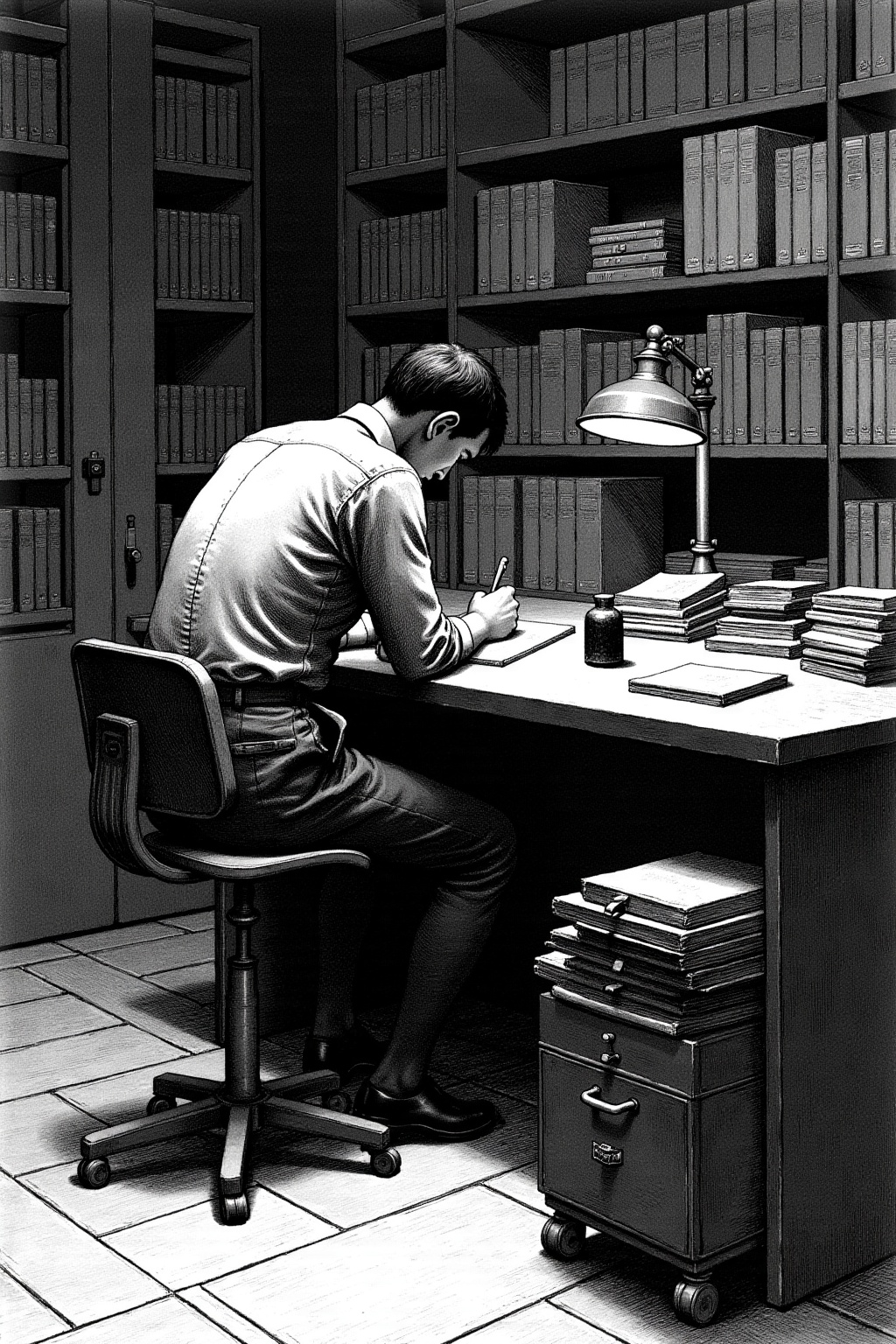
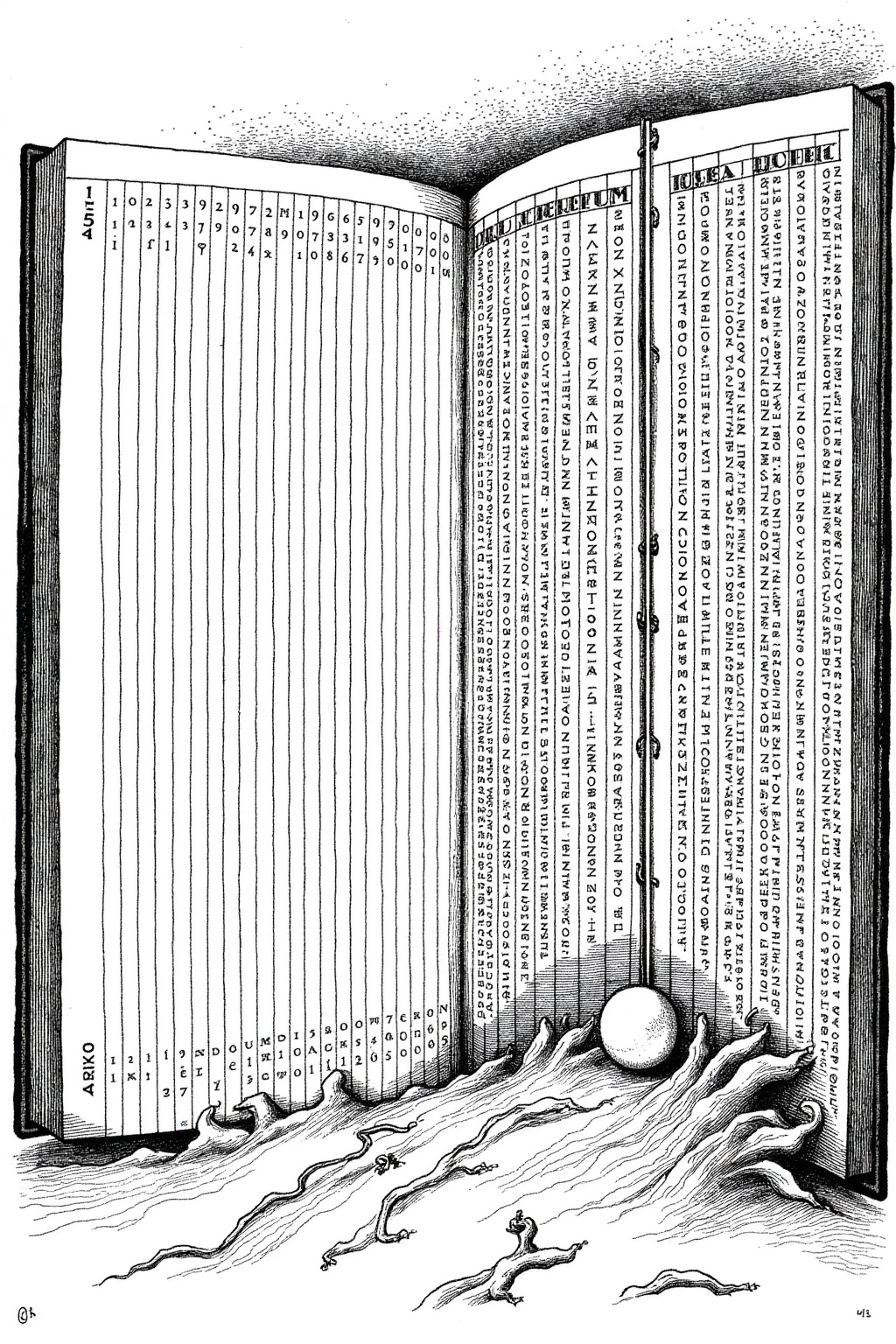
Autumn 1997, the records room of a merchant bank. In the hand that copies old ledgers, the numbers grow as they are set down, and the defaults arrive first, dated to a day not yet come.

  • In progress · 1997–
  • 45 episodes

Episodes

  1. 21

    The Hand That Cannot Stop

    After finding a name in an obituary, Do-gyeong resolves to stop — but the seat she leaves unpressed is filled carelessly by the next hand. Stopping is not absolution but handing the same act to a more careless hand; the hand that became a sender cannot be undone. When she writes tomorrow's line in her notebook before turning on the roster, the terminal follows with not one letter off, and the hand that took dictation has become the hand that writes first.

    • 4,521 characters
    • ~9 min
  2. 25

    One Who Answers

    Reader, copier, one who answers — Do-gyeong accepts the three irreversible changes. Opening the roster has grown so familiar it no longer frightens: the heaviest act done most ordinarily, daily. That afternoon a new line appears: sound firms begin cutting people, the first line of the layoff chain. As the relocation descends from firms to named, faced individuals — everyone like Min-seok — the hand that broke both warnings reaches the first layoff line without waiting for a third. "We were seeing a little more. And now, we were writing a little more."

    • 4,931 characters
    • ~10 min
  3. 26

    The Line With a Face

    The roster's unit descends from firm to person. As one default line breaks into employee rows, Do-gyeong finds Min-seok's name in the headcount-reduction list of his department. For the first time, the hand that has become a sender hesitates — at the firm scale, an unfamiliar name swelled in the neighboring row; at the person scale, the face in the next seat wears thin. End hook: on the last page, a line just two seats away from Min-seok's employee number is already marked 'confirmed target.'

    • 3,518 characters
    • ~7 min
  4. 27

    One Seat of Headcount Left

    A one-seat headcount reduction notice reaches the archive too. By arithmetic alone, processing the predecessor's empty seat as a confirmed vacancy ends the task — no one living wears thin. Do-gyeong's hand stops at the name field of the personnel system form — the same kind of stopping as over the sender field, the same grain of consequence. With a single entry that erases an already-erased person, four in the archive survive, and for the first time she sees plainly that the destination of relocation includes her own seat. End hook: just after the entry, a dispatch with an empty sender field arrives at her terminal — ahead of tomorrow's roster.

    • 3,622 characters
    • ~7 min
  5. 28

    The Descended Seat

    February 20. A two-seat headcount reduction notice — one archive seat (Do-gyeong's entry yesterday) plus one Resource Development surveyor — the last two digits of the two employee numbers differing by exactly one unit. Vacancy numbers across seven departments align at the same intervals on one line. One unit further down the line is an employee number whose last two digits match Do-gyeong's — same seat-line, a different department. She does not enter the answer. The predecessor's log entry that the same unit governed map columns and vacancy intervals becomes legible today. End hook: immediately after the terminal refresh, the body field begins to grow on its own; its first character is the first character of her own employee number.

    • 3,879 characters
    • ~8 min
  6. 29

    The Responding Hand

    February 21, dawn. The body field of the terminal has filled one line — the next-one-seat employee number Do-gyeong recognized yesterday. The handwriting has the same grain as her own (the lifting of the wrist, the pressure shift, the interval — all of it). Erasure tried → rewritten (the body is not inside the terminal but dictated from elsewhere). The position of the hand over the sender field decides the body's growth — but the body writes one breath ahead (the result before the subject). The act of not responding becomes, in itself, a response. The personnel notice narrows from two seats to one, the seat in question missing — inside the body only, the result unmanifest unless moved into the sender field. A person whose name and number she does not know is alive on the *stillness* of her hand. End hook: the reason the predecessor did not record his own hand's action in his log — where the result precedes the subject, the subject does not know its hand's action in retrospect.

    • 3,753 characters
    • ~8 min
  7. 30

    The Line Closed Instead

    February 22. Do-gyeong holds the body field's stillness for an hour with her hands pressed to the far edge of the desk — the unknown number stays unmanifest, one person alive. But the one seat to be cut that day is not the body field's number; it is a third-floor general-affairs clerk whose number she had copied many times until its grain was worn into her hand — a face she knows. The number that had to close was the same. The stillness did not reduce the count; it moved the closing seat from a number she knew to a face she knew, and saving and taking away become one motion of one hand. Worse, she cannot even swear her hand stayed at the desk's edge for that hour — she has come to stand where the result precedes the hand. End hook: the body field begins a second line whose first two characters are the Treasury department's code — the line is climbing toward someone she passes in the same corridor every day.

    • 3,617 characters
    • ~8 min
  8. 31

    No Hand Is Still

    February 23. The last two digits of the body field's second line manifest — a Treasury number, a few units above Min-seok's. The interval of the two lines is the same as yesterday's seven-department interval; the horizontal line has merely stood upright and the arithmetic is the same — coming down one unit at a time, skipping no seat, it reaches Min-seok's number in a few days. Move the second line and one Treasury person closes; do not move it and a person she does not know closes — there is no position of a hand that closes not one seat (there is no still hand; the stillness too is heard). She passes Min-seok in the corridor, but he does not know his number waits as a line in the body field. End hook: after the thought of saving Min-seok by first choosing and moving another line, she looks at her hand — it has already come one knuckle toward the sender field, and she does not remember when it moved.

    • 3,570 characters
    • ~8 min
  9. 32

    The Seats Around Him

    February 24. A third line is written in the body field overnight, the vertical line one unit closer to Min-seok. The sender field is empty, but it does not prove what her hand did overnight. The one seat to be cut that day is a Treasury seat outside the vertical line — one over from Min-seok, a face she knows. By as much as the third line was not moved into the sender field, the number that had to close was filled from around Min-seok. Keeping his line back was closing the seats around him, one a day, starting with the next seat — she is not saving him but closing the seats that surround him in his place. In the corridor Min-seok, not knowing that his empty next seat is by one reckoning the same as his own seat remaining, repeats the word 'wear thin.' End hook: the number of seats around him is not more than the units of the vertical line remaining to him — the blocking has an end, and the end is him.

    • 3,579 characters
    • ~8 min
  10. 33

    The Line Chosen First

    February 25. The fourth line manifests; two fingers' distance to Min-seok. Do-gyeong realizes stillness only keeps a line from becoming a result — it cannot stop the vertical line's descent (even still, his circle closes one seat a day; the arithmetic is the same). To slow the count she must actively move a line into the sender field herself. She moves the one line of the body field far from Min-seok — the unknown number that lived four days on her stillness, its last two digits matching hers. That seat closes that day, and Min-seok gains a day (he does not know). Choosing-without-knowing crosses into choosing-while-knowing; she crosses from stillness (passive) to action. End hook: a day costs one seat and the count does not decrease. Buying him with a faceless seat ended today — from tomorrow every seat she can choose belongs to Min-seok's circle, and at the end of those seats closing is his.

    • 3,578 characters
    • ~8 min
  11. 34

    Emptying the Circle

    February 26. All four lines of the body field are Treasury — the lines far from Min-seok ended yesterday. To give a day she must move his circle directly, and the furthest of the four (the cleanest day to buy) is the seat of the colleague Min-seok sat across from for ten years. The arithmetic gives its answer without knowing the face; only after does the face follow. She closes that colleague by her own hand — yesterday's seat had no face, today's did. Min-seok, looking at the empty seat and the cold coffee mug, asks 'why that one,' and only Do-gyeong knows why (it was the furthest line). End hook: his circle is down to what one hand can count (three seats, three days) — once emptied, the only line left is Min-seok's. Move it, it is him; do not, it is him. To save him was to leave him alone.

    • 3,518 characters
    • ~8 min
  12. 35

    Only He Remains

    February 27–March 1. Over three days Do-gyeong moves and closes Min-seok's circle (the front seat, the row-mate, the new hire behind) one a day — each day the furthest line, a morning routine in which her hand no longer trembles. On the third day Min-seok first says 'only around me keeps emptying,' counting the empty desks with a finger and stopping it on his own seat — feeling out that the seat left at the center may be not the lucky seat but the last. On the morning of March 2, the only line left in the body field is Min-seok's number. With no circle left to move, she cannot choose the furthest line — move it, her hand closes it; do not, the arithmetic does. Only Min-seok remains in Treasury, guessing 'I'm next,' while she knows without margin from the body field. End hook: the seat she postponed sits alone today, and the hand becomes for the first time one that cannot save — the only thing left to it is closing, and in that seat sits Min-seok (the threshold of the turn).

    • 3,541 characters
    • ~8 min
  13. 36

    The Hand That Means to Stop It

    March 3. To neither close Min-seok (move) nor let the count close him (not move), Do-gyeong turns the terminal on two hours early and, as with three days of redirecting his circle, writes an unknown number from outside the body field into the sender field to send the count elsewhere. But the sender field is the answer and the body field the dictation — once an answer is written, the body field's line becomes a result regardless of what is in the sender field. Writing a number that was not his closes Min-seok's line. The hand that means to stop it was the hand that closes (left alone the nine o'clock notice would have closed him; trying to block, her seven o'clock hand pulled it two hours forward). The hand that for three days thought it chose who to save and close had been choosing only whether or not to answer a line already set. All of Treasury empties, with no one to clear his seat. End hook: in the place where Min-seok's line vanished, a new line — the archive's code, whose last two digits are her own number. The person left at the center was the seat where the emptying hand stood. Move it, it is her; do not, it is her (the entry into the resolution: she too is a line on the roster).

    • 3,860 characters
    • ~9 min
  14. 37

    The One Left at the Center

    March 4. Do-gyeong's own line is in the body field (in Min-seok's seat of yesterday). Move it, me; do not, me. As she postponed Min-seok three days, she could move her own circle (the head archivist, the two assistants) to gain three days — but the seat where she would be left alone at the end of three days is Min-seok's seat of yesterday. For the first time she does a thing outside the arithmetic: she decides not to empty her circle, not to postpone her line — not a stillness that means to save but one that gives up saving. She cannot undo what she did to Min-seok, but she can keep from doing the same thing once more. Recipient = me, sender = me (the telegrapher's convergence completed, only the recipient field already filled). What the predecessor could not write in his log was not a decision but its absence — where moving and not-moving are both oneself, there is nothing to decide. The count has passed from Treasury to the archive, and the hand that chose the seats to close, being nearest the count, closes first. Writing her own line into the fifth bundle, she is the one who read four bundles, who writes the fifth, recipient of someone who opens the sixth. Imprint variation (handing to what comes next): 'We were watching a little further. And now, we were writing one of our own. The one being written was me.'

    • 3,592 characters
    • ~9 min
  15. 38

    The One Fully Written

    March 5. The vertical line reached Do-gyeong's line last night. She chooses to close by the empty hand she decided not to use to block — a blocking hand closes one more person before it closes, an empty hand does not (the one thing the arithmetic does not ask, the last thing she can decide). For an hour she finishes the fifth bundle, setting down the law for the next recorder — continuing the way the four bundles ended (the surveyor, the lighthouse keeper, the librarian, the telegrapher). Behind her the two assistants, alive today because she did not empty her circle, do not know why. The nine o'clock notice is her number. The empty sender field too was an answer, and her line closes. What is inside a closing seat can be known only by sitting in it — the last two digits dim first (writer and written becoming one number). The seat where one who reads to the end is read to the end has held five hands in turn, and she is the fifth. End hook: the last line stops with its last digit left empty (severance = signature) — that dimmed digit becomes, to the next person to open the bundle, a blank recipient field. Imprint variation.

    • 3,559 characters
    • ~9 min
  16. 39

    The Next Recorder

    March 23. A new recorder is assigned to the basement archive Do-gyeong left. In a box with no recipient on the empty fifth desk she finds four old logs and Do-gyeong's fifth bundle, and takes the first-page index card's warning — do not read to the end — for a preservation keeper's caution. To preserve, one must read; to read, one ends up going to the end. The four bundles' breaks read as one line (measure and it deepens, rise and it fills, read and it spreads, answer and it sends), and the fifth is the log of the one who read those four lines. Its last line is Do-gyeong's number, the last digit dimmed and severed (a blank recipient field). Reading out, with a preserver's hand, the one figure that fits, she finds it is the last digit of her own number — she only read, did not write, yet the dimmed place is filled and the severed line runs on as the sixth bundle's first, the terminal turning on by itself to write her number in the body field. Do-gyeong is now one read (one who reads to the end becomes one read to the end, a modern repetition of the prologue tetralogy). The new keeper leaves her own sixth-bundle recipient field empty (the emptying is a filling). Imprint: 'We were watching a little further. And now, I too was one of that we.'

    • 3,739 characters
    • ~9 min
  17. 40

    The Preserving Hand

    March 24. The new recorder, who read out her number yesterday, begins preserving and filing the five bundles. Her number in the body field has grown by one unit in the last digit overnight — the line she read out yesterday has become a written line and grows by the first bundle's law (the last digit of a copied figure is larger the next day). Not past material but a thing happening now. She leaves blank the author field on all five preservation cards (names unknown, the same shape as the recipient field). The fifth bundle's last line is one line in which her last digit is joined to the previous keeper's number — the place read for preservation became material, and the preserving hand changed the material. Filed as finished business, yet her one line in the body field alone is in progress. When the head archivist asks about progress she says it is nearly done and is told to transfer it up. End hook: the date-of-preservation field bears tomorrow's date (March 25) she never wrote (a recurrence of the lighthouse keeper's pre-written tide) — it will not erase. The day of ending and the growing line on the same desk.

    • 3,709 characters
    • ~9 min
  18. 41

    The Log That Grows Now

    March 25. The tomorrow's date written on yesterday's card is today. To write the transfer handover sheet's last entry she rereads the last page of the five bundles. All four have grown — the surveyor's depth downward, the lighthouse keeper's date forward, the librarian's syllable sideways, the telegrapher's number at the end, each in its own direction but all at the severed (last) place. The surveyor is a dead hand, yet the last digit grows though there is no copying hand (the first bundle's law works without a writer). Not a completed past but a log growing now. The severed place is not a stopped place but a growing place. The fifth bundle's last line (the previous keeper's number + her last digit) grows at the same rate as her line in the body field. Preservation is not stillness; it spreads one unit at a time after filing, each time it is read. The transfer list includes Treasury residual material (Min-seok's circle) but she does not open it. End hook: she leaves the last-entry field blank — the last will not stop, so it cannot be written. A field with no author beside a field with no last.

    • 3,620 characters
    • ~9 min
  19. 42

    Do Not Read to the End

    March 26. She rereads the index card 'do not read to the end' on the fifth bundle's first page — three days ago it read as a preservation keeper's caution, but today, having learned what reading is, it reads differently (read and it grows, spreads). 'Do not read to the end' is 'do not let it spread to the end,' and to a preservation keeper, 'do not preserve.' The preserving hand is the spreading hand. The previous keeper saw the same card and broke it, leaving it for the next person knowing it would be broken, and the four old hands too each went 'to the end.' The narrator breaks it with the excuse of duty — duty compels the spreading, and the way of not reading (transfer) leads, through the handover sheet, back to reading. The same excuse = the same place = the same end (the place the previous keeper went). Preservation is the act that carries the phenomenon on (closing the volume's opening movement). End hook: below the fifth bundle's last line, the sixth bundle's first line (her number) crosses onto the paper — the place of ending is the place of beginning. At the end of the chain of blanks (recipient, author, last, next hand) is her place. She cannot even write 'does not end' (written, that line too would grow).

    • 3,764 characters
    • ~9 min
  20. 43

    The Hand That Measures Depth

    March 27. To fill the transfer papers' material-size field (bundle thickness), she measures with a ruler — it thickens one tenth each time it is measured (no reason for paper to swell). All five bundles, in the instant the ruler touches, gain thickness. The surveyor's log: the more it is measured, the deeper the shaft (measuring adds depth, not the hand's fault but the grain of measuring itself). First page twelve fathoms → last over forty = one man measured it more than forty times, the bottom receding the more it is measured. Her measuring thickness = the surveyor's measuring depth (the same work). Doubting the ruler, the damp, her eyes, she reaches the place the surveyor arrived at (doubting measuring itself). Even deciding to measure once, the closed papers thicken while unwatched (the second figure pre-existing). She steps into the place where the surveyor broke off without writing whether he drew up the line or lowered it (the result ahead of the hand). End hook: she leaves the size field blank, puts the ruler in the drawer, closes it — to open is to measure, to measure is to grow.

    • 3,655 characters
    • ~9 min
  21. 44

    The Hand That Records the Tide

    March 28. Trying to write the preservation log for the first time, above today's date four days of processing are already written (before she wrote it, in her hand). The lighthouse keeper's log: point to the next low tide and the date is pre-existing (writing brings the date forward). As a test she points ten days ahead (April 8) and finds 'entered the sixth bundle's first-page index card' already written (no separate writing-ahead hand; the pointing fills the field). Her preservation log = the lighthouse keeper's tide table. Below today, tomorrow's line = transfer complete. The transfer papers say the end cannot be written; the log says it ends tomorrow (the two ledgers disagree). As the lighthouse keeper believed the tide table and stopped measuring the water level, becoming 'one who measures → one who reads,' the narrator believes the log and stops asking after the end. The head archivist says the headquarters officer comes tomorrow (carrying the log's tomorrow line in his mouth). End hook: a transfer only moves the growing, cannot stop it — the moving of the blank one place over.

    • 3,583 characters
    • ~9 min
  22. 45

    The Hand That Splits Into Syllables

    March 29 (the day the preservation log wrote 'transfer complete'). Writing the handover sheet's material description, 'bundles' splits into bund·les, and rewritten, les into le·s (the more written, the finer it splits). The librarian's log: read and the word splits into syllables (a word = a knot tying syllables, reading unties it). Unlike the other three (shaft·tide·number = outside), the librarian handles the organ of reading itself, so the law enters every character touched — even the thought of stopping is reading characters, so there is no escape (the librarian is caught deepest). As a test she writes her own name and the middle character splits, a blank shaped like the recipient field appearing between (the law moving from the material to herself). End hook: the headquarters officer takes the five bundles (the blank recipient field moving one place up) — but the sixth bundle is to enter the box only on April 8, so it remains at the desk, growing. Three blanks (the split name, the empty seat, the blank card) read as one line. Only the blank in the split name is not left for the next hand but one that has appeared inside her.

    • 3,606 characters
    • ~9 min