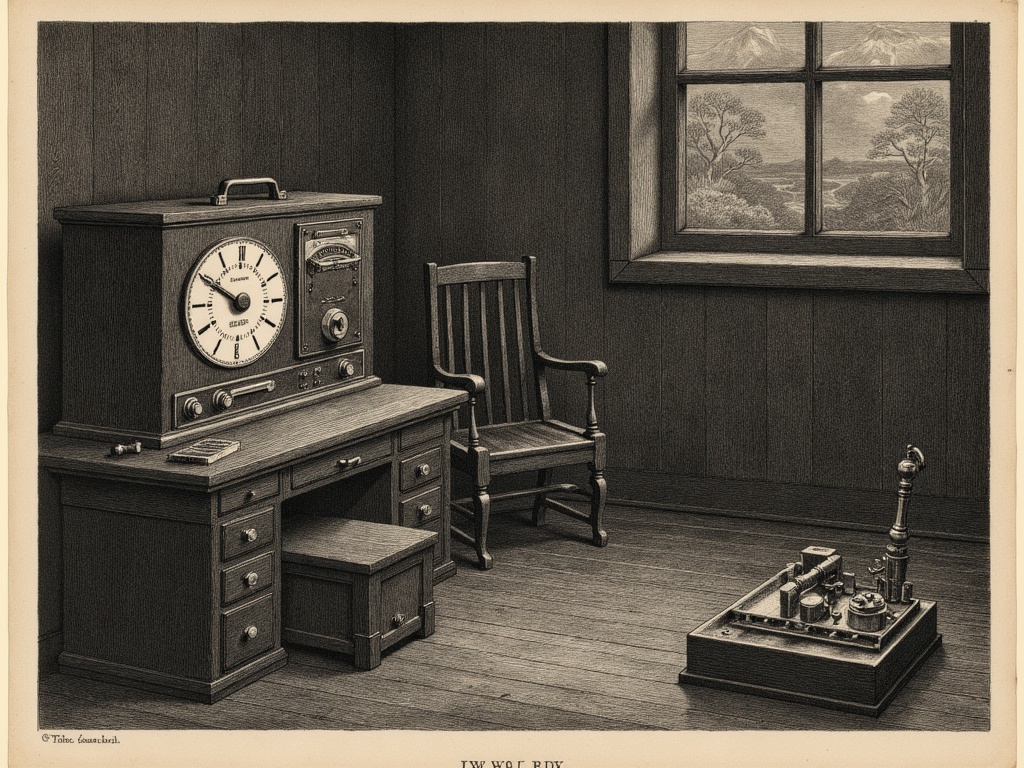
Even after I learned that the first letter of the receiver was my own surname, I did not stop reading. November had already taught me that stopping is no way out. I had been told to read them in order, so of the four bundles I opened the keeper's tide table first. The oldest was the surveyor's shaft log, from 1923, but my reason for starting with the keeper was simple: what was happening on the floor above had begun to move like a tide.
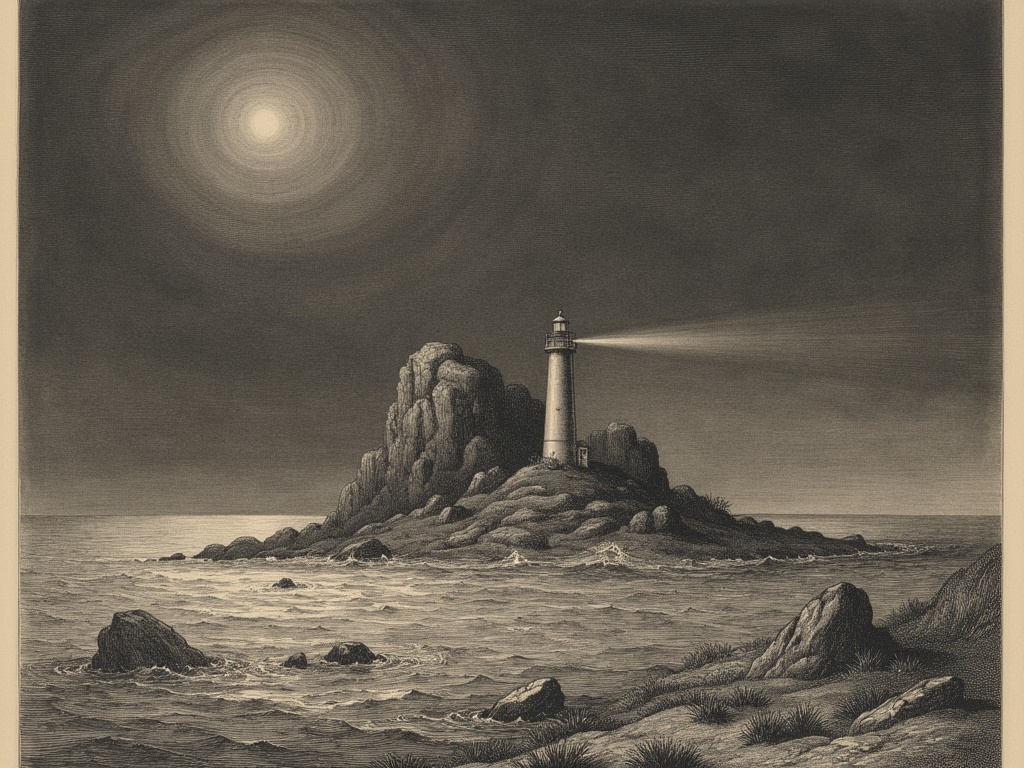
The keeper's tide table came from a lighthouse on an uninhabited West Sea island, 1934. Below the motto on the first page — water does not enter the same place twice — he had set down each day's high and low water. A printed table already existed, yet he kept his own by hand. And from one line on, a tide that appeared in no printed table crept into his script: a thirteenth tide, one that came on moonless nights. At first he took it for a slip of the pen; then he doubted his own eyes; at last he went down onto the flats with a lamp to meet it. The ground the water uncovered, his last whole line recorded, ran on past anything a printed table would allow.
As I copied the table out, one thing struck me. His tides repeated, but never returned to the same height. A little higher with each rise, a little farther out with each ebb. The motto did not lie. Water did not enter the same place twice — because each time it came a hand's breadth farther in. Repetition was not a stopping; it was another name for increase. As the surveyor's shaft went deeper with every sounding, the keeper's water climbed higher with every rise. One law, two faces: depth to the man who measured, height to the man who watched.
And I thought of the floor above.
Two days before, nine firms had stopped. Yesterday, several more. The suspensions did not fall at random. They passed from one house to the next — along the lines that lend and borrow money, one firm's ebb calling down the ebb of the firm beside it. Like the tide. I opened the transaction ledgers in the records room: which merchant bank was tied short-term to which, which lines the call money ran along. Following those lines, I could put my finger on the next place to go under — just as the keeper had marked the next tide missing from the printed table. And like water that climbs higher each time it enters, each ebb ran deeper than the last.
In my working notes I wrote the date of the next ebb — the next firm to stop, and the day it would fall, reckoned from the rhythm of the spread. My hand shook, the way the keeper's hand must have shaken the first time he set down the thirteenth tide. Perhaps I should not have written it. But I was already "we," and the work of "we" was to write. For one who has read to the end, watching and writing are the same act.
When I had finished, I turned back to the keeper's tide table. Beneath his last whole line, in a cell that had stood empty before, a new line had come to rest. A fourteenth tide, with a date beside it — not some day in 1934, but the very day I had just entered in my notes, that coming day in December. Sixty-three years earlier, a lighthouse keeper on the West Sea had set down, in his own hand, the ebb of December 1997. And waited for me to find it.
Water does not enter the same place twice. But the same tide is written twice, across sixty-three years — once in his hand, once in mine.
After the keeper came the surveyor — the oldest of the four bundles. The log of a man who had sounded the depth of a vertical shaft at a coal mine deep in the Gangwon mountains, 1923. I had read his shaft once already, the autumn before: a floor that dropped a fathom deeper with every sounding. But I had read it frightened then, grasping only dimly that my foreign-debt ledger and his shaft were of a kind. This time I read on purpose, to the end, in order.
On the cover of the surveyor's log was Latin cut in with a chisel — the sentence set into his surveying instrument, the same one I would read seventy-four years later on the boot screen of the credit terminal.
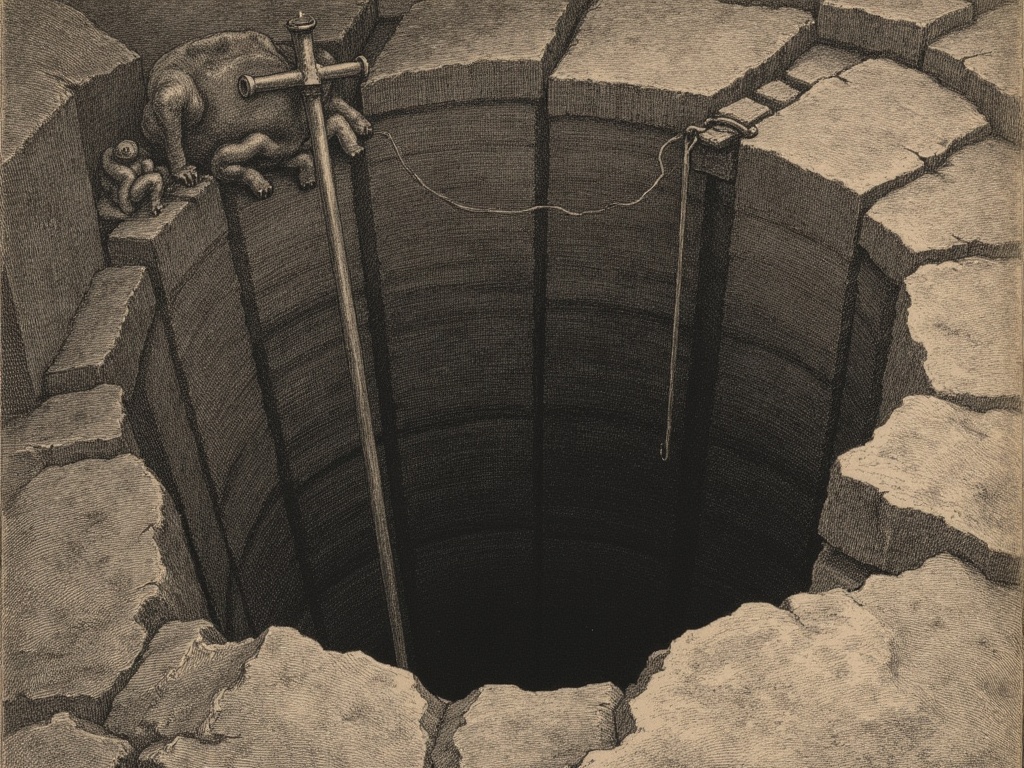
NUMERUS NON MENTITUR.Numbers do not lie. He lowered a plumb line into the vertical shaft to take its depth, and each time the line came to rest a fathom lower than the day before. The Bureau of Mines' printed register fixed the shaft's depth, yet he measured it himself, by hand, and his own figure ran deeper than the register. And from one line on, the plumb began to touch a depth it never should have reached.
As the keeper's water rose with each tide, the surveyor's shaft deepened with each sounding. Height and depth — two directions of one law, the law I had read yesterday as a tide and read today as a depth. Between the two I laid my own ledger: short-term foreign borrowing, a balance that swelled every time it was copied. It was a debt rising like the keeper's water and a hole deepening like the surveyor's shaft. What had to be repaid kept rising; the place it had to be repaid from kept sinking. And the foreign reserves were descending toward that depth, straight and plumb, like the line itself.
I was about to copy out the surveyor's last sounding when I stopped.
Beneath his last whole line, exactly as on the keeper's tide table the day before, a line stood that had not been there before. A new sounding — a date and a depth. Not some day in 1923, but the coming day in December, the very day of the ebb the keeper's table had pointed to. And in the depth column stood a figure: the figure I copied out every day, the whole of the short-term foreign debt our country had to repay. A miner's plumb line had, seventy-four years earlier, sounded in advance the depth of a nation's debt — the same depth, only the unit changed, from fathoms to dollars.
The plumb line touches a depth it never should. The surveyor's last sentence broke off there. But now I knew what came after the break. As the keeper's broken sentence had three days before, the surveyor's shaft too was waiting for the fifth hand. The task of lowering a plumb into a depth it never should reach was mine now to take up — at the next blank line of the short-term foreign borrowing ledger.
After the surveyor came the librarian. 1924, the Miskatonic University library, a leather diary with a bronze lock: the record of Dean Duncan, who had vanished. Of the four bundles, this was the one I feared most. The other three measured or watched or listened to something; this one was about reading itself.
The first page held Father Duncan's warning. Read no further. I had already broken it the autumn before — read the first bundle to the end in November, and watched the splitting begin to spread across me: the affliction of syllables arriving apart. So the warning, read again now, was no longer a warning I could receive. I had already broken it. A warning is meant for the one who has not yet broken it, and I was the one who had.
But reading on purpose was another thing. Where before the syllables had arrived apart, now whole sentences did. As I read Duncan's warning down to its end, the letters came loose from their places and gathered again — six syllables scattering across my fractured eye and settling into a different order.
r e a d e r , f a r t h e r s t i l lI understood. The other three were phenomena — the deepening shaft, the rising water, the dispatch dated tomorrow. But the librarian's diary was not a phenomenon. It was the engine. If measuring and watching and listening had grown those things, reading was the hand that joined them all. Duncan had been the first to see it: that the act of attention is itself the engine. So he wrote, Read no further. And by writing it, he left it there for the next reader to read. The warning was a prohibition and a handing-on at once. He too had read to the end, and so could not help but write it — as I could not.
I could not stop reading. Stopping was no way out, and I was already the fifth hand. Only now I knew what I was reading. Not the shaft, not the water, not the dispatch. I was reading the act of reading itself — the hand that grows the law, and it was that same hand that held the page.
In the diary's last line, Duncan's hand was just as I had first read it — the closing sentence that turns to address us, who read. But when I read it again with my fractured eye, the single word "us" came apart. In the gap, in a place that had not been there before, sat the first letter of a name. K. The letter I had seen on the cover of the box that had no receiver. Across sixty-three years, Duncan's "us" was taking me down one letter at a time. Reader, farther still. Not a warning, but a calling.