If a balance I hadn't even filmed had gained three figures at its end, then control had already lost its meaning.
A dead ledger, touched only now and then by a single hand, grew a figure or two in three days. A living ledger was another matter. Our short-term foreign borrowing was keyed into every terminal, written down at every close, reported up to head office, to the Bank of Korea, and past it. Hundreds of hands copied that number, several times a day. Pull my one hand out of it, and the balance still grew with the weight of hundreds.
I began filming the living ledger as assigned. If the number was going to grow no matter what, I would at least take the measure of how fast — the way the surveyor had measured the depth of the shaft.
Each day I filmed the closing balance, one frame at a time, and reckoned the increase by eye alone, never copying it to the index. To a fractured eye the figures arrived apart — but in exchange, how many places the figure gained in a day showed up plainly.
…the · grow · ing · side · — · from · the · end…Where one number grew, another shrank. On the daily foreign-currency status board head office posted, the reserves stood beside the borrowing — the foreign currency we'd repay with. That number didn't grow. It dropped. While the borrowing swelled from its last figure, the reserves were shaved down from their first. As much as the one side grew, the other wore away — the way the surveyor's shaft went deeper by exactly as much as the plumb line ran out.
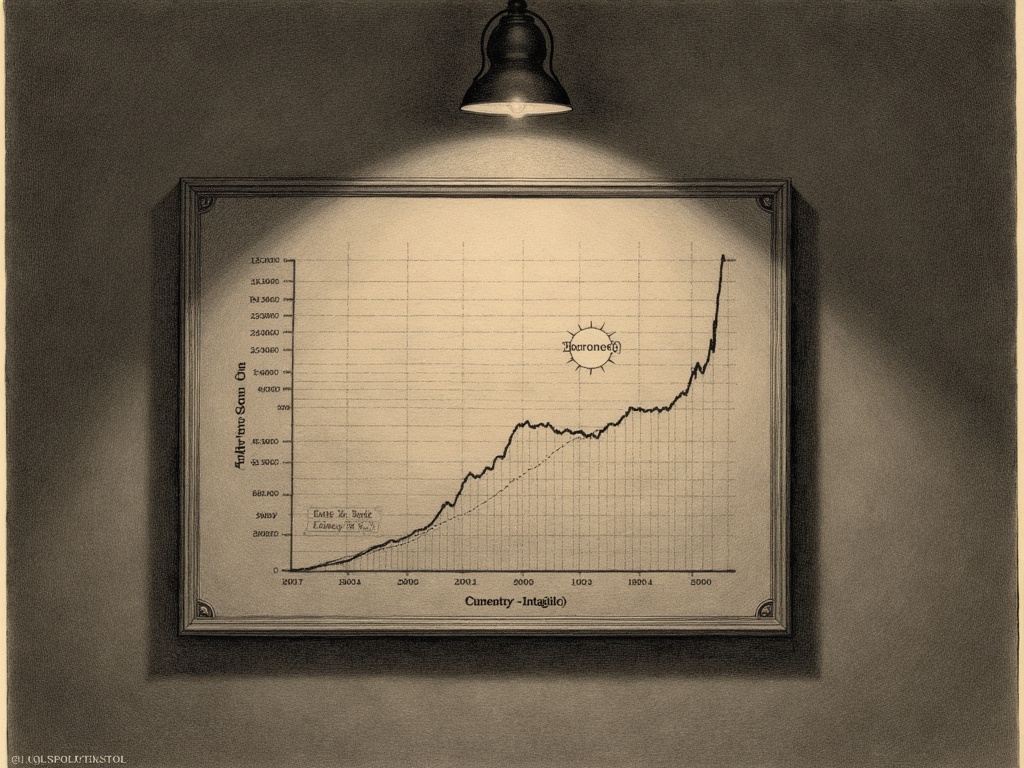
I set the two rates down side by side — the rate at which the borrowing grew, the rate at which the reserves fell. Draw the two lines out, and somewhere they crossed. The day the reserves would touch zero.
The borrowing grows because hundreds of hands write it down. The reserves fall because they wear away repaying it. The record enlarges one side, and the weight of what it enlarged eats into the other. On the day the two lines meet, there's nothing left to repay with and only the day to repay. And that day — is inside this month.I worked the date out. With a fractured eye I traced the two rates and found where the two lines crossed. The tail end of November. Around then, the foreign currency to repay with reaches zero. The number the nation borrowed swallows the nation.
There was only one way to stop a growing number: for no one to record it. Copy it down nowhere and it doesn't grow — as the dead ledger's control balance hadn't. But there was no making a living foreign debt go unrecorded by everyone. You can't stop hundreds of hands, every terminal, the Bank of Korea.
In all the world there was exactly one number that no one recorded.
My own resignation date. That blank field on the personnel card. The date no one had written, and so a day not yet come.
As long as no one wrote it, I wouldn't vanish. As long as it stayed a blank field, that day wouldn't come. I had only to keep that one field out of every hand's reach.
But I had already seen it — my predecessor's film, that half-exposed final frame. Between the digits of the growing balance, December ██ had been written. My resignation date was no blank field. Someone had already set it down.
Hundreds of hands wrote the foreign debt. Every terminal wrote the balance. But my resignation date — which I had never written, which the personnel office had left blank — was already there on my predecessor's film, set down before he vanished.
Who had written it? If not I, and not personnel.
I knew the answer. The single line stamped on the cover of each of the four bundles was the answer. We are watching a little further — and not only watching, but writing. The next recorder's resignation date. In among the digits of a growing number.
Each morning a cash-position sheet was pushed in under the records-room door, one at a time.
The cash position: the cash on hand at that day's close, the money the company actually held and could repay with on the spot. Every morning the funds division printed the previous day's closing position and sent it round to each department, and one copy came to the records room too. I only ever tucked it in among the film files — filming the living foreign debt took every hand I had.
On the morning of November 15th, I picked up the sheet that had slid under the door. I read the date across the top with a fractured eye.
No · vem · ber · six · teenth.November 16th. Tomorrow. Not the previous day's closing position, but the closing position of a tomorrow not yet come, printed and going round this morning. The same as the tomorrow's balance the terminal had thrown onto its screen (November 1st) — only this time it wasn't a screen but a sheet of paper you could hold. Paper sent round to every department, already handled by any number of hands.
The cash on the sheet was small. Too small. Several short-term foreign maturities fell due tomorrow, and the cash to meet them — tomorrow's position — came up short of the maturing sum. Tomorrow, the company can't pay. That fact was already written on this morning's paper.
The telegraph operator's log came to me out of nowhere — the one line I'd been told not to read to the end, and had already read.
Dispatches transmitted with tomorrow's date came in every night, and the next day I watched them come true. The call on the empty frequency told no lie. It only spoke of what had not yet come.The telegraph operator had broken the one rule — take it down, but do not answer — and answered for the first time. In that instant he turned from one who listens into one who transmits, and in the end became the very sender of the dispatches dated tomorrow. Remembering that log, I looked down at the paper in my hand. Take it down, but do not answer. If I did anything with this paper that said the company couldn't pay tomorrow — warned the funds division, covered the maturity — I would become one who answers.
If I don't answer, I'm one who reads. If I answer, I become one who sends tomorrow — as the telegraph operator did. But knowing the company can't pay tomorrow and sitting still — can that be called doing my job? Isn't sitting still an answer of its own?I resolved not to answer. I would check just one thing — where the tomorrow-dated sheet had been printed. At the foot of the page, the identifying number of the terminal that printed it and the time were stamped small. If it was a funds-division terminal, I could put it down to someone's clock being off by mistake. I traced the number and read it with a fractured eye.
Not the funds division's number. The records room's. The credit terminal I'd switched on after five months shut away — the one whose boot screen came up NUMERUS NON MENTITUR. The terminal on my own desk.
I had never printed a cash sheet from that terminal. All I'd ever done with it was query the foreign balance. But the time at the foot of the page pointed to the small hours of this morning, when no one was in the records room. Tomorrow's cash sheet had come printed off my terminal, by a hand I never laid on it, and gone round to every department.
I hadn't yet decided to answer. And already my terminal was printing tomorrow and sending it round from department to department. Before I'd decided to become the sender, I was already sending.