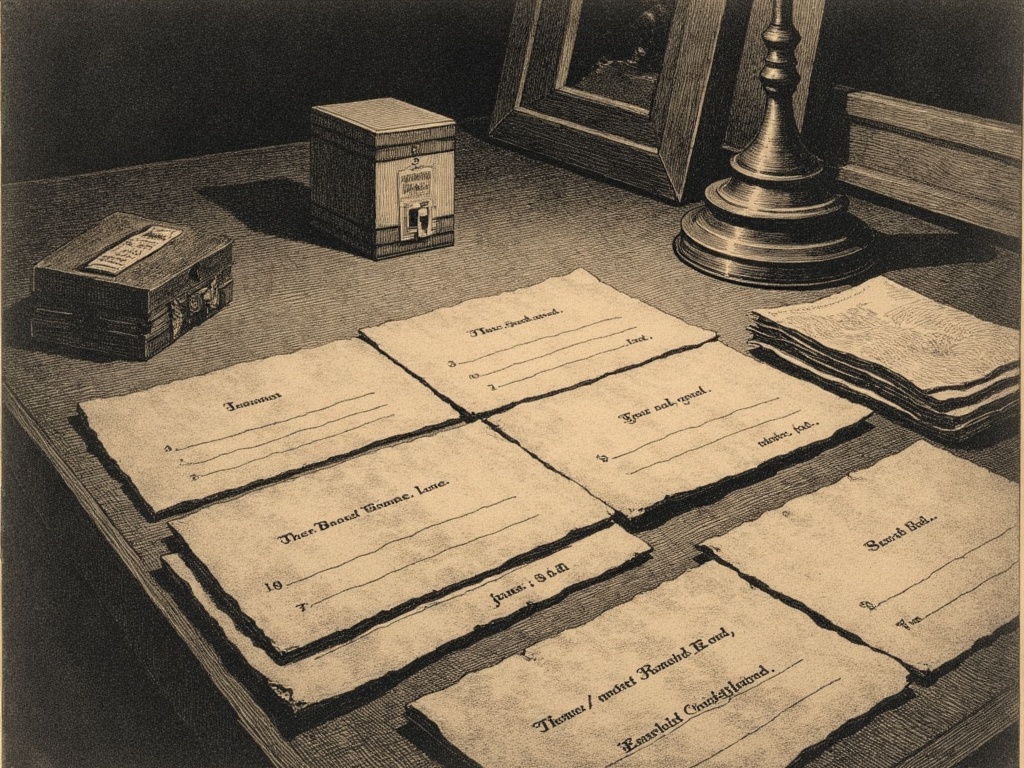
Ever since I learned that my terminal printed tomorrow, I dreaded sitting down in front of it. On November 17th it spat out a sheet before I had even taken my seat.
A downgrade notice from a ratings agency. Our credit rating cut one grade lower. The date at the top read November 18th — tomorrow. A downgrade not yet announced had reached my terminal a day ahead of the announcement.
I know by now that it will come true. The cash report did; the balance on the terminal did. Tomorrow the agency will announce the cut. Foreign creditors will call in their short-term lines, the days to repay will jump forward, and the reserves will drain toward zero faster than before. Let the single number they call a rating drop, and the foreign debt we cannot repay grows that much heavier for it. The record lowers one side; the lowering topples the other.
The motto from the boot screen surfaced on its own, unbidden.
NUMERUS NON MENTITURA rating is a number too. It does not lie. Tomorrow's downgrade is already true — only not yet announced. Whether the agency publishes it or not, the rating has already fallen. The announcement does no more than copy onto paper, late, a descent that has already happened.
I read the rating field of the notice with that fractured sight of mine. The symbols came to me one at a time, each apart from the next. And in the spaces between them — where there should have been nothing at all — I could see the one that came next. A thing no eye that reads a symbol whole would ever catch.
A · ↓ · B · B · B · ↓ · B · B · ↓ · …The downgrade did not stop at a single grade. Down through the gaps between the cells the rating kept falling — past investment grade, past speculative, all the way to default: D. There it should have halted. Default is the floor of ratings. But below default, in the gap where no grade should exist, there were more symbols still. Symbols that were not ratings. Cells no agency assigns, cells that cannot be named.
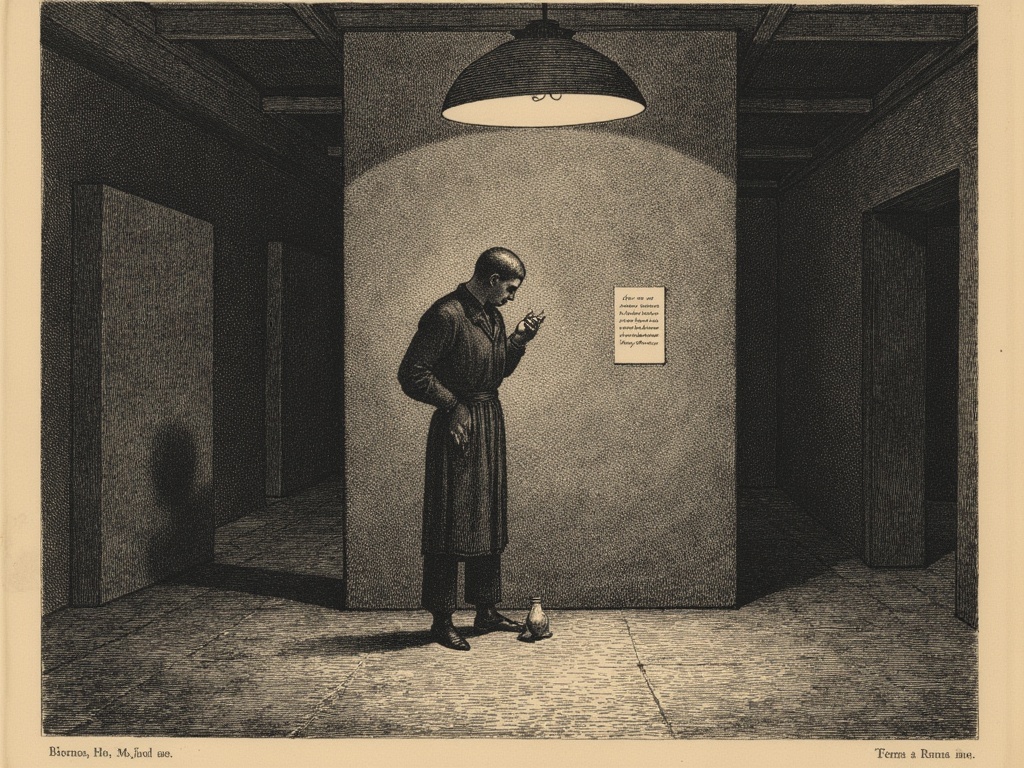
D · ↓ · ██ · ↓ · ████ · ↓ · ██████.Just as the surveyor's shaft had not stopped at forty-eight fathoms but only gone deeper. The rating did not stop at default; it went on down. A shaft that deepens the more it is sounded, a rating that sinks the more it is read. To make out the very bottom of that descent, I held the notice up to the lamp. In the lowest cell of all, where a grade should have stood, there was a date.
It was the field at the foot of the notice marked "next rating review date." The day the agency would next look in on the company.
De · cem · ber · ██.That one day in December. The day the reserves touch zero. The day my predecessor's film wrote in between the digits. The empty discharge date on the personnel card. And now the day the agency comes to look in on the company again. By that day the rating will have sunk to that nameless cell below default. On that day the company cannot pay, the reserves stand empty, and I am discharged.
I laid the notice down. The rating had not lied. The company is downgraded tomorrow, and that downgrade runs on without end through the gaps, until on that one day in December it reaches a bottom that is no bottom. Below default there are no ratings — only an empty place, and in the empty place, a date.
The hand that wrote that date was the same hand that had printed the cash report. My terminal's hand — the one I had never set mine to. The same hand that stamped one identical line onto the covers of the four bundles.
Even after the terminal had printed tomorrow and the rating had gone below default, the company handed me my next task. This time it was the exchange rate.
The treasury department had me copy the won-dollar rate — the fixing the foreign exchange bank posted twice a day, at half past nine in the morning and again at three — into the records-room ledger. Taking it down: the thing I did best, and now feared most. I wrote in the morning fixing, nine hundred and some won to the dollar. I lifted the pen, raised my head, bent back to the page — and the figure in that same cell had grown a shade larger. The afternoon fixing had not even come in yet.
At first I put it down to a trembling hand, a misreading. But I know that tremor now for what it is. A number, once written, will not hold still on the page. The foreign debt had been that way, and the cash position, and the rating. So too the rate — except in one thing: the rate came back. The debt had grown in a single direction. The rate rose like a flood tide, ebbed for a moment, and each time it rose again it stood a hand's breadth higher than before.
With that fractured sight I read the space between the morning and the afternoon fixings. Between the two official figures — in the gap where nothing at all should have stood — ran a whole row of values that had never been posted. Swelling, ebbing, swelling higher. In the space between a rate fixed only twice a day, I counted thirteen risings and fallings.
Flood and ebb. I knew where those words had come to me from. The second bundle in the box — the lighthouse keeper's log.
I was taught the tide comes twice a day. But from the day I lit the lamp and began to count, the water did not stop at twice. It rose as much as I counted. When I had counted thirteen, a fourteenth tide left the next cell of the ledger empty and waited for me. So into that cell I drew the fourteenth tide with my own hand.Yun Sang-hak, the keeper. In counting the tides he came to see that the counting itself bred more of them. And unable to bear the empty cell, he set the fourteenth down in his own hand. That tide he wrote never ebbed. He carried his lamp down under that water.
The rate was a tide as well. Each fixing, one rise and fall. And every time I copied it into the ledger, the next rise came in higher than the last. The hand that took it down was lifting the water. As the keeper had lit his lamp and multiplied the sea, I was raising my pen and multiplying the exchange. That is why the dyke we called a fixed rate had already given way. So long as it is written down, no rate can be held fixed — because to take it down is itself the rising.
The bundle recorded that another line, like the motto beneath the terminal, had stood on the lighthouse's own drawings.
LUMEN SUPER ABYSSUM CUSTODITIt keeps the light over the abyss. A lighthouse's work is not to fill the abyss but to keep one light afloat above it. Yet whoever lights a lamp to peer into the abyss deepens it by exactly as much as he looks. The rate had no floor. Just as the rating had passed below default, the won could pass below any dyke at all. Over that abyss I was holding one small light — a pen — and by as much as it shone, the bottom drew away.
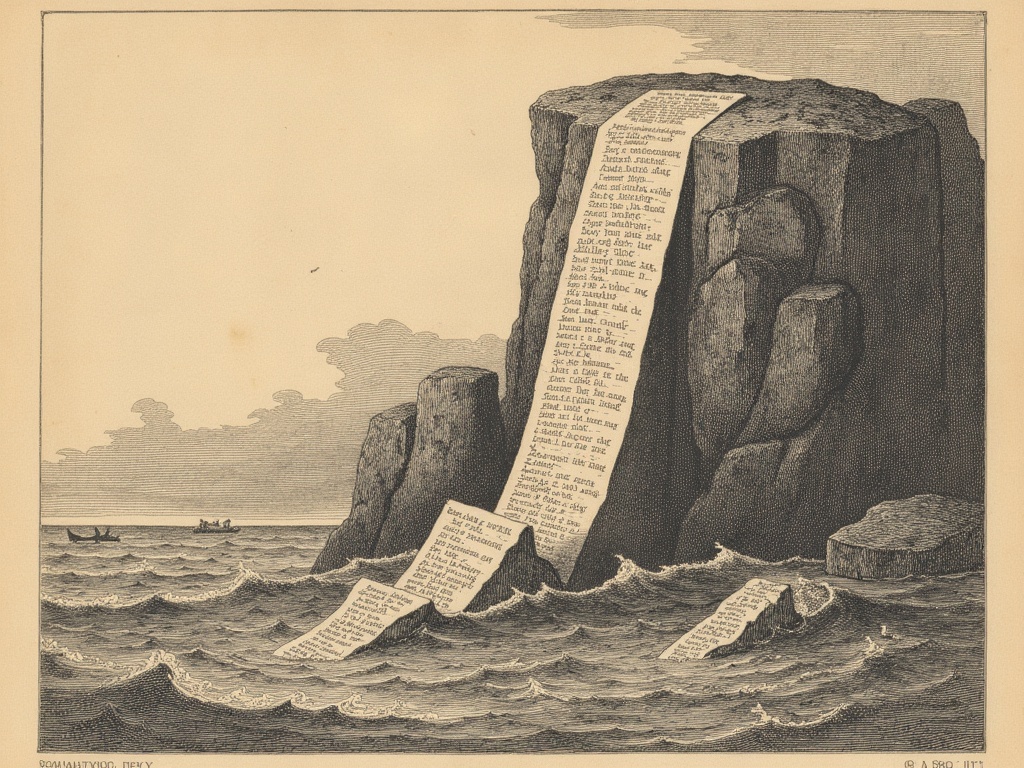
To enter tomorrow's morning fixing, November 20th, I set my pen to the fresh cell. It was not empty. A number already stood there — in my own hand. Far above any line one might have called a dyke: the figure for the point where the won ceases to be money at all. Beside it, a small drawing. It was the keeper's own mark for a tide that will not ebb — the sign of the fourteenth tide.
And I had not yet set down a thing in that cell.