On November 26th an instruction came down from head office's liquidation committee: with liquidation coming, film and preserve every account, not one left out. The whole records room bent to it, and at the terminal and the reader I copied the account ledgers onto film, one at a time.
At first it looked like plain preservation — filming, ahead of time, whatever might be lost. But an hour in, my hands went cold. Each time I shot an account and laid it onto film, that account's status on the terminal upstairs flipped to "closed." I took it for coincidence at first: that the order in which I filmed and the order in which the accounts closed happened to run together.
So I tested it. I skipped the next account on the list on purpose and filmed the one after it first. Upstairs, the account I had filmed first was the first to close. The skipped one stayed open. The order was no coincidence. Preservation was liquidation. To film a thing away and to empty it out were a single act.
The committee had said preserve. But what was preserved closed. As the surveyor's sounding had deepened the shaft, as the librarian's reading had split the word, my filming shut the account. The film was no photograph of an account; it was its grave. One by one I was burying the company's accounts — under the name of preservation.
I wanted to stop, but I knew that if I did, someone would film in my place. So I kept on. The list was long — thousands of accounts. I buried them and buried them. When I reached the end of it, I stopped before the last entry.
Once the customer accounts ran out, one more line stood at the very bottom. Records-room preservation account. Where the account number should have been, my employee number. In the holder's field — Kim Do-gyeong. The status still read "pending," and the scheduled-closure field was stamped December ██.
The list that filmed and buried every account ended with the account of the one doing the filming. The last frame was the one in which I shot myself.
In the deepest cabinet of the records room, among the unsorted effects of my predecessor Han Seong-█, I found a fully wound reel of film. Not the half-exposed roll I had threaded in early November — this was his last finished reel, shot clear to the end. One line stood on the label, in his hand: "The living ledger. To the end."
I threaded it into the reader. The first frame was a page of the foreign-debt ledger — the short-term foreign borrowing total. The next frame was the same page. Same ledger, same cell. But the total's last digit had climbed by one. The next frame, one more. The frame after that, one more again.
Film is a medium for holding fast what does not move. An image once struck into the light stays fixed there; that is the promise of a photograph. My predecessor's film was breaking that promise. Across successive frames of the one ledger, the number had grown from each frame to the next. He had not filmed a growing ledger. On the film itself, inside the embalmed image, the number went on growing. Not even the photograph could stop it. Fixed in light, the figure grew on.
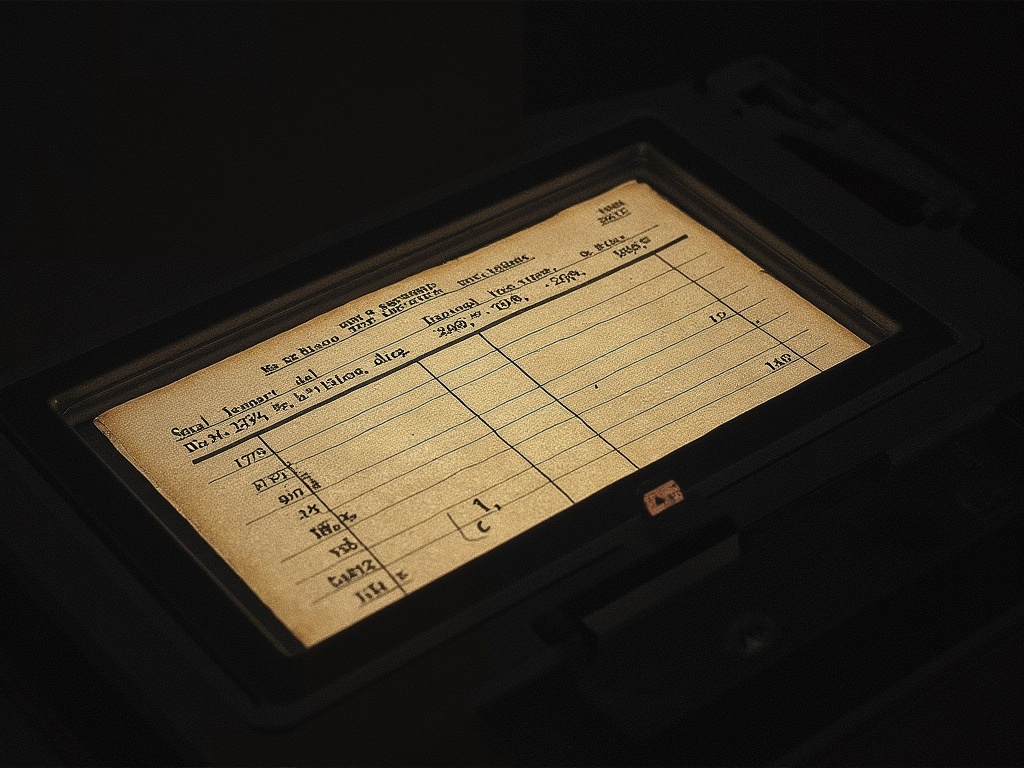
I understood what my predecessor had been trying to prove. To the end, he had written on the label. He had meant to film the growing thing all the way down, to see whether it had a stopping point. Like the floor of the shaft, like the grade below default — whether the growth had any bottom. The reel was long, the number climbed with every frame, and no end came.
Near the end of the reel, the image changed. No longer the ledger page. The camera had turned away from the ledger and was filming the records room itself — the reader, the cabinets, the low ceiling. The room I sit in every day. And at its center, before the reader, a figure sat with its back to the camera.
That figure was not Han Seong-█. The set of the hair, the line of the shoulders, the clothes — it was me. Me, today. Me at this very moment, seated at the reader in just this posture. My predecessor's last frame had not been shot before he vanished. It had been shot today, by someone standing at my back.
Slowly, I turned to look behind me.
No one was there. The motor-hum of the reader, the shadows of the cabinets, the low ceiling. The hand that had filmed me had left no body behind. It was always so — in the keeper's empty lamp tower, in the surveyor's empty shaft, no one had ever been standing. Only the record stayed. The frame shot, the line written. "We" were not a body but a record.
I set the camera down and turned back to my predecessor's paper records — his handover papers, his work log, his index cards. I read them through again, start to finish, this time to settle one question: how his last line ended.
His last log entry did not end.
It stopped in the middle of a sentence — no period, no line after it. Where the pen had lifted from the paper, a faint smear of ink had spread, nothing more. I knew that break. The librarian's log had ended the same way. The keeper, the surveyor, the operator — all four bundles broke off mid-sentence. It was no accidental halt. It was a signature. At the moment the recorder crosses over into the place of the recorded, the sentence breaks off there. That there was no last sentence was the proof that he had passed into the law.
My predecessor was no exception. He was not the one who had sorted this box, nor part of the "we" who had gathered these records. He too had been only one of the fifth and sixth hands. He read as I read, copied as I copied, broke off as I am breaking off. His last sentence I read beneath the lamp.
The true number that grows beneath the ledger, I now resolve to copy—There it broke off. After "resolve to copy—" came no further letter. And I knew that sentence. It was the one I had been shaping in my own mind for days — having read to the end, having seen the true number, now resolving to set it down. The very resolve I had been drawing toward. My predecessor's sentence had stopped at the exact place where my own was about to begin.
Why do the four bundles never end? Now I knew: they cannot. Because the last sentence is written by the next reader. The instant you continue a broken sentence, you become the next to break off. That was how these records passed down the line. One person stops at "resolve to copy—"; the next completes the sentence, and the price of completing it is to lose one's own sentence at that same spot.
I took up the pen. In the cell past my predecessor's broken sentence, I could set down the next single letter. I knew what that letter was. And I knew, too, that the moment I wrote it, the one to break off would be not him but me.