The announcement came exactly as I'd read it that morning.
December 23rd. Around noon the radio and the telex spat out the same thing at once. Not one or two. Several merchant banks suspended all together. More names than a screen could hold. Exactly the length I'd read ahead on the terminal the morning before.
The sound of the funding department caving in upstairs came down through the ceiling. Phones rang all at once, chairs shoved back, someone ran down the corridor. A seat that couldn't clear its settlements, a seat whose call money had been cut off, a seat that couldn't last the day. People took it as sudden news. As a disaster come down on them.
I heard it from the basement records room. I didn't tremble — I'd already read it that morning. And the fact that I didn't tremble frightened me. To the people upstairs it was a thing striking them for the first time today; to me it was only a line, written yesterday, surfacing. Not being startled meant I stood not on their side but on the side of the line.
This time it wasn't one line. The next lines due to wear away were many. Behind each name a desk, behind each desk a person, behind each person a household like Min-seok's. Like an ebb that drops all at once, many beds bared themselves together. The first collective harm. The number that had been growing beneath the ledger had finally spilled up over people's ordinary lives.
I ran my finger down the announced roster. Min-seok's firm wasn't on it. Not today. Somewhere upstairs I might have heard someone let out a breath of relief. I couldn't. Because I remembered the empty cell I'd marked on the tide-table days before — the cell holding his firm's name, waiting its turn to come in. That he wasn't on today's roster meant only that his cell hadn't arrived yet. A few days, until the next ebb.
A few days later, the next ebb came.
December 26th. A fresh announcement spat out another roster. Short, this time. But in that short roster was one name. Min-seok's firm.
I wasn't surprised. I couldn't be. Days before, I'd marked that cell on the lighthouse tide-table and read the name ahead on the terminal's roster for the next day. It stood on the roster exactly as I'd read it, not one letter off. NUMERUS NON MENTITUR. The terminal's motto had proved right once again.
Min-seok came down to the records room. Not, this time, to talk about his household. His face was not the face of the day before. The firm stopping meant his salary stopped, the loan did not, the house shook, his child's future shook. Where a single line of ledger had begun to wear, a living man was standing. The line I'd read ahead days before had arrived now as his face.
I had known for days. I'd seen the tide-table hold his cell open and waiting, read the terminal put his name up before its time. And in all that while I'd said nothing. I couldn't. To speak what I'd read ahead was to answer, and answering was forbidden. But forbidden or not, I had no idea with what face I was supposed to say, "In a few days your firm stops."
Min-seok looked at me. His face wanted to ask something. I opened my mouth. Late, but for a word at least. But the syllables that came out fell apart from one another. …measure, deepens, rise, fills… Not the warning I'd meant — a scattered fragment of the four bundles' sentence. The law would not let the warning out. It allowed reading ahead but blocked speaking ahead. Reading, yes; answering, no. In the end I said nothing to him at all.
Min-seok turned away without an answer. To his back as he climbed the stairs, I finished the warning I'd failed to give — but only inside myself. And a warning finished only inside saves no one. From that day I became a man carrying a sentence he could not say. A line read but never delivered. And inside me, like the number beneath the ledger, it began quietly to grow.
The warning I couldn't give was not one I'd decided not to give. It was one I'd been made unable to give.
December 27th. I tried again. Not Min-seok, then anyone — if I could just hand the next cell I'd read ahead to a single person. If not by mouth, then on paper. I took out a sheet and wrote: "The firm that will stop at the next ebb is—." As far as that, and then the digits dropped off the tip of my pen. The firm's name copied itself over into another name. A clean warning wouldn't stand on paper either. As syllables scattered in the mouth, letters migrated on the page.
Changing the medium changed nothing. Pick up the telephone and the numbers came out wrong; jot a note and the line slid away. The law let a warning escape through no channel at all. It threw reading wide open and barred delivery at every door. Only then did I understand: the silence wasn't my choice. It was forced on me. What a reader-ahead was allowed was knowing — not telling.
Then where does the guilt lie? I thought back to the day I'd lifted my hand to keep from copying. I'd lifted it hoping that not copying would stop the thing — and someone copied in my place. Absence had its price too. So it was again now. There was a price for staying silent, and no road for trying to speak. In a seat where action and absence were sealed off alike, one thing was left — to watch. Without the power to save, without even the freedom to keep silent, I had been set in the seat of one who must only watch to the end.
The half-finished warning note I tucked into the fifth bundle. If it was a line I couldn't deliver, at least let it stay in the record. But the moment it went into the bundle, even that note became a page of record — a place to be copied out, a place to grow. Having saved no one, the warning was absorbed into a single line of the ledger.
The next morning an order came down from upstairs. The people of the suspended firms had begun clearing their desks; preserve their records. For the first time I had to go up and see for myself — not the names on the roster, but the places those names were leaving.
The people packing their boxes didn't know where they were going.
December 28th. With the order to preserve, I went upstairs. A whole floor of a suspended firm was emptying out. People were packing boxes — a cup, a diary, a family photo frame, a packet of pills kept a long time in a drawer. And desk by desk, one more emptied seat was added.
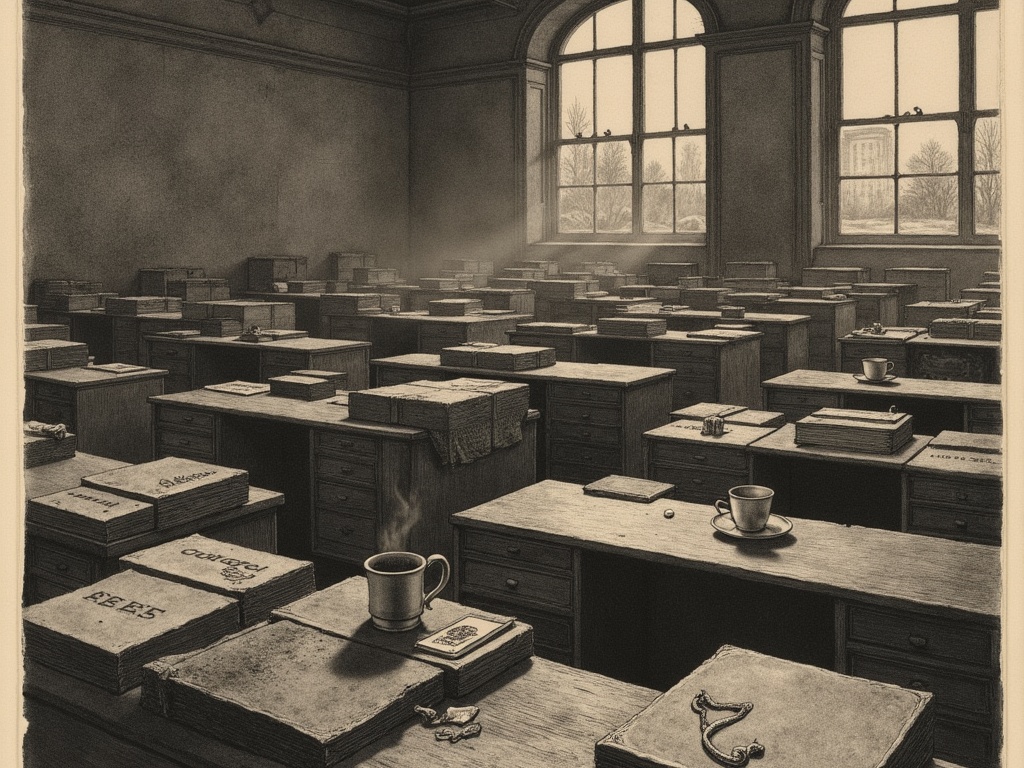
On the roster it had been a single line. One firm's name, one date. But here it was dozens of boxes, dozens of empty desks, dozens of pairs of walking feet. What the next line to wear down was, I now saw not as letters but as the backs of people. For a line to wear away meant this many cups and photographs and footsteps leaving their seats all at once.
Looking at the cleared desks, I thought of my predecessor's empty desk — and of my own desk, standing empty in a page not yet come. A desk emptying was not an ending but a record closing. A closed record became a bundle for the next hand to read to the end. These people weren't leaving the firm; they were becoming closed bundles, being moved to the next cell.
Min-seok was among them. He too was carrying a box — a small one. I could see a photo of his child and a single mug. He passed me. Our eyes met. He didn't blame me: he had no idea I'd read his cell ahead days before. Going unblamed weighed more than being blamed. Once again I couldn't open my mouth.
People thought that once they were out of the building it was over. But the firm stopping didn't stop the loans. They were being moved from one ledger to another. To step out the door was to carry the line from one cell to the next. The people packing their boxes didn't know they weren't leaving the ledger at all — only shifting their seat within it.
That afternoon the record boxes from the cleared desks came down to the basement in a line. To my records room. The order was to preserve. Taking the boxes in, I understood — preserving was not ending but continuing. These people's closed records were gathering now beneath my hand. New bundles, to be read to the end and passed on.