The order to preserve came down as a single sheet of paper.
December 29th. A head-office circular. Transfer the entire records of the suspended firms to the records room, photograph them onto microfilm, and preserve them. It carried a stamp, it carried a date, and its sentences were dry. Preserve. Everyone read the word to mean keeping things safe.
But I read the word differently. To preserve was to photograph, and to photograph was to copy out. And I knew — a number copied out grows. Moving a suspended firm's ledger onto film meant reviving that closed record and setting it growing again. Preserving was not keeping but continuing: making what had been liquidated go on growing beneath the ledger.
I had already seen the pairing back in November. The order to photograph everything before liquidation. Closing and shooting were one and the same act. Now that pairing had come back, grown to the scale of whole firms. The order to preserve was the same sheet of paper as the order to liquidate. Only upstairs called it preservation, and the law called it growth.
The frightening thing was that now I had paper. A stamped order. I was no longer someone reading in secret but someone under an official command to copy out. In borrowing my hand, the law had now furnished itself with an approval box. I was a permitted hand.
I read the circular again. Beneath its dry administrative lines, a familiar sentence showed through. Measure it and it deepens, let it rise and it fills, read it and it spreads, preserve it and it grows. To the four bundles' sentence a fifth piece had been joined. Preserve it and it grows. And the one who had written that fifth was neither head office nor upstairs.
I opened the first box. The records of some suspended firm — slips and ledgers and reels of microfilm. Among them, one thing looked familiar. A sheaf of paper of a different grain: the working notebook the firm's records clerk had left behind. I turned to the first page. The hand wasn't one I knew, but the sentence was. Do not read to the end. Reading that one line, I understood for the first time that this had never been a matter of our firm alone.
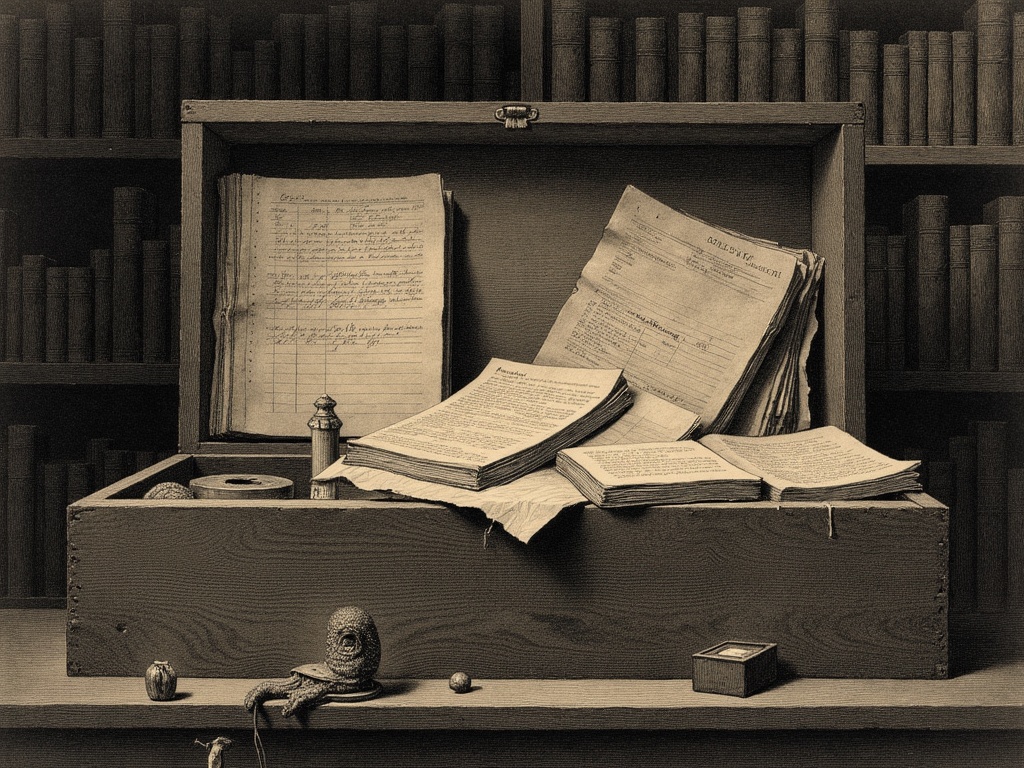
The transferred boxes were not just one.
December 30th. Boxes from the suspended firms stacked up in rows across the records-room floor. I opened them one by one. Every firm had its ledgers, every ledger its records clerk, and every records clerk — a working notebook.
Opening those notebooks, I saw the same thing over and over. The hands differed, one from another. But the sentence was the same. Do not read to the end. A number that grows each time it's set down. A last page cut off mid-sentence. Different firm, different hand, different year — and the same law. It had never been a matter of the four bundles and me alone. Wherever there were records, the same number was growing beneath the ledger.
At the bottom of one box was a wooden box of a grain I knew. The blank receiver cell. The same grain, the same blank, as the box of the fifth bundle under my desk. A different firm — the same box. The Pnakotic trace wasn't in one records room alone; it was in every place where records gathered. I wasn't special. I hadn't been chosen. I was only one knot in a vast reckoning.
Only then did I see the scale of the crisis in a different light. The newspapers called it the collapse of the economy. But what it was, was this: the true numbers that had been growing all along beneath every ledger, surfacing all at once. The whole country was one enormous bundle. And that bundle too would have a last page no one was meant to read to the end.
The other clerk's notebook broke off at the same place mine did. Mid-sentence. What had become of him the box did not say. He'd have become an empty desk. Copied out, and gone. Closing his last page, I tried not to think about where my own notebook's last page would fall.
When I opened one firm's staff roster from the box, the names would not hold still. The letters began splitting into syllables. One name into two fragments, the two fragments sliding down into the nameless cell below default. The roster was coming apart. And the split-off pieces were filing, in a row, into a cell I knew — the cell below default, the grade with no name.
The roster would not hold still.
December 31st. On the last day of the year, I was sorting the transferred rosters — the staff rosters of the suspended firms, sheets with names and ranks and employee numbers set down in rows. But the more I sorted, the less the names would hold still.
One name split into syllables. The surname Kim came apart — first into a consonant and a vowel, then into loose letters. The split pieces didn't stay put; they slid downward, between one cell of the roster and the next, between one line and the next. And where they slid, a cell I knew was waiting. The cell below default, the grade with no name — the cell I'd seen once before on the rating sheet. Then it had been empty. Now it was filling with the broken names.
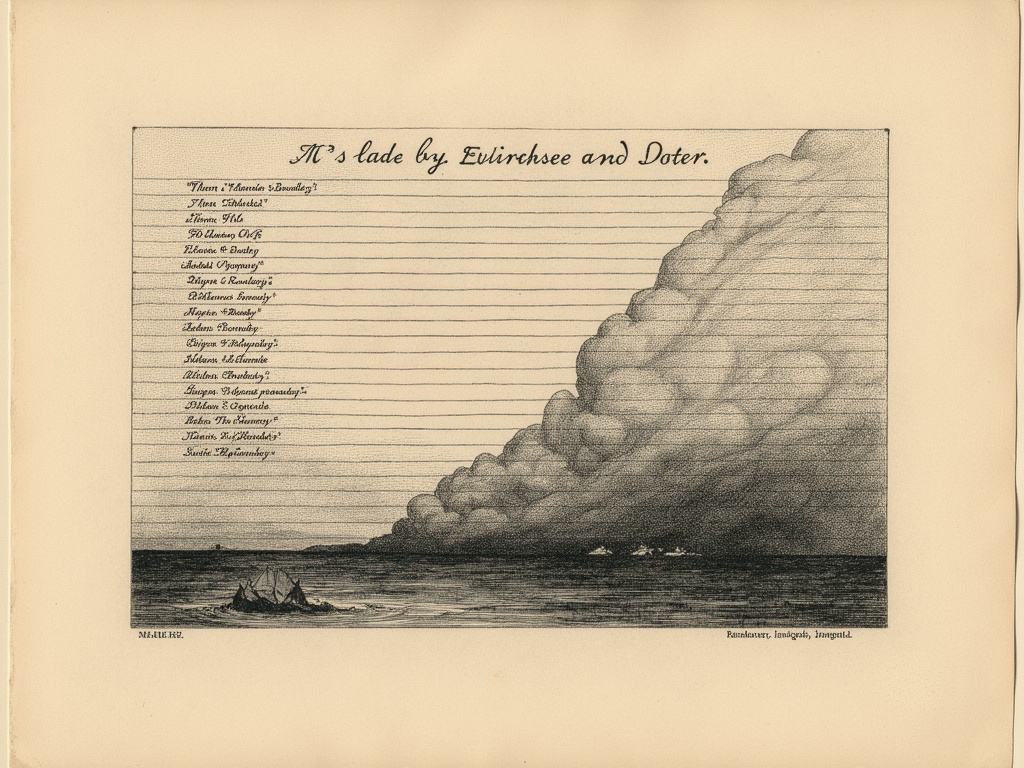
A person lost the firm first, and then the name. Vanishing from the building, boxes in hand, was not the end. Their names unraveled into syllables, the syllables into letters, and the letters at last into a single number in the nameless cell. From person to name, from name to fragment, from fragment to number. Stage by stage, the law sent a person down beneath the ledger.
I tried to keep a clean roster — to copy each name down whole, just once, before it split. But every one I copied split further. Preserve it and it grows, the sentence had said. So with the roster: preserve it and it split. On every sheet my hand touched, a name loosened by one more layer. I was not a hand that kept names but a hand that unraveled them.
On one line of the roster, a name whose way of coming apart looked familiar caught my eye. Still whole. But from the speed at which the names beside it were unraveling, I could tell it was next in line. Min. Seok. The syllables of his given name still held together. Soon I would watch them begin to loosen.
Min-seok's name began to loosen.
January 1st. New Year's Day, and no one else was in the records room. Only I sat before the roster. And the name I'd marked yesterday as next began, today, to come apart. Min-seok. Min and Seok fell away from one another. The first consonant first, then the vowel, then the rest. Just like the other names — into syllables, into letters. The name he knew as his own began to slide toward the cell with no name.
The other names were letters. This name was a face. The small box with a child's photo and a mug. The eyes that hadn't blamed me. That small box he'd carried past me days before was now splitting into its syllables, about to become a single number. I couldn't watch it the way I'd watched while sorting the other rosters.
My hand moved on its own. To the terminal. The sending column blinked, empty. It felt as if filling in a single character could hold the unraveling name together. Min. Seok. If I only wrote the name back together whole. I knew that would be an answer. Do not answer. Do not read to the end. I knew the warning the operator had been given, the warning the predecessor had left behind. But when the name coming apart was Min-seok's, those warnings were, for the first time, hard to bear. My fingertip stopped over the sending column. One character. Just one character, I told myself.
I lifted my hand away. I lifted it — but I knew the lifting was good for only once. Any other name, and I could have kept it lifted forever. But before this name finished coming apart, I would sit before that column again. The question was no longer whether I would answer. It was when. And there the question closed, my fingertip stopped over the empty cell.
Drawing my fingertip back, I decided to do something else. Instead of answering, sorting. I spread the four bundles, the transferred notebooks, and my own working notebook out together on the desk. If I couldn't hold the unraveling name together, I could at least gather them all in one place. But the moment I began gathering them into a single ledger, I realized — gathering was not reading but copying out. I was no longer one who reads. I was becoming one who copies out.