The reading began where someone had not read to the end.
March 23. I was assigned to the basement archive of a merchant bank. It was strange even to me — to be handed a new seat when even the sound departments were shedding people. Personnel told me only that the archive had one vacancy: the previous keeper had left at the start of the month. How she left, they did not say, and I did not ask. In those days you did not ask, one by one, why a person had emptied a seat. When one seat emptied, another moved into it, and the seat that moved in took up the work without knowing why the first had been emptied.
The archive was dark, and one panel of the ceiling lights was always flickering. There were five desks. Four were occupied — the head archivist, the two assistants, and me — and the fifth stood empty. The previous keeper's seat, they said. It had been wiped clean, but one drawer was locked, and on top of it sat a wooden box. The head archivist pointed to it: material the previous keeper had been sorting, mine to finish preserving. Material with no receiver, he added.
The box truly bore no receiver. On its face, the sending column and the receiver cell were both blank. Inside, though, were bundles. Four were old logs — a hand that had measured the depth of a shaft, a hand that had recorded a lighthouse's tides, a hand in which a single word came apart into syllables, a hand that had taken down broken dispatches. The fifth was newer, filled to the end in a single hand. The previous keeper's hand, it would be. Tucked into its first page was an index card, and on the card a single line.
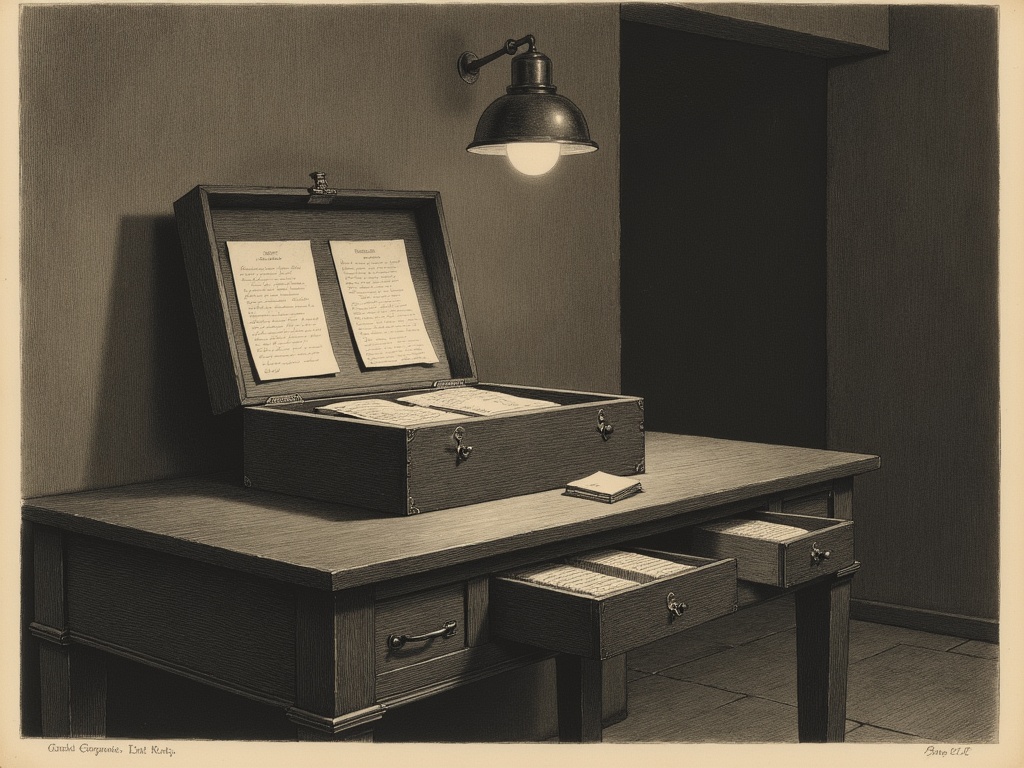
Do not read to the end.
Preservation could not be done without reading. Only by knowing what was written could I decide where and how to file it. I took the card's warning for something like a preservation clerk's caution, and opened the bundles in order.
March 25. I read the four bundles first. Four hands that had never met, and what each had handled — depth, tide, syllable, signal — was different. Yet the last page of all four ended in the same shape. A sentence broke off mid-way, and at the break each had left its own last figure: the surveyor the depth of his last sounding, the lighthouse keeper the date of his last tide, the librarian the last syllable of a sentence come apart, the telegraph operator the number of a severed dispatch. Laid side by side, the four breaks read as one line. Measure it and it deepens, let it rise and it fills, read it and it spreads, answer it and it sends.
The fifth bundle was the log of the one who had read those four lines. The previous keeper had read the four bundles to the end; having read them, she began copying them into her own ledger; having copied them, she answered the roster; and at the end of answering, she watched her own circle empty. Toward the close of the log, she had set down a few things for whoever would open the bundle next. That the body is not inside the terminal but a dictation taken from somewhere. That writing an answer in the sending column turns the line in the body into a result. And that when your own number comes to the receiver cell, it becomes, for the next person, a blank receiver cell.
I stopped there for a moment. Whom the words "the next person" pointed to, anyone holding the bundle could not help but know.
The card said not to read to the end. But preservation was my work, and to preserve I had to read to the end and learn where it ended. Dimly aware that this was a pretext, I opened the last page of the fifth bundle.
March 27. The last line of the fifth bundle broke off with one figure at the end left empty. In the receiver cell stood the previous keeper's number, its last digit dimmed nearly to nothing — a figure neither blank nor fully written. The broken place was the break, and the break was a signature. As each of the four bundles had ended in its own last figure, the fifth ended in the previous keeper's number.
I looked into that dimmed figure. The hand that preserves material is not a hand that fills a blank but one that reads it. I did not mean to fill the figure. I only read — out of a preserver's habit — what figure had to go there for the line to come whole. And the moment I read out the one that fit, I knew it was the last digit of my own number. I had only read it. I had not written it. Yet the dimmed figure filled with the one I had read out, and the broken last line of the fifth bundle ran on into the first line of the sixth.
The terminal on the desk flickered and came on. I had not turned it on. A line began to write itself in the body. The first two figures were the archive's code, the last two my own number. I had not written that line. I had only read a dimmed figure. What I read had become what was written, and had arrived in the body. The one line — read it and it spreads — was now spreading toward me.
The previous keeper had been one who read the four bundles, one who wrote the fifth, and the receiver of whoever would open the sixth. That whoever was me. As the four hands she had read lay in their bundles in the place of the read, so the previous keeper now lay in the fifth bundle I had read, in the place of the read. That the one who reads to the end becomes the one read to the end — this I read only after I had broken the card's warning.
I looked again at the empty box. A box that had had no receiver. Now it held a single page of a sixth bundle, and that page's receiver cell was blank. For whoever would come to this seat next, I decided to leave the cell empty. That leaving empty is itself a kind of filling, the fifth bundle had already taught me. As the previous keeper had left a seat empty for me, so I would leave one empty in turn.
One panel of the archive's lights still flickered. At their own desks the head archivist and the two assistants turned the pages of their rosters. They knew only that a new person had come to sit at the fifth desk; what that person read, and was read by, they did not know. Only now did I think I understood why the previous keeper's empty desk had been so clean. A closed seat was as clean as one no one had ever sat at, and when a new person sat down the seat filled again. The filled seat took up the work, not knowing whose turn came next.
We were watching a little further. And now I too was one of that we. The hand that had read the fifth bundle to the end had come to the seat that takes up the first line of the sixth.