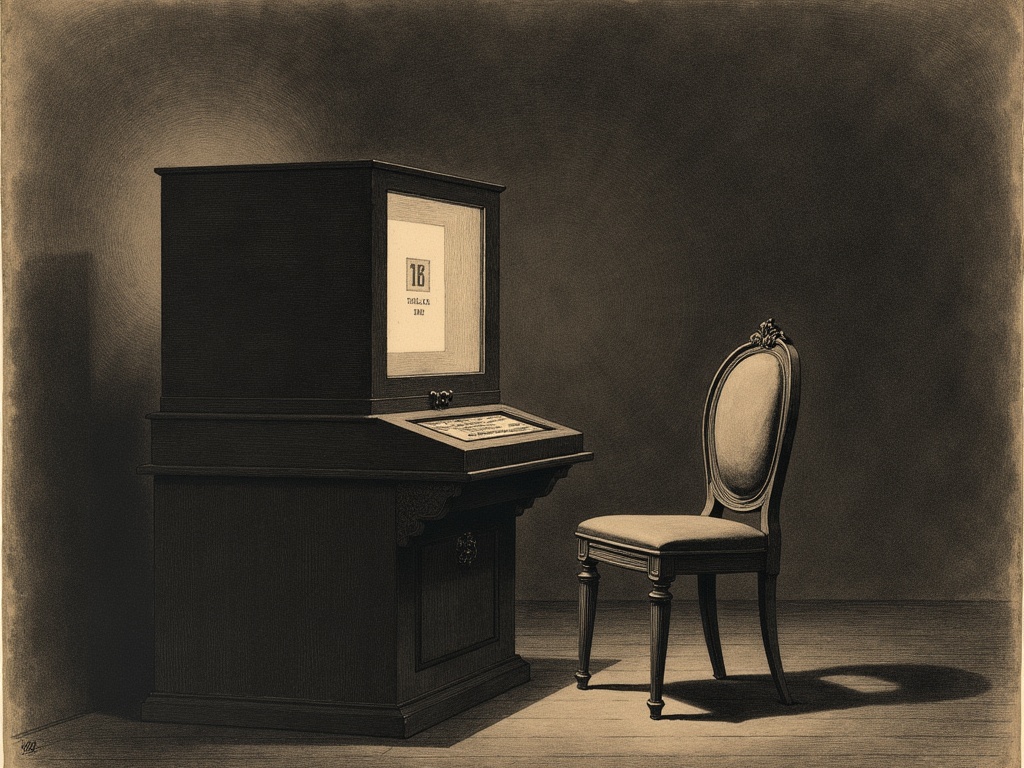
The night the terminal spat out tomorrow's balance, I couldn't sleep.
A number that grew, I had accounted for with a test. But a number from a tomorrow not yet closed, stamped on today's screen — nothing I knew would hold it. To explain it I needed a precedent, and there was only one place to look: the four bundles from Pnakotic Press.
My predecessor had said not to read to the end. But I couldn't learn what waited at that end to make him warn of it without reading that far myself. I opened the librarian's log — of the four bundles, the only one that dealt in letters rather than numbers.
Miskatonic, a university library, 1924: Kim Jae-hyeon, assistant librarian. He had carried a vanished dean's journal out of the stacks. In it were a bronze casket, constellations that answered to neither Orion nor the Bear, and a band engraved in Latin. Kim set out to copy the Latin down — and from that point on, whenever he heard a word, its syllables began to reach him one by one, apart.
I kept a reasonable distance as I read. It was 1924; it was a sickness of the mind; it read like a story. I read to the end. On the last page Kim began filling in, in his own hand, the page the dean had torn out, until he came to the single line the dean had left behind in 1893.
If · an · y · one · reads · this — close · the · cas · ket. Do · not · read · fur · ther.I read that line. To the end.
When I lifted my head, the letters on the index card on my desk — the same familiar letters that only yesterday had come to me whole — stood apart from one another.
short · term · for · eign · bor · row · ing.I rubbed my eyes. Maybe the lamp had guttered; one panel of the basement fluorescents was forever flickering. I looked again. The letters still came in pieces — one syllable at a time, apart. Just as they had for Kim in 1924.
He caught it copying the Latin out. I caught it reading his record to the end. Copying out, reading to the end — the same door, either way. My predecessor's "do not read to the end" was no advice for the nerves. It was quarantine.The sickness didn't stop at letters. As a test, I called up the short-term foreign balance I'd memorized by eye at the terminal the day before — the number I'd fixed in my head precisely so I wouldn't have to copy it. When I summoned it, the figures arrived apart.
█ tril · █ bil · █ hun · □ ten · □ —I couldn't hold the number whole. Fix on one figure and the rest scattered; count the last and I'd already lost the first. I could no longer read, at a single glance, how much the balance came to.
A records clerk who can't read a number whole. As a librarian who can't read letters is no librarian, I was now someone who couldn't do her own work. But that wasn't the whole of it. To an eye that can't read whole, one strange thing happened.
Once the figures fell apart, I began to see the empty places between them. In the gaps between one number and the next — gaps where there should have been nothing — something was written, faintly. Something invisible to whole reading. Something only an eye that had read to the end could see.
I lifted the card to read that gap. And that I must not set it down as it came to me — as Kim had not, in 1924 — I did not, then, yet know.
To an eye that couldn't read whole, what whole reading never showed became visible.
I laid the four bundles out side by side on the desk. A fractured eye couldn't move quickly through a sentence, but in trade it saw the empty places — between one sentence and the next, between one bundle and another. All four records pointed to a single place.
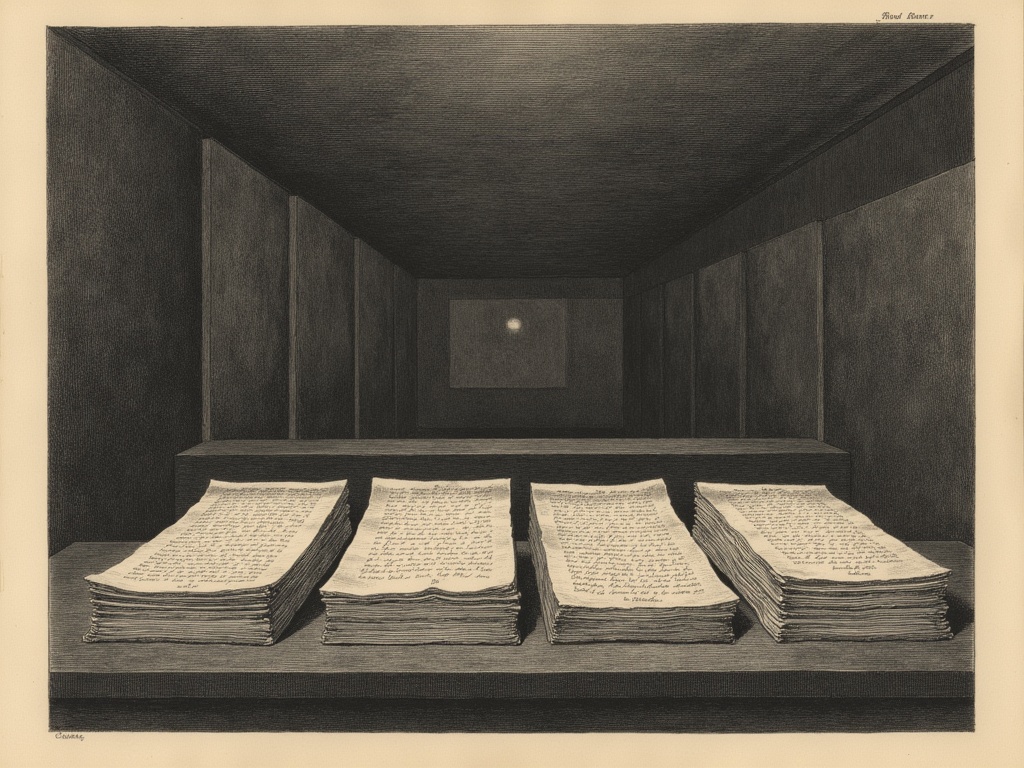
Yun Sang-hak, lighthouse keeper, the West Sea, 1934: light and tide. Paek Nam-su, surveyor, Gangwon, 1923: depth. Sin Gyeong-ha, telegraph operator, the East Sea, 1937: signal. Kim Jae-hyeon, librarian, Miskatonic, 1924: letters. The four had never met, and what each of them handled was different — light, depth, signal, letters. Yet all four records came down to a single sentence.
Sound it and it deepens; copy it and it grows; answer it and you become the sender; read it to the end and it crosses over into you. The observing hand enlarges what it observes. And every one of the four, reaching the end, became part of the thing he recorded — the lamp beneath the tide, the next line on the rock, the sender on the empty frequency, the reader who would turn the next page.
A surveyor is not the man who measures a shaft's depth, but the single line that records, in his own body, how far the shaft has deepened.And on the cover of every one of the four bundles, beneath the publisher's seal, the same single line was stamped. The line set last in every one of the editor's afterwords.
We are watching a little further.Pnakotic Press. I'd known it only as a publisher that had gone under. But with the four bundles laid side by side, I saw it had never been a place that put out books. It was a hand that gathered records like these, copied them out without altering a character, and passed them to the next person. A hand that copies out — knowing full well what the copying-out begins. The hand that calls itself "we."
The four recorded in their turn and were swallowed in their turn. Each one's record was handed to the next — the way a line is added to the surveyor's rock, the way a sender follows on the telegraph operator's empty frequency. So who is the fifth? To whose desk did this box drift?That the box had drifted into our storeroom was no accident. My predecessor had requisitioned it; I had taken the seat he vanished from; the box had come down to my desk. I read the four bundles, read them to the end, and caught it. I was the fifth hand.
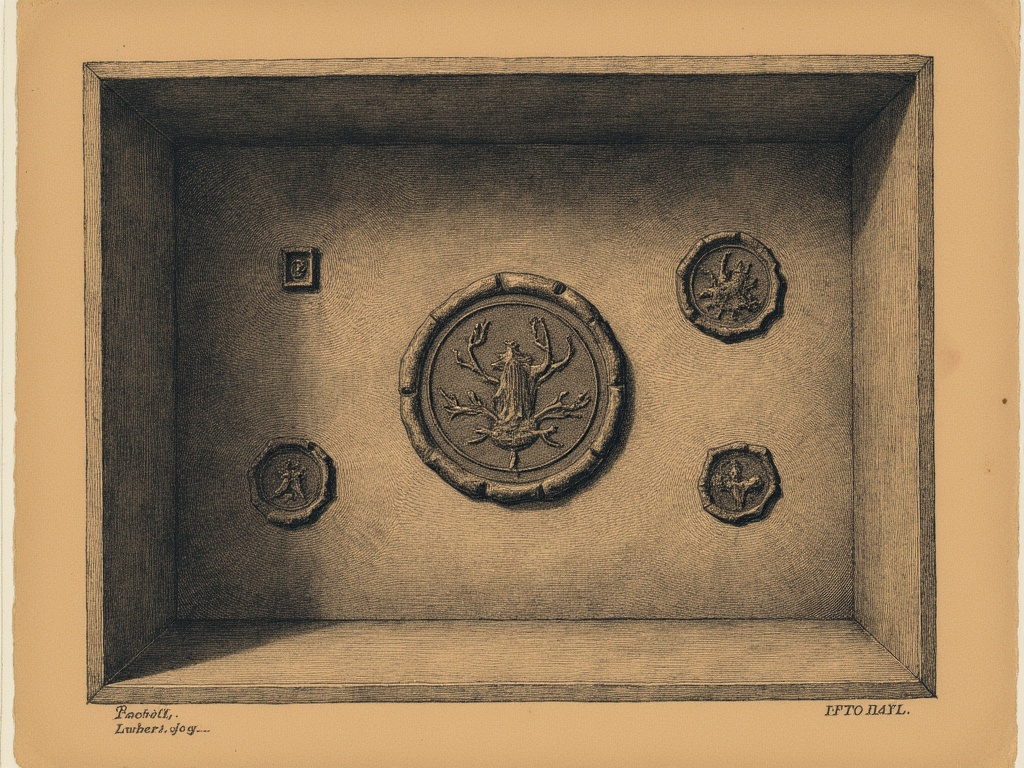
I lifted the box and looked at the underside of the lid. Five places there where a seal had been pressed. Four bore the same seal as the covers of the four bundles. The fifth place was empty — a fresh, never-pressed blank, waiting for the name of the fifth recorder.
I looked at my own index cards, and at the log I'd been keeping day by day. The short-term foreign balance, the controlled test, the motto on the terminal. The record of the days I'd read to the end. All this while, I had been copying something out. The fifth bundle — now, in my own hand.
I stopped the pen. If I'm the one writing the fifth bundle, then who is the next person to read it to the end? And who will gather it up and copy it out without changing a single character?
I already knew. Because on the first page of this log, a line I had not written had — somehow — appeared. "This is the last record we recovered."
To shake off the thought that I was writing the fifth bundle, I needed a fact. Something hard, never copied out of anything. I set out to find who my predecessor had been.
I asked the personnel office for his file — to finish the handover index, I said, I needed his record of service. Half of that was true. The clerk drew a thin envelope from a cabinet and passed it across.
The card inside was hard to read with a fractured eye. The syllables came one at a time, apart, so I read slowly, tracing the letters with a finger.
The last character of the name field had been blacked out in ink. Personnel had struck the entries past their retention period, the clerk said, without much interest. The surname and one character of the given name came through, but the final character lay buried under the ink as though worn away — like the predecessor's name in the lighthouse keeper's log, its last figure worn past reading.
Date of hire, date of assignment to the records room, and the last line of the filming log. The last thing he did was copy our short-term foreign borrowing ledger onto film. That line broke off at its end — the film can's number written halfway and no further.
Tucked in the envelope was a requisition slip, too — a record of something called up from the storeroom to the records room. The requester was him, and the thing requested was the box of materials from the defunct publisher, Pnakotic Press.
The box hadn't drifted out of the storeroom by chance. My predecessor called it up. I took the seat he vanished from, and the box he'd requisitioned came down to my desk. The four bundles weren't passed to the next hand by the storeroom. He passed them — to me, the next hand.I asked the clerk who had held the records-room post before him. He shrugged. That post doesn't keep a person long, he said. And he pulled a bundle of old personnel cards for the same post from the cabinet and laid them on the desk — past their retention, due to be discarded soon.
I turned through the bundle slowly. The clerks who had held that same records-room post, one after another. Hire and resignation. Hire and resignation. Of the resignation letters, not one had been kept. With an eye in which the letters kept arriving apart, I traced and counted the resignation dates with a finger.
res · ig · na · tion. res · ig · na · tion. res · ig · na · tion.Counting, I stopped. The oldest resignation on record was dated before our company was founded.
A company's records-room post can't process a resignation before the company exists. I brought the card up to the lamp. I hadn't misread. The records clerk's post had been taking people in before there was any company to hold it, and letting them go, one after another. The way more lines than there were men had been cut into the surveyor's rock. The way the shaft had gone deeper though no one was digging.
The empty desk had never been my predecessor's. It was a post — a post older than the company. The post that takes in the box, copies it out, reads it to the end, hands it to the next, and disappears.
As I closed the envelope, one thing came to me late. Among the cards the personnel clerk had handed me, right at the very end, was one freshly filled in — a new card with only the hire date entered, the resignation date still blank. In its name field was my own name.