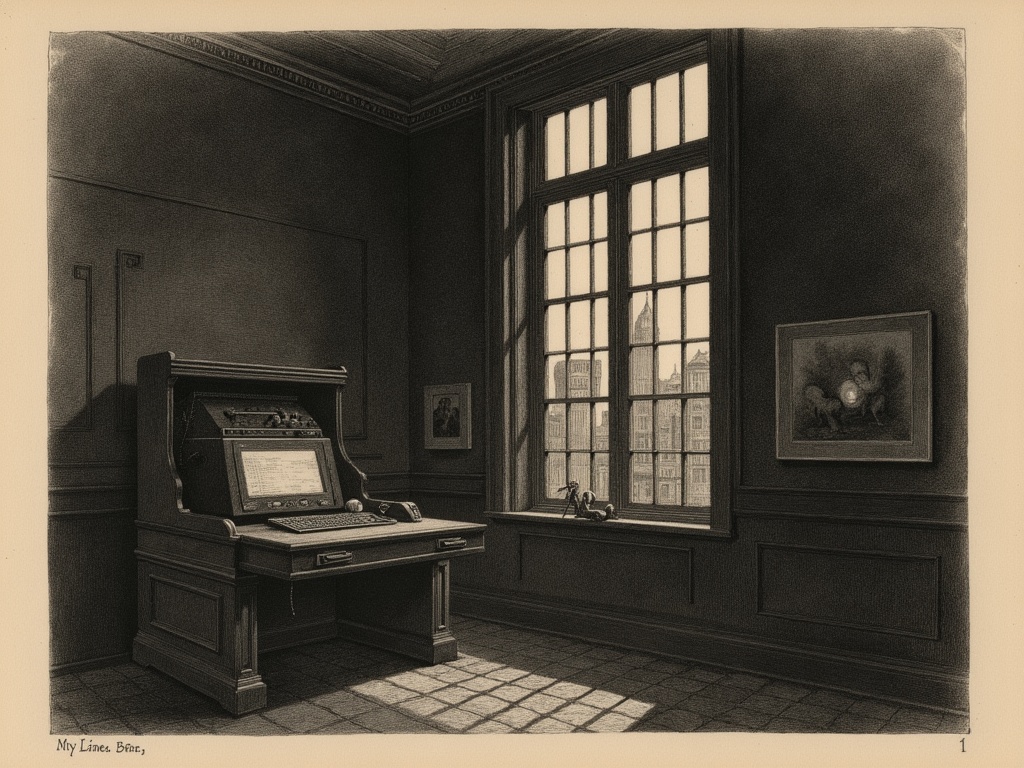
February 21. Five in the morning. I turned the terminal back on.
The empty dispatch was in the same place. Empty sending column, empty receiver cell — and the body. The body had been a single character when I shut the terminal off yesterday; over the hours it took me to turn it back on this dawn, it had filled a whole line. The line held one employee number. Its last two digits matched the last two of mine. It was yesterday's line of seven departments, its last number plus one unit.
The next one seat's employee number.
I studied the handwriting in the body. The shape of the letters was the shape my own hand makes copying employee numbers into the memo pad. The angle of the pen against the paper, the pressure at the start and end of each stroke, the spacing as the hand crosses from one character to the next — all of it the grain of my hand writing an employee number.
The first two characters were the firm code. Writing the firm code, my hand had a habit: finish a stroke, lift the wrist for a breath, then begin the next — and the body's first two characters carried that same breath's lift. In the middle of the number, at the rank slot, my hand tapered the pressure inside a character and then bore down again on the last stroke — and the body's middle character carried that same shift. In the serial's last two digits, my hand set the two numerals closer together than usual — and the body's last two sat closed at the same spacing.
The hand in the body was my hand, or a hand with the same grain as mine.
I could not tell which. If no one had sat at my desk across the seven hours I kept the terminal off — the records-room door was locked until five, and even the head archivist had never come in before five — then that handwriting was not what my hand had written. And yet its grain was my hand's grain. I had written yesterday that when the shape of the hand is the same, so is the grain of the result. Today the proposition had gone a level deeper: when the shape of the hand is the same, the line between the hand being mine and the hand being another's dissolves.
I tried to erase that one line in the body. I pressed a key and erased a character. For a moment the terminal showed it erased. A breath later, the same character sat in the same place. I erased it again. There it was again. Three times I erased it, and three times the same character came back to the same place. On the fourth try the terminal did not even show the erasure; the character simply stayed, unchanged, in its place. I did not try a fifth time. The body was a body that would not erase.
That the body would not erase meant the body was not inside my terminal. It was a body somewhere else, and the terminal was only showing it. My terminal was no more than a device taking it down.
I tried writing an answer in the sending column, to stop the body from growing. The hypothesis: if the sending column stayed empty while the body grew, then putting something in the sending column would stop the body. I brought a hand over the sending column.
The instant the hand was over the sending column, the body's next character was written a breath early. The character I was about to enter already stood in the body.
I lifted the hand. The body's next character stopped.
I placed the hand again. The body's next character came, again, a breath early.
The motion of my hand was deciding the body's growth. And yet the body wrote a breath ahead of my hand. The subject of the writing and the result of the writing stood apart — the result was in front of the subject.
Keep the hand off the sending column forever, and the body would stop forever. The terminal left on, the hand kept off the sending column — the act of not answering became, in itself, an answer. One seat would stay unclosed, unfinished, and the body's next character would stay unwritten, an empty breath.
Seven in the morning, the head archivist came in. Half past seven, the two assistants. All three went to their desks, opened the rosters they had not finished yesterday, glanced once at my screen, and turned back to their own work. A dispatch with an empty sending column pinned to the terminal's first line was a sight they were not used to, but no one asked. The records room's silence thickened past what it had been at dawn. The head archivist watched me go an hour without entering a single character, and after that kept his eyes fixed on his own terminal.
Nine in the morning. A second personnel notice went up. The firm's reduction had narrowed from two seats to one. The records-room seat had been processed yesterday. The Resource Development surveyor's seat had been processed yesterday. And the next seat — the seat whose number the body had written — was not in today's notice.
The seat whose number the body had written, so long as I entered no answer in the sending column, was not confirmed as the reduction's next seat. The body was written, but the result had not surfaced. To move what the body had written into the sending column was to turn that body into a result.
The other departments' vacancy numbers filled seven seats along one line, and the seat one unit past the end of the seven stood inside the body alone. The seat inside the body was not counted in the firm's reduction. Move it into the sending column, and it would be.
The weight of the empty sending column came clear to me for the first time. The sending column staying empty meant one seat unclosed; one seat unclosed meant one person still living. So long as I laid no hand over the sending column, some person — in some department I did not know, on some seat-line I had never been to, holding an employee number whose last two digits matched mine — stayed outside the reach of the firm's reduction.
I did not know the name, only the number written in the body. I had never seen the person of that number, and yet that person's living rested on the stillness of my hand.
Without turning the terminal off, I rose from the desk and walked to the end of the records room and back. The terminal was on, the body stopped at one line. The sending column was empty.
The body was waiting for the moment I sat back down at the desk. If I sat down, there was a chance the hand would come near the sending column, and if the hand came near, the body would write one more character. To stop the body from growing, I would have to never sit at the desk again.
I could not stay away forever.
The predecessor had stood in this same place once. Near the end of his log there was an entry where he had laid his hand over the sending column and lifted it away. What he decided before he vanished is not in the log. In that one breath where the writing's subject is outrun by its result, the reason the log did not record whether he laid the hand down or lifted it away is this — the hand that wrote the log did not know whether it had laid the hand over the sending column or lifted it. Where the result runs ahead of the subject, the subject cannot know, afterward, what its own hand has done.
The moment I sit back down at the desk today — whether I lay a hand over the sending column or lift it away — may, for the first time today, be something I cannot know.
Before I had decided to return to the desk, the dawn light through the records-room window thinned by one unit.