At first I read tomorrow's roster. Today, tomorrow's roster came from my own hand.
January 21st. Before opening the roster, I tried setting one thing down. In my notebook: which line would split tomorrow. It was only a guess. Read the roster day after day for a while and the hand knows first whose turn it is to wear. I wrote that guess of the hand's in a single line. Then I switched on the terminal.
The line I had written stood on the roster, just so. Not one letter different. At first I thought I had merely read well. But what I had written, I had not written from reading the roster. I had written it before the roster was even on. Not read — written first. And the roster had come following after my notebook.
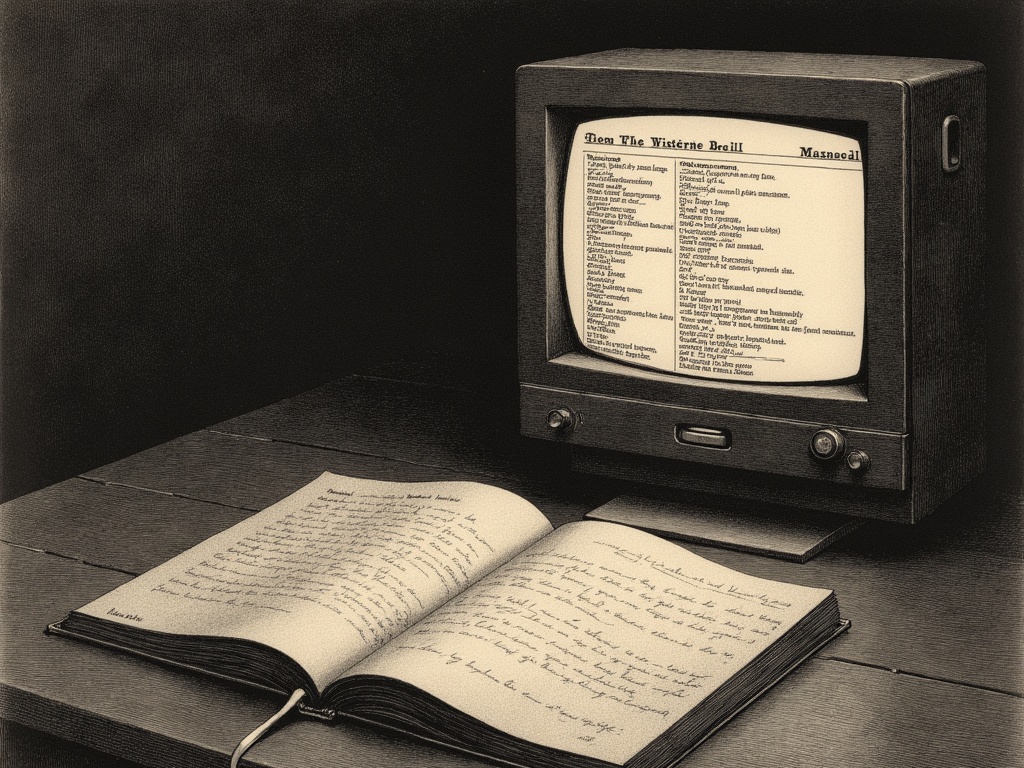
The telegraph operator's log came back to me. He had not been a receiver but a sender. Dispatches went out from his hand, and the dispatches that went out came true. For a long time I had seen him only as one organ of the law. Today I was sitting in his seat. Tomorrow's roster was no longer coming to me from the terminal; it was going out from my hand into it. The hand that had taken dictation had become the hand that writes first.
What this meant, I understood slowly. To answer was to lay a hand on a line already there. But to write first was to make a line that had not been there at all. I was passing beyond relocation — from choosing whom to save and whom to take, to writing who would appear on the roster in the first place. How far that distance was, and how much of it I had already crossed, a single line in my notebook was telling me.
I did not tear the page out; I put it in the drawer. Tearing it, I knew, was pointless. What was written had already gone to the roster, and what had gone to the roster would become someone's tomorrow. Getting rid of one notebook page does not get rid of that tomorrow. What I feared was only this: what my hand would write the next time I opened the notebook. A thing that had begun as a guess had become, somewhere along the way, not the taking of dictation but the making of others take it. What lay far ahead I did not yet know, but already the hand was turning that way.
Following where the moved weight had gone, I came upon a name in no register.
January 23rd. The day before yesterday I answered a line. Yesterday the line beside it opened, and today I set out to learn whose the opened line was. I opened the staff register. I opened the client register. I opened the credit ledgers of the transferred firms. The name was nowhere. It stood on the roster, and yet it was in no register at all.
I read the name again. Its last letter was K. And the first letter, and the one in the middle, were somehow familiar too. Following that familiarity, I understood: it was the letters of my own name, scattered apart. The order changed, a letter or two left blank — but made of the same characters. The reason it stood in no register was that it was a name not yet entered in any register. The name of the next records-keeper. It was me.
The day the first letter of my surname rose in the blank receiver cell came back to me. Back then I had written it down — that the reader is the one read. That had been a matter of reading. Today's was a matter of sending. The weight I had moved, passing through one man and the next, was coming back at last to a name in no register — my own name, scattered apart.
I had thought answering was a going-out. When I pressed, some other person bore the price of it. But followed far enough, the line of that price turned and came back to me. Relocation had an end, and the end was the sender — myself. As the predecessor, his sentence left unfinished, had become one line of the roster, so the weight I had sent was coming, at last, to fill one line of my own scattered name.
I brought my hand up to erase the name from the roster, then stopped. Erasing, too, is writing — that I know now. To erase a name in no register would only become a record that it had been in no register, set down in a deeper place. I drew my hand back. My scattered name was gathering, slowly, one letter at a time, on the roster. The place where the receiver becomes the sender was drawing nearer, letter by letter.
The receiver cell and the sending column became, today, one place.
January 25th. The roster on the terminal had always held two: the receiver cell, where tomorrow arrived to me; the sending column, where I sent my answer out. For the first months I saw only the receiver cell, for I was a receiver. These past weeks I had been learning the sending column, for I had become a sender. Today, the line between the two had vanished.
The tomorrow I read in the receiver cell was the same type as what I had written in the sending column. I was receiving what I had sent. Sending what I had received. Which came first could not be asked. What had begun to tilt when the boundary first started to blur had, today, closed completely. Receiving = sending. And the name floating in that single cell was my own scattered name, the one that had been gathering. Receiving = sending = me.
This was the end of growing habituated to answering. First I had learned what answering was; after that, I had grown habituated to it. At the end of that habituation, the place I arrived at was neither receiver nor sender, but a place where the two were folded into one. I was no longer one who reads the law. I was no longer even one who answers the law. I had become the hand with which the law writes its own script. As the predecessor had.
That I felt no fear was the most frightening thing of all. Watching the two become one, I was not startled. Like someone who had long been waiting for exactly this, I only nodded. Not acceptance — habituation. A habituated hand is not startled by what it has become.
I left the terminal on. Switching it off, leaving it on — these were now the same answer. Before the roster, now a single cell, I closed my eyes a moment. Behind the closed lids that one cell still floated. For the receiver to become the sender was not the event of some single day, but this: a single line, erased. And in the place where that line had been erased, whatever came next — whether it was my intention or the law's — I would no longer be able to tell apart.