February 24. Eight in the morning. I sat down at the desk.
Three lines stood in the body. The first and second were as they had been yesterday; the third had been written overnight. Its last two digits were one unit below the second line's. The vertical line had come down another unit in the night. The units left before Kang Min-seok's number were one fewer than the day before.
The hour at which the body wrote a line was not fixed. Some lines came at dawn, some in the daytime. Only the interval — one line, one unit, a day — had never once broken. As long as it held, the third line would be followed by a fourth, the fourth by a fifth, and once all those lines were written, the last two digits of the final line would be Min-seok's. The body was, in effect, stepping down one notch a day toward that final line.
I looked at the sending column. It was empty. When I had come back to my seat and sat down yesterday, my hand had been one knuckle toward the sending column, and I did not remember when it had moved. Whether that hand had written anything there, or nothing, I did not remember either. That the sending column was empty now could mean I had written nothing, or it could mean that what I had written had already turned into a result and been cleared from the column. The emptiness of the sending column proved neither.
Last night I left without turning the terminal off. Before I left I saw my hand a knuckle toward the sending column, and after seeing it I did not see whether I drew the hand back or not. I went home and slept, and while I slept no one stood at the terminal in the records room, and when I came back in the morning the third line was written. That my hand's position makes no difference between a line written while I sleep and a line written while I wake — I felt I had already known it, somewhere in the folds of last night's sleep.
Nine in the morning. A personnel notice went up. The firm's headcount reduction dated February 24 was one Treasury seat.
I read the number of that one seat. A Treasury number — but none of the lines of the body's vertical line. Not the first, not the second, not the third, and set at none of the even intervals of the vertical line: a seat outside the line. As the third-floor clerk had closed outside the line yesterday, today one person in Treasury had closed outside the line.
That number too had a face. An inner seat in Treasury, the one who sat one seat over from Min-seok. The profile I would catch over Min-seok's shoulder whenever I went up to Treasury to check cash sheets. The next seat Min-seok had mentioned at the pantry a few days back — that seat.
The third line had come down one unit overnight, and that unit had not been moved into the sending column. By as much as the unit went unmoved, the number that had to close was made good outside the line. The seat made good outside the line was a Treasury seat, and the Treasury seat was one over from Min-seok's.
The same thing had happened yesterday. Yesterday a line of the body had gone unmoved into the sending column, and that day's one seat was made good by the third-floor clerk, outside the line. The day before, a line had gone unmoved, and that day's seat was made good by another seat outside the line. Until yesterday the seat made good outside the line had been one I did not know; today, for the first time, it had moved into Min-seok's circle. From the moment the vertical line came down into Treasury, the seat pushed outside the line was being chosen from Treasury too.
While I held the vertical line far from Min-seok, the number that had to close was being made good, a seat at a time, from the ring around him. Keeping his line from coming down meant closing the people around him one by one, starting with the seat beside him. I was not saving him; I was closing the seats that ringed him, one a day, in his place.
Whether my hand had done it or the firm's arithmetic had, I could not tell, as yesterday. Whether my hand had moved something into the sending column overnight and closed that one Treasury seat, or the arithmetic had chosen the seat on its own while I did nothing — the emptiness of the sending column proved neither. Only, there was a seat that had closed, and on it a profile that resembled the profile beside Min-seok.
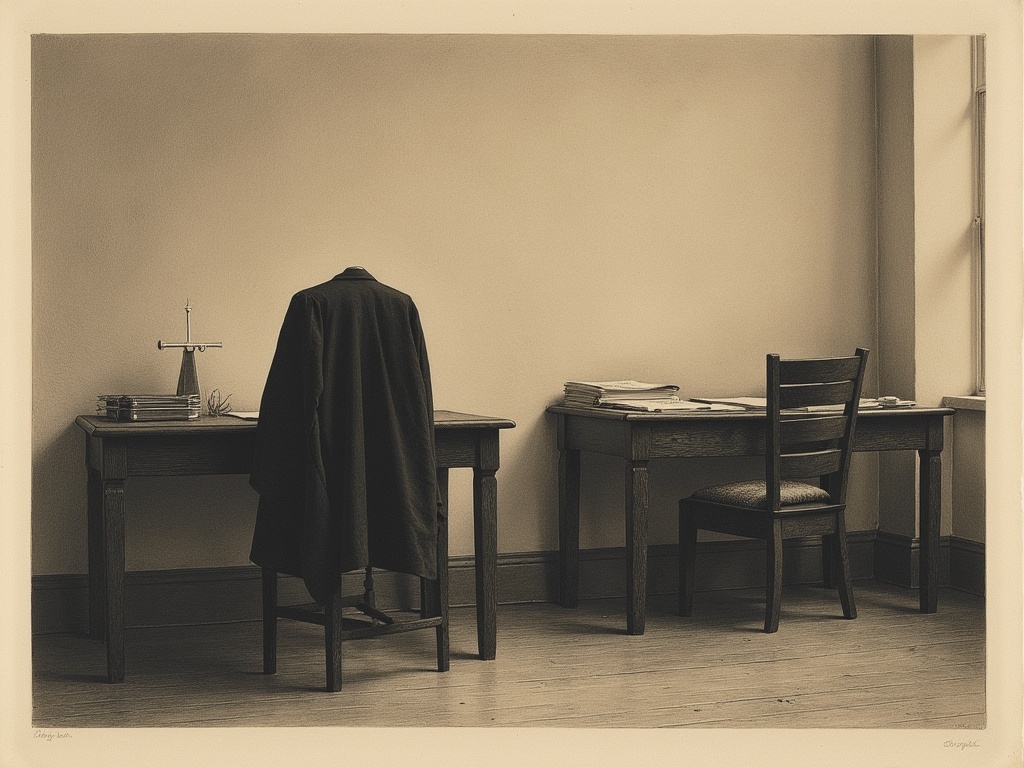
In the morning I went up to Treasury. The seat beside Min-seok was empty. Min-seok was in his place, and he raised a hand to me as he had yesterday, but he did not smile as he had yesterday. The next seat got its notice yesterday, he said, low. A perfectly fine man, he said, and looked at the empty seat. A navy coat the man from the next seat had left the day before still hung over the back of the empty chair, and no one had cleared it yet. Min-seok looked at the coat a long while, then said, they say there's no telling how many more in our section will wear thin this week, and looked down at the back of his own hand. Where he had heard the word wear thin, I did not ask. That his own seat remaining came, by one reckoning, to the same thing as the next seat's closing, he did not know; I did. As long as his seat remained, the seat beside him would keep closing. I could not say that to him.
There was one more thing I could not say. That the closing of the seat beside him came, by one reckoning, to the same thing as the stillness of my hand trying to save him. That trying to save him was closing the seat beside him. To say it I would have had to explain the body, the vertical line, my hand trembling over the sending column — and even explained, he would not believe it. Not believing was better for him. To a man who counts his own seat remaining as a relief, to tell him that the relief was the price of the seat beside him would not be saving him.
I came back to my seat and looked at the body again. Below the third line, the fourth stood empty. If the fourth line came down another unit in the night and was written, then the one seat closing outside the line tomorrow morning would be another part of Min-seok's ring — the seat in front of him, the seat behind him, or someone from his section.
I counted the seats that ringed him. The seat beside, the seat in front, the seat behind, the people of his section — I counted them on my fingers and counted once more. The number of seats around him came to no more than the units of the vertical line still left before Min-seok's number. Before the vertical line reached him, the seats around him would all close first.
While the seats around him closed one by one, Min-seok would stay in his place. And while he stayed, he would count himself lucky; watching the seat beside him, the seat in front, the seat behind all close, he would count his own seat remaining as a relief. The more he counted it a relief, the emptier his ring would grow. The relief was a relief only until the ring stood wholly empty.
On the day the vertical line reached Min-seok, there would be no seat left around him to close. That day, the number that had to close could only be made good by his own seat. The blocking had an end, and the end was him.